1919–1932 · 20th century
Barth and Dialectical Theology: The Revolt against Immanence
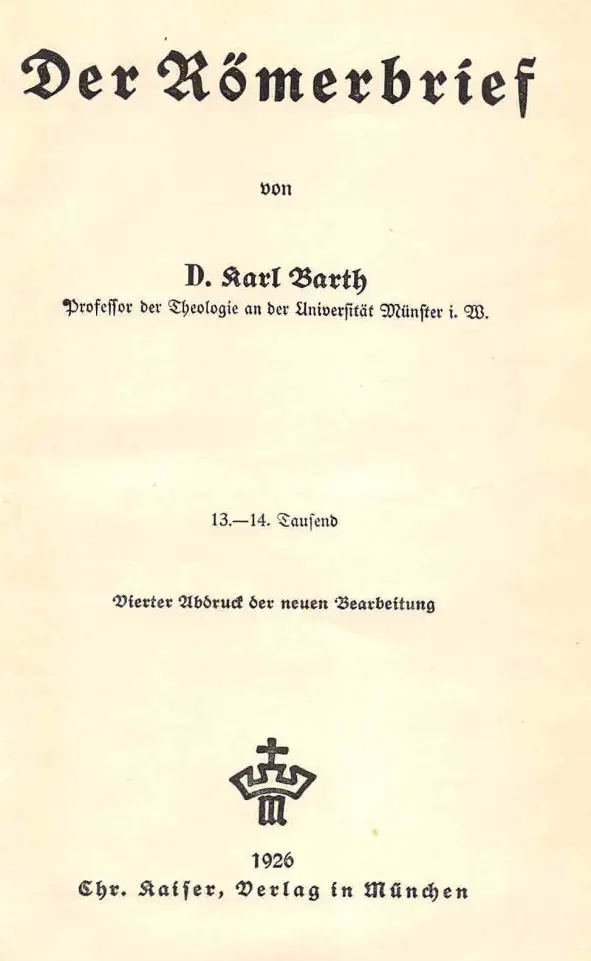
Disillusioned with liberalism by the First World War, Barth in The Epistle to the Romans (1919; 2nd ed. 1922) proposed a theology of discontinuity between the human and the divine – the "infinite qualitative distinction" between time and eternity, in Kierkegaard's phrase; it was called "dialectical theology," "theology of crisis," and later "neo-orthodoxy." In the 1920s Barth parted ways with Gogarten and Bultmann, who insisted on an existential dialectic. His study of Anselm (Fides Quaerens Intellectum, 1931) convinced him to seek the "logic of faith" and to abandon philosophy as an instrument of theology; in 1932 the first volume of the Church Dogmatics appeared. Barth rejected natural theology, which also led to a break with Brunner.
Positions
- Liberal theology
- Continuity of the human and the divine; emphasis on immanence and natural theology
- Barth
- "God is in heaven, and you are on earth"; the Word of God is the sole source of authority; natural theology is rejected
- Gogarten, Bultmann
- Theology is an account of the experience and understanding of faith within an existential dialectic
- Critics (Pannenberg, Balthasar, Berkouwer)
- Fideism, Christomonism, the triumph of grace overshadows human decision
Key points
- Grenz and Olson read 20th-century theology through the tension of transcendence and immanence; after 1914 – a return to transcendence
- R. Niebuhr on liberalism: "A God without wrath brought men without sin into a kingdom without judgment through the ministrations of a Christ without a cross"
- Theology is inseparable from prayer and obedience and cannot be a dispassionate science
- In the Church Dogmatics the word "Church" replaced "Christian"; it is marked by a "christological concentration"
- Brunner, following Pascal and Kierkegaard: the God of philosophical theism is not the God of biblical revelation
- Morgan: neo-Reformation theology, a response to Europe's secularization, was detonated by an interpretation of Romans; Barth spurned common ground with culture. Bultmann presented Paul as an existentialist theologian speaking of humanity coram Deo; Käsemann and Macquarrie showed Paul's legacy is wider.
Outcome
A paradigm shift – theology "from above" instead of theology "from below"; neo-orthodoxy shaped Protestant theology for several decades, and Barth was the principal figure of theology between the wars (González).
People
- Karl Barth
- Eduard Thurneysen
- Friedrich Gogarten
- Rudolf Bultmann
- Emil Brunner
- Søren Kierkegaard
Terms
- infinite qualitative distinction
- Kierkegaard's expression for the distinction between time and eternity, adopted by Barth for the distinction between God and humanity.
- faith seeking understanding – Fides quaerens intellectum
- First to believe, then to seek by reason to understand what has already been accepted by faith; reason in the service of faith.
- Christomonism
- According to critics, excessive concentration on Jesus Christ in all aspects of Barth's theology.
Place
Safenwil; Göttingen; Switzerland; Germany
Sources disagree
The Epistle to the Romans – 1919, 2nd ed. 1922; the journal – 1922; Christian Dogmatics – 1927 (Grenz and Olson refer to the rejected attempt of 1928); the book on Anselm – 1931; the first volume of the Church Dogmatics – 1932.
Sources
- Justo L. González – A History of Christian Thought in One Volume (Abingdon, 2014), p. 412–415
- Justo L. González – A History of Christian Thought, vol. III: From the Protestant Reformation to the Twentieth Century (Abingdon, rev. ed. 1987), p. 445–446
- Stanley Grenz, Roger Olson – 20th-Century Theology: God and the World in a Transitional Age (Russian edition), p. 7–12, 84–86, 91–93, 103–109
- The Cambridge Companion to St Paul, ed. James D. G. Dunn (2003), p. 266
Related entries
- Rejects: Protestant Liberalism: Ritschl's Value Judgments and Harnack's Thesis of "Hellenization" (1870–1900)
- Develops: Anselm of Canterbury: "I Believe in Order to Understand" – Faith Seeking Understanding (1077–1078)
- Rejects: Schleiermacher: Religion as Feeling and Theology as the Expression of Religious Self-Consciousness (1799–1830)
- Response to: The anthropocentric turn: Kant, Hegel and Schleiermacher's christology of God-consciousness (1793–1831)
- Rejects: Bultmann: Kerygma and the Demythologization of the New Testament (1941)
- Developed in: Karl Barth: Theology from Above and the Word of God in Three Forms (1919–1968)
- Rejected in: Tillich: The Method of Correlation and Apologetic Theology (1951–1963)
In church history
- Karl Barth and neo-orthodoxy (1919–1968)
Data compiled: 2026-11-17