1793–1831 · 18th century
The anthropocentric turn: Kant, Hegel and Schleiermacher's christology of God-consciousness
According to Berkhof, in the 18th century christology turned from theocentric (starting from the Logos) to anthropocentric – starting from the historical Jesus; a distinction was drawn between the historical Jesus and the "theological Christ" of the creeds. For Kant (Religion within the Limits of Reason Alone, 1793) Christ is the idea of a morally perfect humanity, and it is faith in the ideal that saves; for Hegel the incarnation expresses the unity of God and humanity (Philosophy of Religion, the Absolute Religion: "the unity of the divine and human natures; God has become Man"). Schleiermacher in The Christian Faith (1821–1822, 2nd ed. 1830) rejected the classical doctrine of two natures as illogical: Jesus differs from other people only by "the constant potency of his God-consciousness", explicable only by the presence of God in him. His redemptive work is the communication of this God-consciousness to others; Schleiermacher describes Christ's work in terms of the three offices, and considers the resurrection, ascension and second coming unnecessary for Christian consciousness.
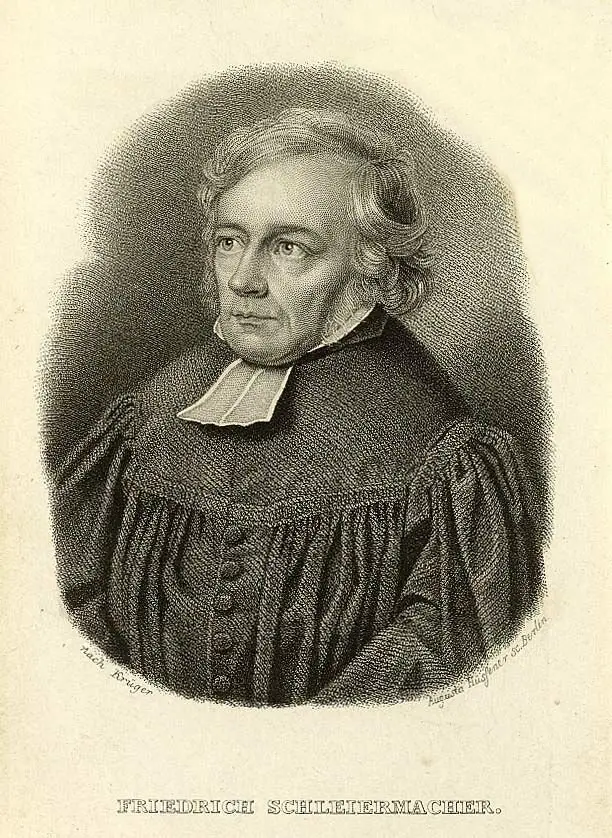
Positions
- Kant
- Christ is an ethical ideal; "to pass from virtue to pardoning grace"
- Hegel
- The incarnation is an image of the unity of God and man (Philosophy of Religion, the Absolute Religion); philosophy expresses the truth in rational necessity
- Schleiermacher
- Jesus is the perfect exemplar of human God-consciousness; his "divinity" lies in this ideal and its effect on others
- Berkhof, Lane (assessment)
- Jesus hardly rises above the human level; a weak doctrine of sin leads to a low estimate of Christ's work and person
Key points
- González: Schleiermacher rejects the exchange of properties, since it presupposes a divine nature described apart from the human consciousness of God
- Berkhof: the virgin birth is unnecessary; there is no hereditary sinfulness
- Grenz and Olson see here the prototype of a “functional christology”
- Lane: R. Niebuhr on liberal theology – “a God without wrath brought men without sin into a kingdom without judgment through a Christ without a cross”
- Shelley: for Schleiermacher the miracle is Jesus himself, a man of full God-consciousness; the Church witnesses that people gained it through his life.
Outcome
Berkhof judges the new method to have been largely destructive; elements of the earlier rationalism, according to González, persisted in much of 19th-century theology, and after the First World War this theology provoked the neo-orthodox reaction of Barth (Lane).
People
- Immanuel Kant
- Georg Wilhelm Friedrich Hegel
- Friedrich Schleiermacher
- H. Richard Niebuhr
Terms
- God-consciousness
- The perfect and continuous sense of union with the divine – the essence of Jesus in Schleiermacher; Christian religious feeling bound up with Christ's redemptive work.
- ideality / exemplarity – Urbildlichkeit / Vorbildlichkeit
- The ideal of human God-consciousness and the capacity to reproduce it in others.
Sources disagree
The Christian Faith – 1821–1822, 2nd ed. 1830 (González), 1821–1830/1831 (Grenz–Olson, Lane); Berkhof: 19th century without exact dates. Kant – 1793; Hegel – lived 1770–1831 (Grenz–Olson).
Sources
Primary sources
- Hegel – Lectures on the Philosophy of Religion, bk. 2, p. 347; bk. 3, p. 71–73
Textbooks
- Louis Berkhof – History of Christian Doctrines (Russian edition), p. 81–83
- Justo L. González – A History of Christian Thought, vol. III: From the Protestant Reformation to the Twentieth Century (Abingdon, rev. ed. 1987), p. 364–366
- Tony Lane – Christian Thinkers (Russian edition), p. 232–233
- Stanley Grenz, Roger Olson – 20th-Century Theology: God and the World in a Transitional Age (Russian edition), p. 34–36, 45–48, 64–65
- Bruce L. Shelley – Church History in Plain Language (Russian edition), Ch. 40, sec. «Голоса либерализма»
Related entries
- Developed in: Liberal christology and the quest of the historical Jesus: Ritschl, Harnack, Schweitzer, Bultmann (1870–1921)
- Answered by: Barth and Dialectical Theology: The Revolt against Immanence (1919–1932)
Data compiled: 2026-11-17