1941 · 20th century
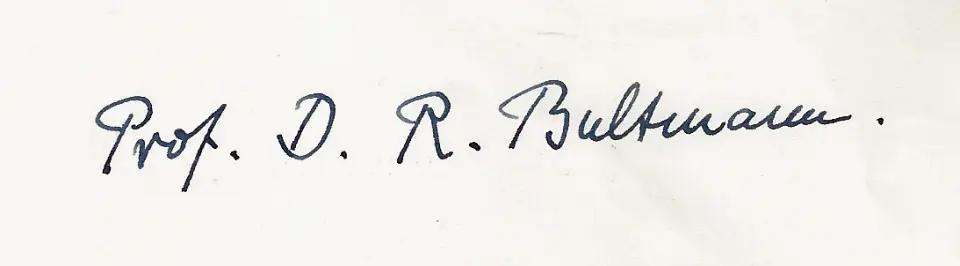
Bultmann: Kerygma and the Demythologization of the New Testament
In the essay "New Testament and Mythology" (1941) Bultmann raised the question of hermeneutics: the worldview of the New Testament – a "three-story" universe, angels, demons, miracles – is "mythological," and modern man, for whom the world is a closed chain of cause and effect, cannot accept it. Liberals such as Harnack removed the myth, reducing the gospel to ethical principles; Bultmann objected that together with the myth the kerygma would disappear, and proposed not to eliminate the myth but to interpret it existentially, as an expression of human self-understanding. Following Kähler, he concluded that what matters for faith is not the historical Jesus, about whom little can be known by means of form criticism, but the kerygma – the church's proclamation of Christ, through which the Word is addressed to every person. Bultmann regarded human existence as the link between the ancient text and the present, and existentialism, close to Heidegger, his colleague at Marburg, as the best starting point for understanding it. González notes the ambiguity of the concept of "myth"; critics reproached Bultmann for removing not so much myth as history and for making the modern worldview the norm.
Positions
- Harnack and the liberals
- Remove the myth, exposing eternal truths and ethical principles; the norm of theology is the historical person of Jesus, recoverable from the Gospels
- Schweitzer
- The real Jesus was a prophet of the imminent end of the world, deeply alien to modern people; the quest for the historical Jesus failed
- Kähler
- "The only real Christ is the Christ who is preached"
- Bultmann
- Not to remove the myth but to interpret it existentially, otherwise the kerygma is lost; what matters for faith is the personal encounter with the Christ of the kerygma in the present, and historical research does not strengthen faith
- Critics (Lane; Grenz and Olson; Moltmann, Macquarrie)
- Bultmann made the modern worldview the norm, narrowed the doctrine of God to the theme of human existence and understood faith privately
Key points
- The gospel is a stumbling block, but there must be no false stumbling blocks (miracles, demons, the virgin birth)
- Bultmann saw examples of demythologization already in Paul and John
- "If a man wants to speak of God, he must speak of himself"
- González: by stripping away the mythological covering, Bultmann hoped to lead to a direct encounter with the Lord of the New Testament
- Bultmann applied the Lutheran doctrine of justification by faith to the sphere of knowledge: faith is solely a gift of grace that comes through the kerygma (Grenz and Olson)
- Lane: the question whether the universe is closed is philosophical, not scientific; there is no single "modern man"
- Ziegler: for Bultmann the Gospels are the Church’s message, not a source on Jesus’s life; in Christology historicity (the “that”) matters, not history. Unlike Strauss, Bultmann turns the Gospels’ mythologizing into a constructive hermeneutic – demythologization proclaiming the present Christ
Outcome
An existential interpretation of the New Testament replaced the mythological framework, and faith was freed from dependence on the results of historical criticism. The essay became one of the most significant theological works of the century, but Bultmann's conclusions were received with no less hostility than liberalism (Lane); Grenz and Olson regard the program as valuable but limited.
People
- Rudolf Bultmann
- Martin Heidegger
- Adolf von Harnack
- Martin Kähler
- Albert Schweitzer
Terms
- demythologization – Entmythologisierung
- The interpretation, not the elimination, of the New Testament's mythological elements for the sake of their existential meaning.
- kerygma
- The core of the Christian message, distinguished from its mythological framework; the early church's proclamation of Christ, the Word of God addressed to every person.
- "authentic" life
- Life "in faith," based on invisible realities: renouncing all reliance on oneself and on what is transient.
- preunderstanding
- The prior questions and concepts with which a reader approaches a text.
Place
Marburg
Sources disagree
Lane: the essay "New Testament and Mythology" – 1941; Grenz and Olson place Bultmann's program in the years of his teaching at Marburg (1921–1951) without a specific year; González gives only Bultmann's lifespan (1884–1976).
Sources
- Justo L. González – A History of Christian Thought in One Volume (Abingdon, 2014), p. 416–417
- Justo L. González – A History of Christian Thought, vol. III: From the Protestant Reformation to the Twentieth Century (Abingdon, rev. ed. 1987), p. 451–453
- Tony Lane – Christian Thinkers (Russian edition), p. 274–277
- Stanley Grenz, Roger Olson – 20th-Century Theology: God and the World in a Transitional Age (Russian edition), p. 121–127, 129–130, 134–139
- The Oxford Handbook of Christology, ed. Francesca Aran Murphy (2015), p. 413–414
Related entries
- Rejected in: Barth and Dialectical Theology: The Revolt against Immanence (1919–1932)
- Rejects: Protestant Liberalism: Ritschl's Value Judgments and Harnack's Thesis of "Hellenization" (1870–1900)
- Response to: The Historical Criticism of the Bible: From Reimarus and Lessing to the Tübingen School and Strauss (18th–19th centuries (Strauss – 1835))
- Rejects: Liberal christology and the quest of the historical Jesus: Ritschl, Harnack, Schweitzer, Bultmann (1870–1921)
- Rejected in: Moltmann, Theology of Hope: eschatology at the center of theology (1965)
In church history
Data compiled: 2026-11-17