1919–1968 · 20th century
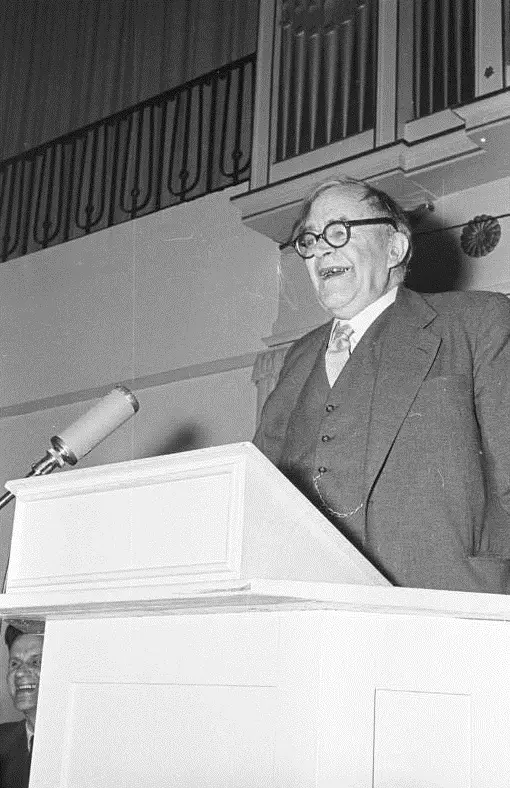
Karl Barth and neo-orthodoxy
The Swiss pastor Karl Barth became disillusioned with the liberal theology of his teachers when in 1914 they supported the Kaiser's war policy. His commentary The Epistle to the Romans (1919) began "dialectical theology," which he developed together with Thurneysen, Gogarten, and Bultmann in the journal Zwischen den Zeiten (1922–1933).
Barth taught at Göttingen, Münster, and Bonn. In 1934–1935 he carried on a principled dispute with Emil Brunner over natural theology. In 1935, for refusing to swear an oath to Hitler, he was removed from teaching at Bonn and returned to Basel. There he wrote the multivolume Church Dogmatics (1932–1968), which remained unfinished. Barth died in 1968; he had been invited to the Second Vatican Council as an observer.
Key points
- The Epistle to the Romans (1919) – the beginning of dialectical theology
- Dispute with Brunner over natural theology (1934–1935)
- 1935: removed from teaching at Bonn, returned to Basel
- Church Dogmatics (13 volumes, 1932–1968), unfinished; invited to the Second Vatican Council as an observer
- Heltzel and Winn: social ethics concerned Barth from his pastoral years – the “red pastor of Safenwil”
- Heltzel and Winn: they read his trinitarian theology “politically” – the Trinity grounds his radical politics
- Heltzel and Winn: in the doctrine of reconciliation (“Jesus is Victor”) the church is called to struggle for justice by the Spirit’s power
- George: Carnell, who called Barth an “inconsistent evangelical”, joined a public dialogue with him during Barth’s only North American visit (1962). Ramm read all of the Church Dogmatics in Basel; Barth was to him “a restatement of Reformed theology” not capitulating to the Enlightenment. Bloesch, of Pietist roots, appropriated Barth more acutely than Ramm: Jesus is Victor! Karl Barth’s Doctrine of Salvation (1976).
- Gunton: Barth answered Kant: since God did become present in Christ, he was able to; Christ is the “hub of a wheel” in a theology that disavows system.
- Billings: in Anselm (1931) Barth framed the Creed as faith seeking understanding; the first volume of Church Dogmatics followed the next year. Barth’s student T. F. Torrance (1913–2007) sought to be more ‘catholic’ than Barth in patristic retrieval, union with Christ and the sacraments.
- Pickstock: Barth’s stress on the revealed word rests, in her view, on Kantian closure; it is unclear how the Word changes experience, knowledge, politics.
- White: Barth (genus tapeinoticum) sees in the dereliction on the cross a revelation of the divine nature’s capacity for self-emptying and suffering out of love.
- Lyman: for Barth the history of theology is a theological task: past authors are questioned as living Christians; the detached were “Philistines”
People
- Karl Barth
- Emil Brunner
- Adolf von Harnack
- Eduard Thurneysen
- Friedrich Gogarten
- Rudolf Bultmann
- Bernard Ramm
- Donald Bloesch
- Thomas F. Torrance
Place
Switzerland (Safenwil, Basel); Germany (Göttingen, Münster, Bonn)
Sources disagree
Heltzel and Winn: the Church Dogmatics – 14 volumes, 1932–1967 (above: 13 volumes, 1932–1968)
Sources
- Stanley Grenz, Roger Olson – 20th-Century Theology: God and the World in a Transitional Age (Russian edition), p. 89–94, 101, 109–110, 116–120
- Justo L. González – The Story of Christianity, vol. II (Russian edition), Part 4, ch. 34, section «Протестантизм в Европе»
- Justo L. González – A History of Christian Thought in One Volume (Abingdon, 2014), p. 412–415
- Justo L. González – A History of Christian Thought, vol. III: From the Protestant Reformation to the Twentieth Century (Abingdon, rev. ed. 1987), p. 442–448
- Tony Lane – Christian Thinkers (Russian edition), p. 241, 257–263
- The Cambridge Companion to the Trinity, ed. Peter C. Phan (2011), p. 184–185, 195–196, 184
- The Cambridge Companion to Evangelical Theology, ed. Timothy Larsen and Daniel J. Treier (2007), p. 297, 298, 298–299
- The Cambridge Companion to Christian Doctrine, ed. Colin E. Gunton (1997), p. 38–39
- The New Cambridge Companion to Christian Doctrine, ed. Michael Allen (2023), p. 359–360, 360, 233, 379
- The Oxford Handbook of Systematic Theology, ed. John Webster, Kathryn Tanner, Iain Torrance (2007), p. 515
More on the doctrine
- Barth and Dialectical Theology: The Revolt against Immanence (1919–1932)
- Karl Barth: Theology from Above and the Word of God in Three Forms (1919–1968)
- The Dispute over Natural Theology: Brunner, Barth's "Nein!" and the Barmen Declaration (1934) (1934)
- The revival of the doctrine of the Trinity in the 20th century: Barth, Rahner, Moltmann, Pannenberg (1932–1988)
Data compiled: 2026-11-09