1919–1968 · 20th century
Karl Barth: Theology from Above and the Word of God in Three Forms
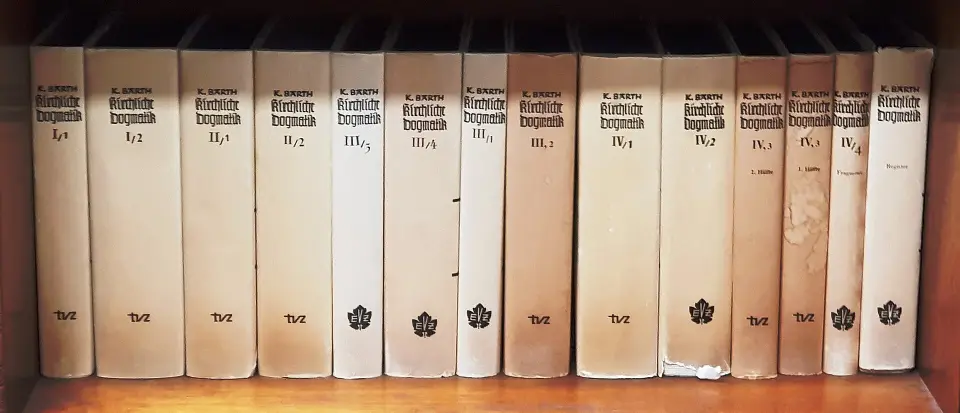
Disillusioned with his liberal teachers, who supported Germany's war policy in 1914, Barth in his Epistle to the Romans (1919) called for replacing theology "from earth to heaven" with theology from above and stressed the "infinite qualitative distinction" between God and humanity. In the Church Dogmatics, Barth's theology is a theology of the Word: the Word of God is not a static object but an event, "God's speech to us through Jesus Christ." It exists in three inseparable forms – revealed (Jesus Christ), written (the Bible as witness to revelation) and proclaimed (the church's preaching); the latter two become the Word when God uses them to reveal Jesus Christ. Instead of the "analogy of being," Barth starts from the "analogy of faith," which God himself establishes in Jesus Christ.
Positions
- Liberal theology
- The study of human religion; Christianity as the highest human achievement; the immanence of God
- Barth
- "The Bible contains not the right human thoughts about God but the right divine thoughts about man"; "it is not our faith that makes the Bible the Word of God"
- Harnack
- "Marcion again!"
- Liberals and conservatives (according to Grenz and Olson)
- Liberals accused Barth of exalting the Bible and evading historical-critical analysis; conservatives, of subordinating Scripture to the event of revelation and denying inerrancy ("new modernism")
Key points
- A contemporary likened the Epistle to the Romans to a bomb dropped on the theologians' playground (Grenz and Olson)
- Lane: "One cannot speak of 'God' simply by speaking of 'man' in a loud voice". The three forms of the Word are inseparable, by analogy with the Trinity; the Bible bears witness to Christ like John the Baptist
- González: the Church Dogmatics stands out for its "christological concentration": all its volumes speak of God's revelation in Jesus Christ
- In Grenz and Olson's assessment, in practice Barth treats the Bible as absolutely authoritative, which is at odds with his theory
Outcome
Barth became the leader of neo-orthodoxy; his position, according to Grenz and Olson, occupied a distinctive place between the orthodox doctrine of inspiration and liberal criticism, and the Church Dogmatics remained unfinished.
People
- Karl Barth
- Eduard Thurneysen
- Christoph Blumhardt
- Adolf von Harnack
Terms
- three forms of the Word of God
- Revealed (Christ), written (the Bible), proclaimed (preaching).
- infinite qualitative distinction
- Kierkegaard's expression for the distinction between time and eternity, adopted by Barth for the distinction between God and humanity.
- analogy of faith
- The analogy between God and humanity that God himself establishes in Jesus Christ, as opposed to the "analogy of being".
- neo-orthodoxy
- The movement founded by Barth after the First World War that sought to recover much of the traditional teaching abandoned by the 19th century, though not a return to the old orthodoxy.
Place
Safenwil, Göttingen, Bonn, Basel
Sources disagree
The Epistle to the Romans – 1919 (all books); González does not date the revised second edition; Christian Dogmatics – 1927 (Lane); the first volume of the Church Dogmatics – 1932 (González), while Grenz and Olson do not give the starting year; Barth died in 1968.
Sources
- Justo L. González – A History of Christian Thought, vol. III: From the Protestant Reformation to the Twentieth Century (Abingdon, rev. ed. 1987), p. 442–445, 449–451
- Tony Lane – Christian Thinkers (Russian edition), p. 253–256
- Stanley Grenz, Roger Olson – 20th-Century Theology: God and the World in a Transitional Age (Russian edition), p. 88–90, 93, 95–98, 105
Related entries
- Develops: Barth and Dialectical Theology: The Revolt against Immanence (1919–1932)
- Developed in: The revival of the doctrine of the Trinity in the 20th century: Barth, Rahner, Moltmann, Pannenberg (1932–1988)
- Developed in: The Dispute over Natural Theology: Brunner, Barth's "Nein!" and the Barmen Declaration (1934) (1934)
In church history
- Karl Barth and neo-orthodoxy (1919–1968)
Data compiled: 2026-11-17