589–816 · 6th century
The Filioque in the West: Toledo (589), Friuli (796), Aachen (809) and Pope Leo III
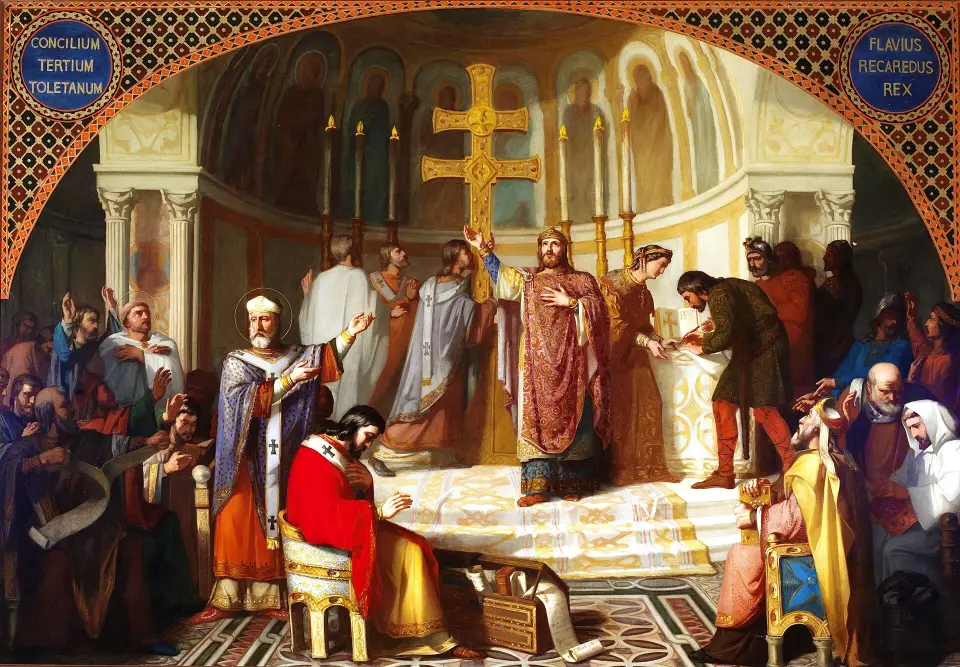
The Niceno-Constantinopolitan Creed says that the Spirit "proceeds from the Father"; according to González, this does not deny procession from the Son as well, but in the West people more often said "from the Father and the Son," and in the East "from the Father through the Son." At the Synod of Toledo in 589 the word "filioque" ("and from the Son") was added to the creed; the interpolation spread from Spain to Gaul and the rest of the West. Under Charlemagne the Filioque became an important doctrinal issue: against adoptionism, Paulinus of Aquileia argued that the consubstantiality of the Father and the Son requires teaching that the Spirit proceeds from both, and the council of Friuli (796) produced the earliest document of the Western version of the creed with the Filioque. The Synod of Aachen (809) declared the Greek formula heretical, but Pope Leo III, while accepting the teaching itself, refused to insert the interpolation into the creed.
Positions
- Frankish bishops (Aachen, 809), Charlemagne
- The Greek formula is heretical; the Spirit proceeds from the Father and the Son, and the Filioque must be in the creed; the Libri Carolini: "from the Father and the Son, not from the Father through the Son"
- Latin monks on the Mount of Olives
- Accused of heresy by the Greek monk John, they asked the pope to investigate where the fathers say "who proceeds from the Father and the Son"
- Pope Leo III
- The Spirit "proceeds equally from the Father and the Son," but this must not be inserted into the creed: "we do not sing it, but we say it"
- Eastern Christians
- The interpolation is heresy and innovation; the Spirit proceeds "from the Father through the Son"
Key points
- Berkhof: the 381 formula proved unsatisfactory – “from the Father only” looked like a denial of the Son’s unity with the Father, while “and from the Son” looked like an indication of the Spirit’s dependent position
- Pelikan: the dispute was also a dispute about the interpretation of Scripture: the Latins relied on expressions about the Spirit of the Son, while Photius read "the Spirit of God" as pointing to the Father as source. The Filioque was not a papal dogma, but the question of the right to insert it became closely intertwined with the question of Rome's right to bind the whole Church
- González: there were two questions – the orthodoxy of the interpolation and the right of later authorities to change the ancient creed; only a few, above all Leo III, distinguished them
Outcome
Rome accepted the teaching but under Leo III did not insert the Filioque into the creed, though it could not prevent the Latin church from adopting the interpolation; according to Berkhof, this became the stone on which West and East split.
People
- Charlemagne
- Leo III
- Paulinus of Aquileia
- Theodulf of Orléans
- Elipandus of Toledo
- Felix of Urgell
- Gottschalk of Orbais
- Hincmar of Reims
- Ratramnus of Corbie
Terms
- filioque – ex Patre Filioque
- "and from the Son" – an addition to the creed's statement on the procession of the Spirit.
- threefold Deity – trina Deitas
- An expression of Gottschalk's disputed by Hincmar of Reims.
Place
Toledo, Friuli, Jerusalem (Mount of Olives), Aachen, Rome
Sources disagree
Toledo – 589 (Berkhof; Hall gives 589 as the year of insertion into the creed); González says only that the interpolation appeared in Spain. Friuli – 796, Aachen – 809, death of Leo III – 816 (Pelikan, González).
Sources
- Jaroslav Pelikan – The Christian Tradition, vol. 2: The Spirit of Eastern Christendom (600–1700) (Russian edition), p. 312–317, 326
- Louis Berkhof – History of Christian Doctrines (Russian edition), p. 61–62
- Justo L. González – A History of Christian Thought in One Volume (Abingdon, 2014), p. 206–207
Related entries
- Grew out of: Augustine: The Spirit as Gift and Bond of Love – The Roots of the Filioque; the "Athanasian" Creed (c. 414)
- Develops: Augustine: The Spirit as Gift and Bond of Love – The Roots of the Filioque; the "Athanasian" Creed (c. 414)
- Response to: The adoptionist controversy in Spain and the Synod of Frankfurt (794) (675–794)
- Answered by: The Filioque in the East: Photius, On the Mystagogy of the Holy Spirit, and the Break of 1054 (9th–11th centuries)
In church history
- The Third Council of Toledo (589): the conversion of the Visigoths and the filioque (589)
- Charlemagne: conquests, the Carolingian Renaissance, and the Council of Frankfurt (794) (772–804 (conquests and revival); 794 (Council of Frankfurt); 809 (Council of Aachen on the filioque))
- Coronation of Charlemagne and the Aachen Filioque Dispute (800–809)
Data compiled: 2026-11-17