800–809 · 8th century
Coronation of Charlemagne and the Aachen Filioque Dispute
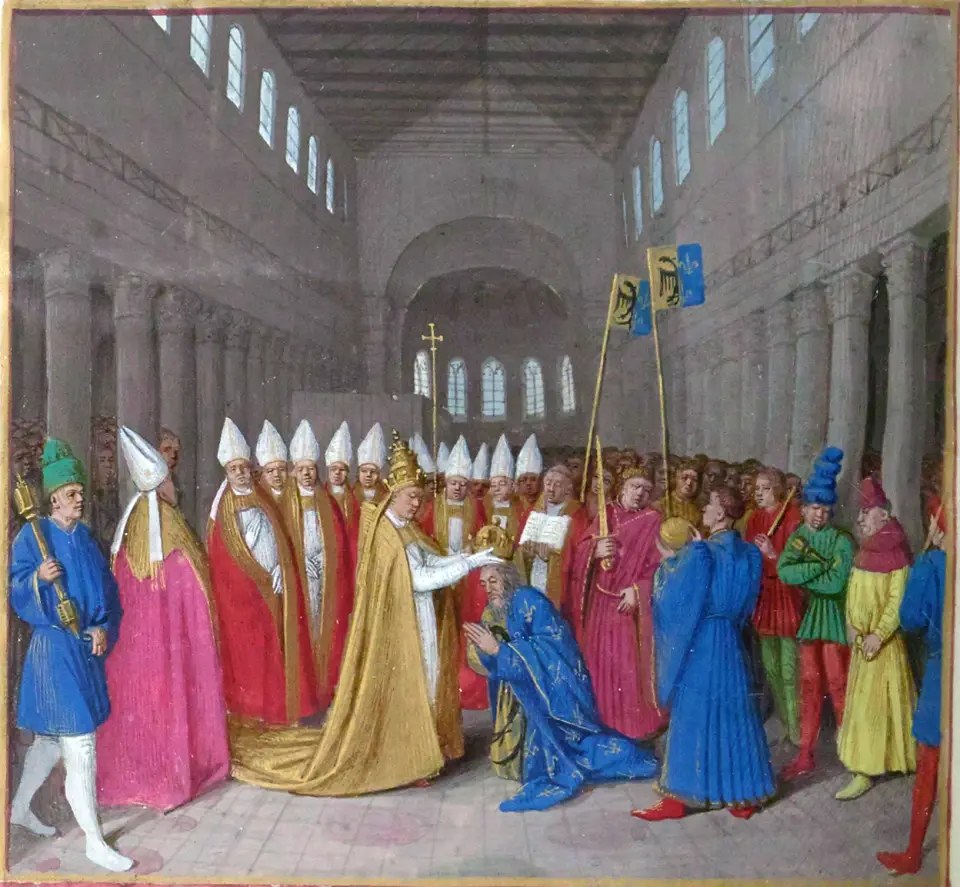
On Christmas Day 800, Pope Leo III crowned Charlemagne emperor. This restored a Western empire under the church's aegis for the first time since the fall of the last Western Roman emperor. Shortly before, a Roman synod had cleared Leo of his opponents' accusations.
The coronation raised the papacy's prestige. But it also set up a future dispute over whether imperial power depended on papal coronation. Constantinople's protest was ignored, which deepened the East-West divide.
In 809 a Frankish synod at Aachen declared the Greek formula of the creed without the Filioque addition heretical. At Aachen the creed was already sung with the Filioque. Pope Leo III accepted the Filioque doctrine but refused to insert the words into the Nicene Creed's text.
After Charlemagne's death in 814 his empire did not hold together. Strife broke out among the sons of Louis the Pious. It ended in 843 with the Treaty of Verdun, which split the realm into three parts.
Key points
- Leo III crowns Charlemagne emperor of the Romans on 25 December 800
- The dispute of Frankish monks on the Mount of Olives over the Filioque – the first open clash with the East on this issue
- The 809 Aachen synod declares the Greek formula without the Filioque heretical; the pope accepts the doctrine but not the text
- The 843 Treaty of Verdun splits the empire into the future France, Germany and the 'middle lands'
- Shelley: at Christmas 800 Pope Leo III crowned Charlemagne: the pope needed protection, the king divine approval. After the coronation Charlemagne set up missi dominici to oversee officials. The ceremony marked the start of the empire’s struggle with the papacy and the birth of “Christendom”; the imperial ideal lasted until 1806, with pope and emperor rivals.
People
- Charlemagne
- Leo III
- Theodulf of Orléans
- Louis the Pious
Place
Rome; Aachen; the Frankish Empire
Sources disagree
The sources agree on '25 December' / 'Christmas' 800 for the coronation.
Sources
- Tony Lane – Christian Thinkers (Russian edition), p. 90
- J. North – A History of the Church (Russian edition), p. 135–139
- Justo L. González – The Story of Christianity, vol. I (Russian edition), Ch. 20, sec. 20.3–20.4; ch. 22
- Justo L. González – A History of Christian Thought in One Volume (Abingdon, 2014), p. 206–212
- Jaroslav Pelikan – The Christian Tradition, vol. 2: The Spirit of Eastern Christendom (600–1700) (Russian edition), p. 308, 312, 315–316, 319
- Bruce L. Shelley – Church History in Plain Language (Russian edition), Ch. 18, introduction и sec. «Зодчий империи»; Ch. 18, sec. «Зодчий империи»
More on the doctrine
Data compiled: 2026-11-09