c. 414 · 4th century
Augustine: The Spirit as Gift and Bond of Love – The Roots of the Filioque; the "Athanasian" Creed
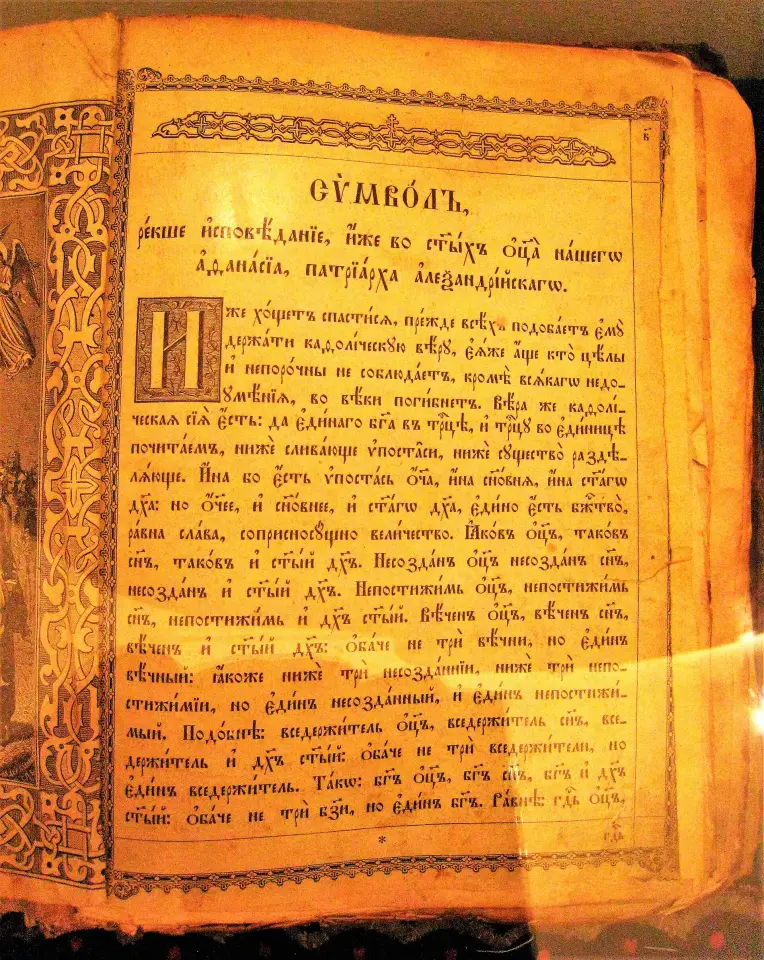
Theologians found it hard to express the difference between the generation of the Son and the procession of the Spirit, and the Arians took advantage of this. Augustine at first confesses his ignorance but then proposes a theory that became common in the West: the Holy Spirit is the bond of love between the Father and the Son and the "Gift" given by both and related to both equally (On the Trinity 5.11.12; 6.5.7: the Spirit is "a certain unutterable communion of the Father and the Son", their love). Hence the idea that the Father and the Son are one "principle" (principium) for the Spirit (5.14.15), who proceeds from both outside time. According to González, the medieval dispute over the Filioque has its roots here, and Hall holds that the blame for the emergence of the new dogma lies with Augustine. The idea entered the "Athanasian" Creed, in which the Spirit proceeds "from the Father and the Son."
Positions
- Arians
- If the Son and the Spirit are both from the Father, why is one called Son and the other not?
- The Cappadocians (according to Hall)
- The Father is unbegotten, the Son begotten, the Spirit proceeds from the Father
- Augustine
- The Spirit proceeds from the Father and the Son as from a single source; he is the bond of love between them
- The Eastern churches (according to Lane)
- Rejecting the filioque of the "Athanasian" Creed, they either denied Athanasius's authorship or regarded the word as a later interpolation
Key points
- Hall: unlike the Cappadocians, Augustine rarely ascribes priority to the Father in the inner relations of the Hypostases; the tendency to equalize the Persons is one of the causes of the dogma of the double procession
- Pelikan: Western apologists for the Filioque also relied on Tertullian (the Spirit "from God and the Son") and Hilary. According to a scholar he cites, for Augustine "procession from the Father and the Son" is the distinctive property of the Spirit within the immanent being of God. The "Athanasian" Creed was probably composed about a hundred years after Augustine's death (Lane dates it c. 500)
- Barnes: Augustine learns from Marius Victorinus and Hilary and formulates the doctrine of the Spirit as the intra-Trinitarian love of Father and Son; his main concern is the Spirit’s etiology (procession), and Filioque’s advantage was a stronger account of the Spirit’s causal origin
Outcome
The West adopted the doctrine of the double procession, which it regarded as the tradition of the fathers; the East rejected the addition, and the question still divides the Church.
People
- Augustine
- Tertullian
- Hilary of Poitiers
- Didymus the Blind
Terms
- double procession
- The doctrine of the procession of the Holy Spirit from the Father and the Son.
- principle – principium
- The Father and the Son are a single principle with respect to the Spirit (Augustine).
Place
Hippo
Sources disagree
Hall: c. 414; González: 399–419 (the period of work on On the Trinity). The "Athanasian" Creed – c. 500 (Lane).
Sources
Primary sources
- Augustine – On the Trinity, bk. V, ch. 11–15; bk. VI, ch. 5
Textbooks
- Stuart G. Hall – Doctrine and Practice in the Early Church (Russian edition), p. 131–132
- Jaroslav Pelikan – The Christian Tradition, vol. 2: The Spirit of Eastern Christendom (600–1700) (Russian edition), p. 316–320
- Justo L. González – A History of Christian Thought in One Volume (Abingdon, 2014), p. 146
- Tony Lane – Christian Thinkers (Russian edition), p. 92–94
- The Cambridge Companion to the Trinity, ed. Peter C. Phan (2011), p. 90–91, 96
Related entries
- Leads to: The Filioque in the West: Toledo (589), Friuli (796), Aachen (809) and Pope Leo III (589–816)
- Develops: Augustine, On the Trinity: from the unity of substance to the Persons, relations and psychological analogies (399–419)
- Leads to: The Athanasian Creed (Quicunque vult) – "condensed Augustinianism" (c. 500)
- Developed in: The Filioque in the West: Toledo (589), Friuli (796), Aachen (809) and Pope Leo III (589–816)
Data compiled: 2026-11-17