772–804 (conquests and revival); 794 (Council of Frankfurt); 809 (Council of Aachen on the filioque) · 8th century
Charlemagne: conquests, the Carolingian Renaissance, and the Council of Frankfurt (794)
Charlemagne waged war against the Saxons for more than fifteen years, from 772. He forcibly baptized thousands and brutally suppressed resistance; the execution of 4,500 Saxon warriors is recorded. Saxony was subdued in 785. His 778 campaign into Muslim Spain ended with the destruction of his rearguard at Roncevaux, later celebrated in the "Song of Roland."
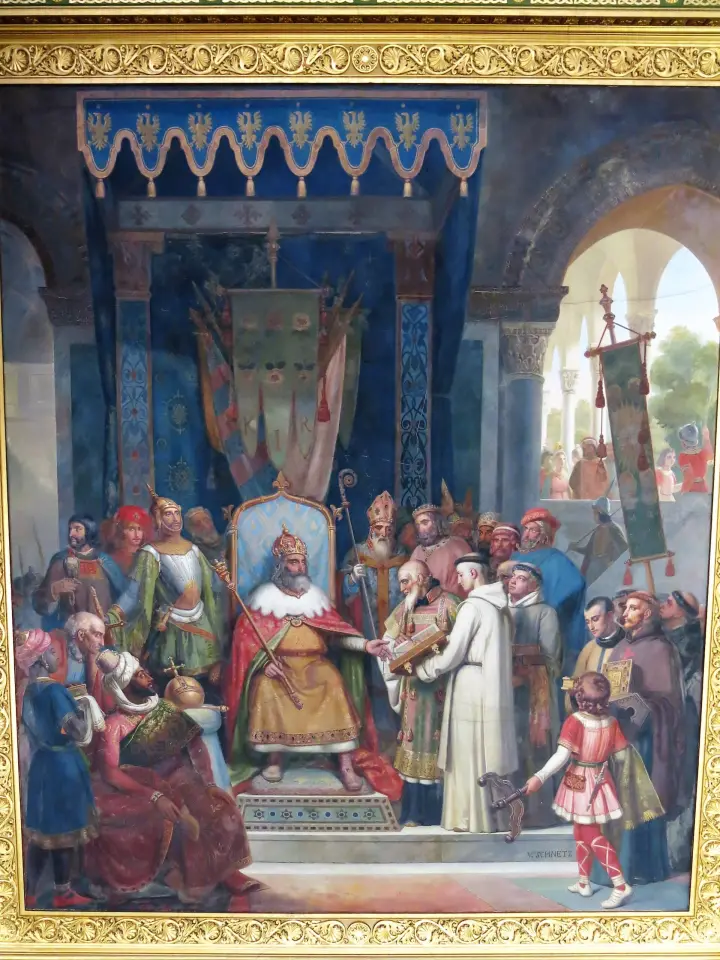
Charlemagne drew on invited scholars, chiefly Alcuin of York (at court 781–796). He also built on the earlier legacy of Bede the Venerable. He organized a network of cathedral and monastic schools and introduced a uniform Roman liturgy across the empire. Through Benedict of Aniane he reformed monasteries according to Benedict's Rule. This cultural upsurge is known as the "Carolingian Renaissance."
Theological disputes of the era included Adoptionism. It was the teaching of the Spanish bishops Elipandus of Toledo and Felix of Urgell. They held that Christ, in His humanity, was Son of God only "by adoption" rather than by nature. Alcuin accused them of splitting Christ into two sons. The error was condemned at the Council of Frankfurt in 794. The same council, due to a faulty Latin translation, also rejected the decisions of the Second Council of Nicaea on icons.
It also furthered the spread of the filioque formula, already introduced at Toledo in 589. Paulinus of Aquileia, at a local council at Friuli (796), gave what is apparently the earliest Western creed text with this addition. The filioque was officially confirmed at the Council of Aachen in 809. It became a lasting source of friction between East and West.
Key points
- Fifteen-year war against the Saxons (772–785), forced baptisms
- Defeat at Roncevaux (778) – the basis of the "Song of Roland"
- Carolingian Renaissance: Alcuin of York, cathedral and monastic schools, uniform liturgy
- Adoptionism of Elipandus of Toledo and Felix of Urgell condemned at the Council of Frankfurt (794)
- The same council rejected the decisions of the Council of Nicaea on icons (due to a translation error)
- The filioque confirmed at the Council of Aachen (809), cementing the East-West divide
- Shelley: Charlemagne annexed regions by force: the Spanish March in the south, the Eastern March against the Avars, and the Bavarians. In Italy Charles at the pope’s will defeated the Lombards (774), made himself their king and confirmed Pepin’s Donation; he also built a government. Subduing the pagan Saxons between the Rhine and Elbe took thirty-two campaigns; Charles divided Saxony into bishoprics and built monasteries, and laws against paganism punished with death even eating meat in Lent – Charles conquered and converted the Saxons “with extreme cruelty”. In 789 Charlemagne decreed a school in every monastery; at Aachen he founded a palace school, inviting scholars from Italy and Ireland; the Anglo-Saxon Alcuin headed it and urged students not to waste days in idleness. Charlemagne left a cultural legacy
People
- Charlemagne
- Alcuin of York
- Bede the Venerable
- Benedict of Aniane
- Theodulf of Orléans
- Elipandus of Toledo
- Felix of Urgell
- Paulinus of Aquileia
- Adrian I
Place
Saxony, Spain, Frankfurt, Aachen, Friuli
Sources disagree
Bruce (Shelley) speaks of thirty-two military campaigns against the Saxons; the site record has a fifteen-year war with the Saxons (772–785).
Sources
- Justo L. González – The Story of Christianity, vol. I (Russian edition), Ch. 22, sec. 22.1
- J. North – A History of the Church (Russian edition), p. 132–134, 136
- Justo L. González – A History of Christian Thought in One Volume (Abingdon, 2014), p. 204
- Louis Berkhof – History of Christian Doctrines (Russian edition), p. 76–77
- Jaroslav Pelikan – The Christian Tradition, vol. 2: The Spirit of Eastern Christendom (600–1700) (Russian edition), p. 314, 317
- Justo L. González – The Story of Christianity, vol. I (Russian edition), Ch. 22, sec. 22.2
- J. North – A History of the Church (Russian edition), p. 162
- Justo L. González – A History of Christian Thought in One Volume (Abingdon, 2014), p. 233
- Jaroslav Pelikan – The Christian Tradition, vol. 2: The Spirit of Eastern Christendom (600–1700) (Russian edition), p. 312, 314, 322
- Bruce L. Shelley – Church History in Plain Language (Russian edition), Ch. 18, sec. «Зодчий империи»
More on the doctrine
- The adoptionist controversy in Spain and the Synod of Frankfurt (794) (675–794)
- The Filioque in the West: Toledo (589), Friuli (796), Aachen (809) and Pope Leo III (589–816)
Data compiled: 2026-11-09