589 · 6th century
The Third Council of Toledo (589): the conversion of the Visigoths and the filioque
The Visigoths had ruled Spain as Arians since 415. They did not persecute Nicene Christians. But their kings gradually realized that the stability of their kingdom required the support of the native Roman population.
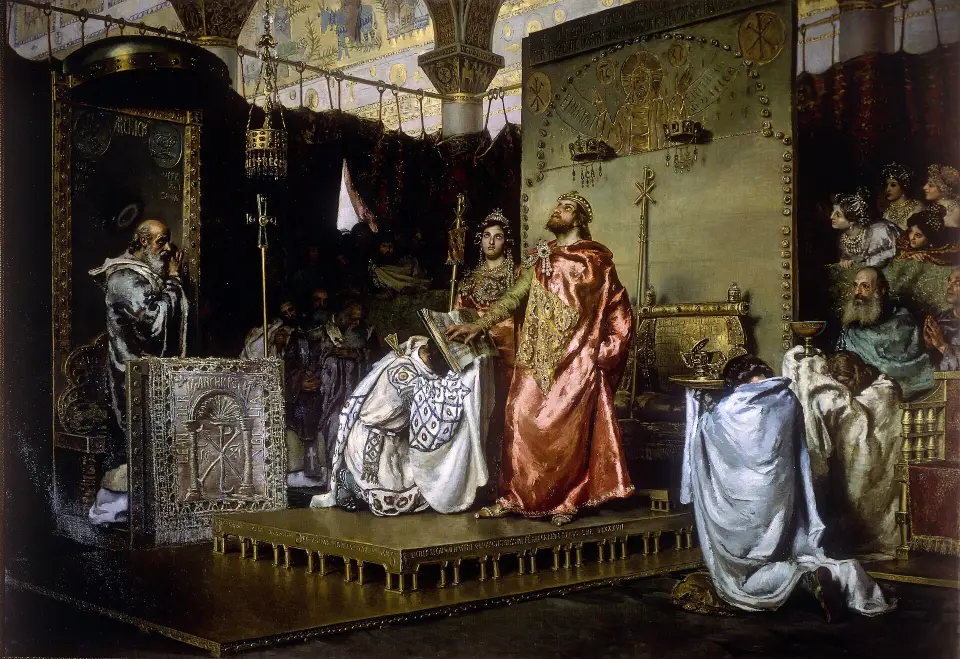
King Reccared (r. 586–601) adopted the Nicene faith. He solemnly proclaimed it at the Council of Toledo in 589. The nobility followed him, and Arianism soon disappeared in Spain.
The same council formally enshrined the Western theological formula of the procession of the Holy Spirit "and from the Son" (filioque). The doctrine goes back to Augustine's treatise "On the Trinity" and was already included in the Athanasian Creed. The formula was now added to the text of the Nicene-Constantinopolitan Creed.
The East never accepted this addition. For centuries the filioque question became one of the chief points of division between the Eastern and Western Churches.
Key points
- King Reccared adopts the Nicene faith and proclaims it at the council (589)
- Arianism disappears among the Visigothic nobility following the king
- The filioque (procession of the Spirit "and from the Son") is added to the Nicene-Constantinopolitan Creed at this council
- The doctrine goes back to Augustine's "On the Trinity" (5.14: the Father and the Son are the one beginning of the Holy Spirit) and the Athanasian Creed
- The East rejected the addition; the filioque question became one of the causes of the division of the Churches
People
- Reccared
- Augustine of Hippo
- Gregory the Great
- Isidore of Seville
Place
Toledo (Spain)
Sources
Primary sources
- Augustine – On the Trinity, bk. V, ch. 14
Textbooks
- Stuart G. Hall – Doctrine and Practice in the Early Church (Russian edition), p. 112, 131–132
- Justo L. González – The Story of Christianity, vol. I (Russian edition), Ch. 20, sec. 20.1, 20.3
- Louis Berkhof – History of Christian Doctrines (Russian edition), p. 61–62
- J. North – A History of the Church (Russian edition), p. 96–97, 108
More on the doctrine
Data compiled: 2026-11-09