c. 320–325 · 4th century
Arius: the Son as a perfect creature, and Arian christology
Arius, a presbyter of Alexandria, clashed with Bishop Alexander over how to understand the divinity of Jesus. According to Arius, there is "one God, unbegotten, eternal, without beginning", while the Son is only-begotten, a perfect creature of God, "but not as one of the creatures": he has a beginning, was created "before the ages", and through him everything else was created. According to one interpretation presented by González, Arius was defending a view of salvation: the divinity of Jesus was conceived in terms of will, open to imitation, and the Son had to be Son by adoption so that we too could be adopted. Pelikan sums up: Christ ends up suspended between man and God, God interpreted deistically, man moralistically. Alexander convened a synod of nearly a hundred Egyptian bishops, which condemned and deposed Arius; he gained the support of Eusebius of Nicomedia and of part of Origen's followers.
Positions
- Arius
- Only the Father is God; the Son is a creature from nothing and has a beginning; he is called Son by adoption
- Alexander of Alexandria
- The Son is eternal and divine by nature; otherwise God was not always Father
- Hall
- Arius and Arianism are far from being the same thing; the surviving letters and the Thalia show that Arius considered himself a follower of tradition
Key points
- Lane: Arius introduced a radical monotheism into Origen's system, and himself reduced the dispute to two points – the Son had a beginning and was created from nothing
- Pelikan: Arianism was the "last powerful manifestation" of angel christology (Heb 1:4); the Son is changeable and remains good by will. The Arians continued to worship the Logos and to baptize in the name of the Father, Son and Spirit, and their opponents accused them of polytheism.
- Hall: the charge of the Son's "changeability" is refuted by Arius's own letters; Arius relies on John 1:18 and Proverbs 8:22
- Lebedev: the strict Arians (Arius, Eusebius of Nicomedia) came from the Antiochene theological school of Lucian, inclined to rationalism, and the moderate ones from Origen
- Anatolios: for Arius, Asterius and Eunomius divinity was measured by being unbegotten: the ‘begotten’ Christ stood below the one unbegotten God. Christ is Word, Wisdom and Power of God, yet mediator between God and creation, which could ‘not withstand the immediate hand of God’ (Asterius); Eusebius of Caesarea explained that creatures could not approach God, so the Father’s philanthropy set the Son to constitute and govern the universe. Alexander of Alexandria saw Arian christology’s flaw in separating Christ from the highest divinity; the Nicenes charged it with idolatry. The Arius–Alexander dispute was also about worship: in Arius’ Thalia, “we worship the eternal one through the one who came to be in time”, and Theognis of Nicaea held that worship is due “to the Father alone”, while the Son is “reverenced” because his glory ascends to the Father. Alexander justified Arius’ excommunication by the incompatibility of his doctrine with “the Church which worships the divinity of Christ”.
- Weinandy: Arius, as he presents it, began from three necessary attributes of God – unbegottenness, unity and transcendent immutability. The Son, begotten, distinct from the Father and subject to change and weakness as man, cannot be God and so is created (‘there was when he was not’); Arius rejected the Son as a ‘lesser deity’ (second god), to which Origen’s emanational view of God’s unity in the one Father had led.
- Shelley: Arianism appealed because Christ as a divine hero below God recalled converts’ old religion; its consequence is two Gods.
Outcome
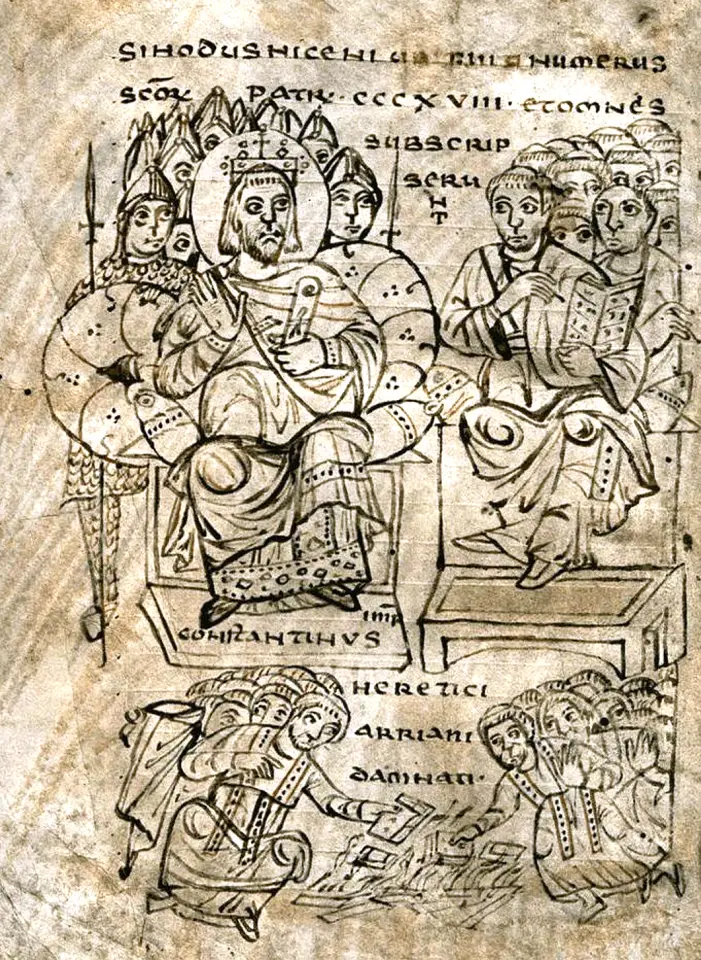
Arius was condemned by a synod of Egyptian bishops; the dispute grew into the main theological conflict of the East and was brought before the Council of Nicaea in 325.
People
- Arius
- Alexander of Alexandria
- Eusebius of Nicomedia
- Eusebius of Caesarea
Terms
- only-begotten – monogenes
- In Arius, unique of its kind: not possessing the Father's unbegottenness, but essentially different from creatures.
- "there was when he was not"
- An Arian formula condemned by Nicaea; the Arians maintained that there was no "time" before the Son (Pelikan); Hall notes there is no proof Arius himself wrote this.
Place
Alexandria
Sources disagree
Hall: c. 320–325 (mentions Alexander's conflict with Colluthus in 321); González: early 4th century; Lane: before 325; Pelikan: 4th century without exact dates.
Sources
- Stuart G. Hall – Doctrine and Practice in the Early Church (Russian edition), p. 82–85
- A. P. Lebedev – History of the Ecumenical Councils, part I, p. 17, 19–20, 47–48
- Jaroslav Pelikan – The Christian Tradition: A History of the Development of Doctrine, vol. 1 (Russian edition), p. 207–212
- Justo L. González – A History of Christian Thought in One Volume (Abingdon, 2014), p. 115–116
- Tony Lane – Christian Thinkers (Russian edition), p. 35
- The Oxford Handbook of Christology, ed. Francesca Aran Murphy (2015), p. 147–148, 150, 661–662
- The Oxford Handbook of Sacramental Theology, ed. Hans Boersma, Matthew Levering (2015), p. 182–183
- Bruce L. Shelley – Church History in Plain Language (Russian edition), Ch. 10, sec. «Осмысление тайны»
Related entries
- Grew out of: Clement and Origen: the eternal generation of the Son, three hypostases and subordination (first half of the 3rd century)
- Grew out of: The two Dionysii: "right-wing" and "left-wing" Origenism and the first discussion of consubstantiality (260s)
- Answered by: The Nicene definition: "consubstantial with the Father" (325)
- Answered by: Athanasius and Nicene christology: only the Creator can save (328–373)
- Developed in: The Arians and Eunomius against the Cappadocians: Is God's Essence Knowable? (357–381)
In church history
Data compiled: 2026-11-17