328–373 · 4th century
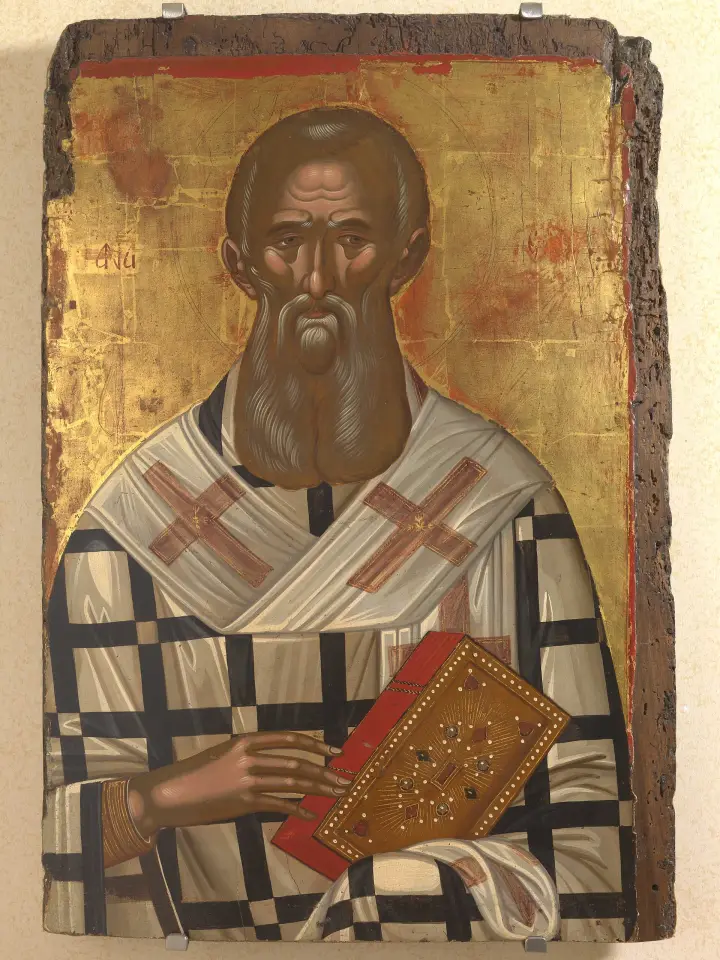
Athanasius and Nicene christology: only the Creator can save
In the Orations against the Arians, Athanasius offers four arguments: the passages where the Arians saw the superiority of the Father refer to Christ's human status; worship of a creature would be idolatry (1.8); only God can save; God could not be "without Reason", that is, the Word (1.24; 2.32). Pelikan shows that the defenders of Nicaea linked consubstantiality with the conviction that only the Creator can save: "He who called people from non-being into being can call them again from falling away into nothing." González notes that Athanasius apparently assumed that Jesus had no human rational soul and that the Word took its place. He stressed the unity of the divine and the human in Christ: the properties of one can be transferred to the other (3.31–34), so it is fitting to worship the man Jesus, and Mary is the Theotokos, "Bearer of God" (3.29, 33).
Positions
- Arians
- The passages about subordination refer to the preexistent Logos as a creature
- Athanasius, Amphilochius, Didymus
- These passages refer to the incarnate Christ and his human nature; the Son is God by nature
Key points
- Lane: the image of the sun and its rays – the Son is begotten not outside the Father but from his essence
- Pelikan: "God the Logos became man so that people might become God" (cf. Athanasius, Against the Arians 1.39: "He was God, and then became man, and that to deify us"); the condition is that the Logos does not belong to things that have a beginning
- Proverbs 8:22 ("created") was taken either in an improper sense or as referring to Christ's humanity
- González: the teaching that there was no human soul does not agree with Athanasius's own soteriological principles, as the Cappadocians later pointed out
- Lebedev: Athanasius held the Nicene confession sufficient for all time, not to be changed in a single letter; Gregory the Theologian called him “the pillar of the church”
- McGuckin: Athanasius spoke of “identity of essence” of Son and Father and accepted the Nicene formula if it separates supporters of the Son’s full divinity. The Word and the Father are not members of a class but “the selfsame being”; images – light and radiance, source and stream (Against the Arians 3.1–3)
- Phan: Athanasius modifies Neoplatonism – he holds “unoriginate” to be a personal attribute of the Father alone, not an essential attribute of God; so the begotten Son and the Spirit “proceeding” through the Son are no less divine than the Father
- Anatolios: against assigning everything about Christ to a created mediator, Nicenes saw in Scripture two acts of the Word’s drama – pre-eternal and incarnate; Athanasius called this the “double account of the Savior”, and Gregory Nazianzen drew a rule: the exalted to divinity, the lowly to the composite Christ. To “anointing” by the Spirit (Ps 45:7) the Nicenes answered with “Spirit Christology”: Christ gives the Spirit as God and receives it as man. So humanity in Christ receives the Spirit’s fullness indefectibly, since Giver and Receiver are one (Athanasius, Against the Arians 1.48–50)
- Russell: Athanasius and Cyril distinguish Christ who is the Image from man made only “in the image”; Athanasius avoids subordinationism. Only a Savior beyond the created–uncreated divide can save: salvation is the transformation of human nature
- Shelley: the Trinity matters for three reasons. First, salvation is union with God in communion, not just ascent to heaven: we shall be made neither God nor equal to God but transformed for eternal communion (the image of a grandson between grandparents on a porch). Second, the Trinity is imprinted on worship: baptism is “in the name” (not “names”) of Father, Son and Holy Spirit, and Paul gave a trinitarian blessing (2 Cor 13:14). Third, the Trinity is tied to human dignity: subordinationists reasoned that serving the Father means lower dignity, while the Christian idea honours the Son who serves out of love, not from lower rank, so service is a sign of likeness to Christ
Outcome
Athanasius became the chief defender of the Nicene faith; consubstantiality was defended as the condition of salvation and of right worship.
People
- Athanasius the Great
- Amphilochius of Iconium
- Didymus the Blind
- Ambrose of Milan
- Hilary of Poitiers
Terms
- communication of properties – communicatio idiomatum
- The transfer of the properties of one of Christ's natures to the other: the actions and states of the humanity may be ascribed to the divinity and vice versa. In Luther and strict Lutherans, the basis of the ubiquity of Christ's body.
- Theotokos
- She who gave birth to God, the Bearer of God; for Athanasius, denying the title would be denying the incarnation of the Word.
Place
Alexandria
Sources disagree
The books do not date the individual positions; Athanasius was bishop of Alexandria from 328 until his death in 373 (Pelikan, Lane); his largest work, according to Lane, was written in exile.
Sources
Primary sources
- Athanasius – Four Discourses against the Arians, bk. I, ch. 8, 24, 39, 48–50; bk. II, ch. 32; bk. III, ch. 3, 29–34
Textbooks
- A. P. Lebedev – History of the Ecumenical Councils, part I, p. 41–42, 62
- Jaroslav Pelikan – The Christian Tradition: A History of the Development of Doctrine, vol. 1 (Russian edition), p. 216–220
- Justo L. González – A History of Christian Thought in One Volume (Abingdon, 2014), p. 133–134
- Tony Lane – Christian Thinkers (Russian edition), p. 38–41
- The Cambridge Companion to the Trinity, ed. Peter C. Phan (2011), p. 76–77, 23
- The Oxford Handbook of Christology, ed. Francesca Aran Murphy (2015), p. 151–152, 152, 205; 208–209
- Bruce L. Shelley – Church History in Plain Language (Russian edition), Ch. 10, sec. «Важность Святой Троицы»
Related entries
- Response to: Arius: the Son as a perfect creature, and Arian christology (c. 320–325)
- Develops: Athanasius, On the Incarnation of the Word, and the Greek doctrine of salvation as deification (c. 318 or 335–337)
- Develops: The Nicene definition: "consubstantial with the Father" (325)
- Developed in: Apollinaris and the Cappadocian response: "What is not assumed is not healed" (c. 360–381)
In church history
Data compiled: 2026-11-17