first half of the 3rd century · 3rd century
Clement and Origen: the eternal generation of the Son, three hypostases and subordination
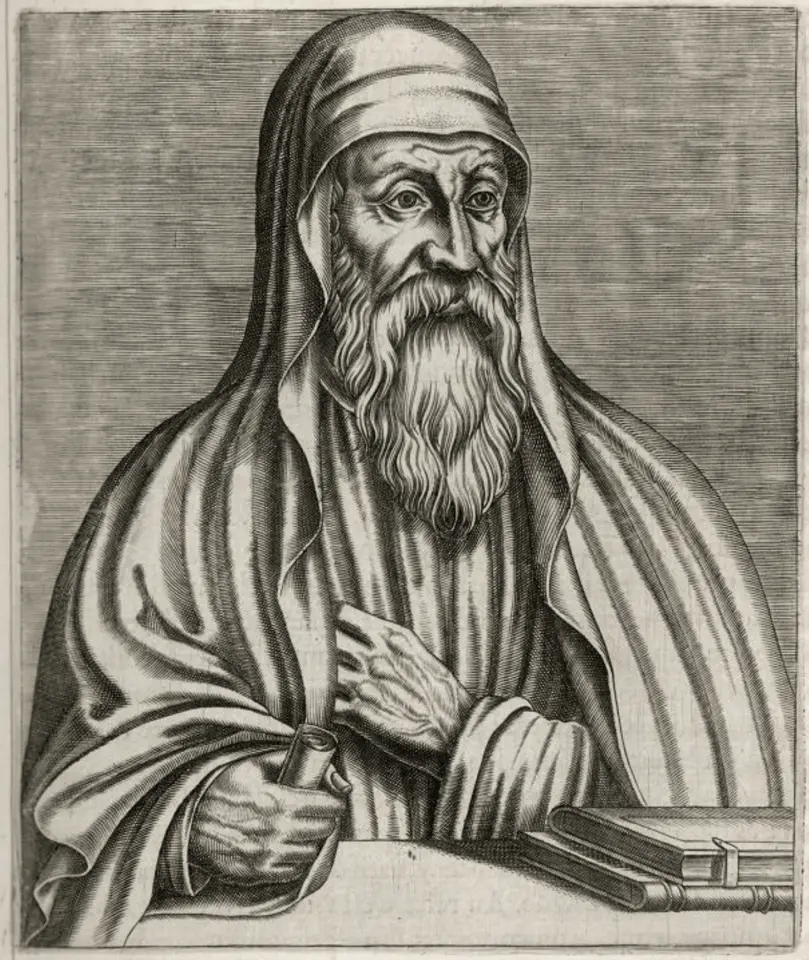
Clement of Alexandria spoke of God mainly negatively and added that God is triune: beside the Father from eternity stands the Word, although, according to Berkhof, Clement also speaks of the Logos's subordination to the Father. Origen, opposing the Monarchians, taught that the Father, the Son and the Spirit are three eternal hypostases and that the Son is begotten by the Father eternally, continuously: there was no time when he was not (On First Principles 1.2.2, 4). At the same time he presented the Trinity as hierarchical: the Father is autotheos, the Son is God by participation in the Father and sometimes "a second God" (Against Celsus 5.39), the Spirit is below the Son. According to González, Origen held these two tendencies in balance, but later they divided his followers; Berkhof and Lane see in the subordination the starting point of Arius.
Positions
- Origen
- Three eternal hypostases, the eternal generation of the Son; in one sense two Gods, in another one (Dialogue with Heraclides).
- Beryllus of Bostra (according to Eusebius)
- The Saviour did not pre-exist as a distinct Person and has no divine nature of his own.
- Origen's opponents
- Called him "a forerunner of Arianism" because of his subordinationism.
- Hall
- Origen's teaching on the eternal generation of the Son contradicts the ideas of Arius.
Key points
- Lane: Origen’s argument (On First Principles 1.2.2) is philosophical – if the Son’s generation were not eternal, the Father formerly could not or would not beget, unworthy of God; the doctrine of eternal generation is regarded as orthodox. Lane calls Origen’s Trinity “three-tiered”: if the Father is God, the Son is “god” with a small letter
- Berkhof: the Father imparts to the Son only a secondary deity (theos, not ho theos), and generation flows from his will
- Pelikan: anti-Sabellian exegesis led Origen to the idea of the eternity of the Logos, and his interpretation of Prov 8:22–31 to the image of a "created wisdom" subordinate to God.
- González: in Origen (On First Principles 1.3.5, 8) the Father gives being to all creatures, the Son acts in rational ones, the Spirit in the sanctified. In Clement there is no clear doctrine of the Holy Spirit; the Spirit is above all a principle of cohesion drawing us to God; trinitarian formulas are frequent in him.
- Hall: in Origen the Son surpasses rational beings, the Spirit the saints.
- McGuckin: Origen calls Trinitarian faith the “triple woven rope” from which “the whole Church hangs”; under the Law the Trinity was not fully revealed. He takes hypostasis as “single concrete being”: three hypostases, only the Father unbegotten; he finds unity in harmony and identity of will. Origen rejected homoousios as Gnostic necessary emanation and called the Logos a “second God”, yet wrote nothing in the Trinity is greater or less (On First Principles 1.3.7). The Arians developed Origen’s stress on the Son’s difference, the Nicenes his eternal generation, but had to affirm homoousios against his text
Outcome
The unresolved tension between the eternity and the subordination of the Son, in the books' assessment, became the source of the 4th-century controversies and divided Origen's followers.
People
- Clement of Alexandria
- Origen
- Beryllus of Bostra
Terms
- eternal generation
- The continuous begetting of the Son by the Father without a beginning in time, not a once-for-all event.
- hypostasis
- Individual, distinct objective being of each of the Persons of the Trinity – the term for the Three since Origen. A word the parties understood differently: in the Nicene anathema and for the Westerners at Serdica, a synonym of substance (ousia); for the Cappadocians, not.
- trinity
- The Latin term introduced by Tertullian in the dispute with the defenders of God's simple unity; Origen knew it and used it often.
Place
Alexandria
Sources disagree
González: Origen c. 202–250; Hall: c. 203–253; Lane: c. 202 – 250s; Clement c. 200–215 (González). Berkhof and Pelikan date only by century.
Sources
Primary sources
- Origen – On First Principles (De Principiis), bk. I, ch. 2–3
- Origen – Against Celsus, bk. V, ch. 39
Textbooks
- Stuart G. Hall – Doctrine and Practice in the Early Church (Russian edition), p. 71–73
- Jaroslav Pelikan – The Christian Tradition: A History of the Development of Doctrine, vol. 1 (Russian edition), p. 202–204
- Louis Berkhof – History of Christian Doctrines (Russian edition), p. 47, 55–56
- Justo L. González – A History of Christian Thought in One Volume (Abingdon, 2014), p. 84–85, 91–92
- Tony Lane – Christian Thinkers (Russian edition), p. 29–30
- The Cambridge Companion to the Trinity, ed. Peter C. Phan (2011), p. 74, 74–75
Related entries
- Leads to: Arius: the Son as a perfect creature, and Arian christology (c. 320–325)
- Developed in: Origen: Eternal Creation, the Pre-existence of Minds and a Pre-mundane Fall – from Gregory of Nyssa to the Condemnation of 553 (3rd–6th centuries)
- Developed in: The two Dionysii: "right-wing" and "left-wing" Origenism and the first discussion of consubstantiality (260s)
- Developed in: The Cappadocians: "one ousia and three hypostases" and the charge of tritheism (second half of the 4th century)
Data compiled: 2026-11-17