325 · 4th century
The Nicene definition: "consubstantial with the Father"
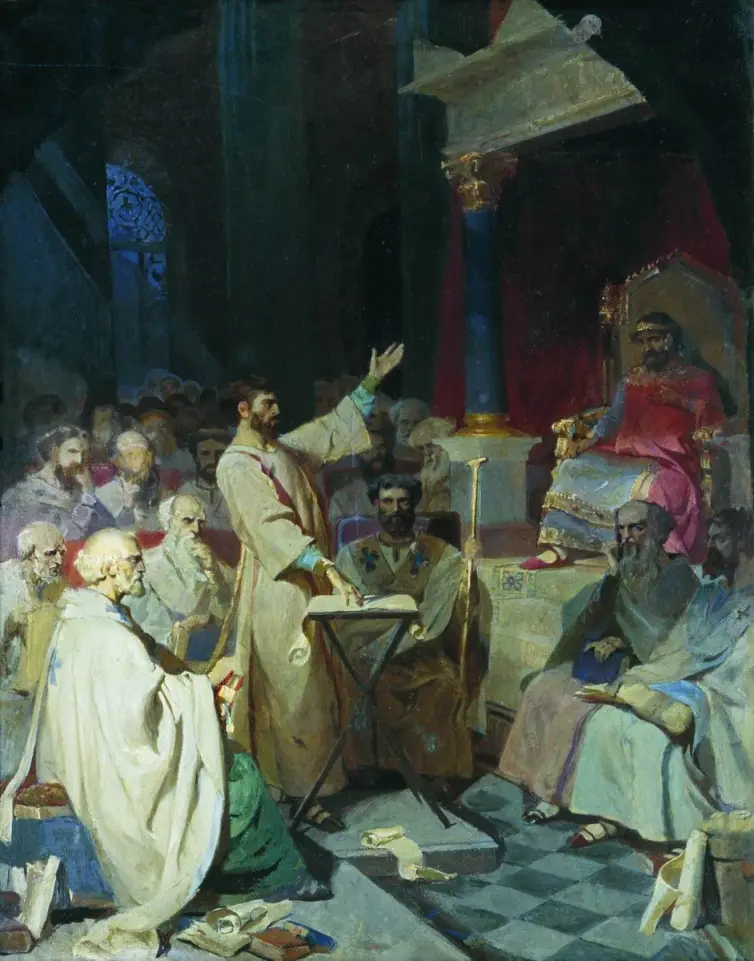
The dispute that began in Alexandria over the interpretation of Prov 8:22 and Arius's teaching of the Son as a creature (on Arius see the article in the Christology section) was brought before the council at Nicaea convened by Emperor Constantine. Already in the spring of 325 a council at Antioch had supported Alexander of Alexandria and anathematized three dissenting bishops, including Eusebius of Caesarea. The Nicene Creed (as given in Eusebius of Caesarea's letter to his diocese, 4) confessed the Son as "begotten of the Father, only-begotten, that is, from the substance of the Father, God from God, Light from Light, true God from true God, begotten, not made, consubstantial with the Father" and anathematized those who say "there was when he was not". The word "consubstantial" (homoousios), according to Eusebius's letter (4), was proposed by the emperor, possibly at the prompting of Ossius of Córdoba; it was non-biblical, but it was needed because the Arians interpreted biblical expressions in their own way. Athanasius, according to Berkhof and González, grounded consubstantiality soteriologically: only One who is himself God can unite us with God.
Positions
- Arius
- The Son is created from nothing, is not eternal and not consubstantial with the Father; he rejected homoousios as Manichaeism – as if a part of the Father had separated (Hall).
- Alexander and Athanasius
- The Son is consubstantial with the Father, came forth from his substance, is eternal; the generation is an inner, necessary and eternal act of God, not dependent on will.
- Eusebius of Caesarea and the middle party
- According to Berkhof, they proposed "of like substance"; according to Hall, Eusebius accepted homoousios as "having the same nature"; in his letter (7) the Son "bears no resemblance to the originated creatures" and is "in every way assimilated" to the Father alone.
- Followers of Origen (Lane)
- Feared a materialistic division of God's substance and opening the door to the Monarchians.
Key points
- Pelikan: the council wanted Scripture’s “from God”, but creatures too are “from God” (1 Cor 8:6; 2 Cor 5:17), so it added “from the substance of the Father” and “consubstantial”; the word aroused suspicion through Gnostic and Manichaean associations and a link with Paul of Samosata. The basis of the Nicene Creed was a local Syro-Palestinian baptismal creed. Maximus the Confessor regarded Nicaea as the measure of orthodoxy: the neologism only expressed what had been presupposed, and later councils merely interpreted the Nicene definition.
- Lane: drops of dew are also “begotten” (Job 38:28). The word “consubstantial” was familiar to the West since Tertullian and to Antioch, but alien to most in the East; the creed was apparently based on one of the creeds of the Eastern church.
- Hall: the Nicene Creed was written anew, not from the Caesarean creed
- Lebedev: the council first rejected the strict Arian creed of Eusebius of Nicomedia (“the Son is a creature”), above all for expressions absent from Scripture, and reworked the creed of Eusebius of Caesarea (his Letter to Caesarea, 1–4): Constantine, at the prompting of orthodox bishops, proposed adding “consubstantial” to it. Eusebius of Nicomedia and Theognis signed the creed but not the anathema; Eusebius of Caesarea, he says, reinterpreted the definitions (Letter, 5–8).
- González: the phrase “for our salvation” is the axis of the creed, and of the Holy Spirit it says only “and in the Holy Spirit”; Athanasius argued that without consubstantiality monotheism, salvation and deification collapse: a non-God cannot restore creation
- McGuckin: Arius publicly accused his bishop Alexander of misrepresenting biblical tradition and, once dismissed, became a cause célèbre. For the next century the investigation of the Trinity became a series of public bishops’ meetings modeled on the Roman Senate’s law-making; landmarks – Nicaea (325, Son ‘of the being of the Father’), Alexandria (362, ‘one ousia, three hypostases’), Constantinople I (381, Spirit’s deity).
- Barnes: alongside the Latin tradition of ‘one power’ a fourth-century line stressed substance: Ossius of Cordoba, Marius Victorinus, Potamius of Lisbon. Substance language is prominent in statements of Ossius’ synods (Nicaea, Western Serdica, Sirmium II); he and Potamius may represent an Iberian school, perhaps influenced by Ossius’ deacon, the Platonist Calcidius, while Victorinus’ focus on substance owes to homoousios and Porphyrian Platonism.
- Shelley: the semi-Arians proposed homoiousios for homoousios; their iota would have meant two gods and a slide into paganism.
Outcome
Arius was condemned and the creed with "consubstantial" was adopted; those who did not sign were exiled and Arius's books were burned (González). According to Lane, the school of Origen signed the creed out of respect for the emperor but was not defeated, and the dispute continued; in time the Nicene Creed became the creed of the whole church (González).
People
- Constantine the Great
- Hosius of Córdoba
- Alexander of Alexandria
- Arius
- Athanasius the Great
- Eusebius of Caesarea
- Eusebius of Nicomedia
- Eustathius of Antioch
- Marcellus of Ancyra
- Maximus the Confessor
Terms
- consubstantial – ὁμοούσιος
- Of one essence: with the Father according to the Godhead, with us according to the humanity. The most disputed, non-biblical word of the creed.
- from the substance of the Father
- A clarification excluding an understanding of the Son as a creature, which is also "from God".
- hypostasis
- Individual, distinct objective being of each of the Persons of the Trinity – the term for the Three since Origen. A word the parties understood differently: in the Nicene anathema and for the Westerners at Serdica, a synonym of substance (ousia); for the Cappadocians, not.
Place
Nicaea
Sources disagree
Hall: the solemn opening of the council on 20 May 325; Lane: June 325. Number of participants: Hall – at least 230, Lane – more than 220 bishops (later tradition – 318), González – more than three hundred. The Council of Antioch – spring (Hall) or early (Pelikan) 325.
Sources
Primary sources
- Eusebius of Caesarea – Letter to the People of His Diocese on the Council of Nicaea, ch. 1–8
Textbooks
- Stuart G. Hall – Doctrine and Practice in the Early Church (Russian edition), p. 84–91
- A. P. Lebedev – History of the Ecumenical Councils, part I, p. 14–39, 283
- Jaroslav Pelikan – The Christian Tradition: A History of the Development of Doctrine, vol. 1 (Russian edition), p. 204–205, 212–215
- Jaroslav Pelikan – The Christian Tradition, vol. 2: The Spirit of Eastern Christendom (600–1700) (Russian edition), p. 116–118
- Louis Berkhof – History of Christian Doctrines (Russian edition), p. 56–58
- Justo L. González – A History of Christian Thought in One Volume (Abingdon, 2014), p. 116–118, 132–134
- Tony Lane – Christian Thinkers (Russian edition), p. 35–37
- The Cambridge Companion to the Trinity, ed. Peter C. Phan (2011), p. 75–76, 81, 88
- Bruce L. Shelley – Church History in Plain Language (Russian edition), Ch. 10, sec. «Бог истинный от Бога истинного»
Related entries
- Response to: Arius: the Son as a perfect creature, and Arian christology (c. 320–325)
- Answered by: After Nicaea: the ambiguity of "consubstantial", Marcellus of Ancyra and the split between East and West (325–346)
- Developed in: Athanasius and Nicene christology: only the Creator can save (328–373)
- Answered by: The anti-Nicene parties (Anomoeans, Homoeans, Homoiousians) and the reconciliation of 362–363 (355–363)
- Developed in: Athanasius, Letters to Serapion: The Deity of the Holy Spirit and the Synod of Alexandria (362) (359/360)
- Developed in: The Controversy with the Pneumatomachi (Macedonians), Basil's On the Holy Spirit and the Council of Constantinople (381) (360–381 (council – 381))
- Developed in: The Cappadocians: "one ousia and three hypostases" and the charge of tritheism (second half of the 4th century)
- Developed in: The Niceno-Constantinopolitan Creed: composition, the debate over its origin, and acceptance (381 (acceptance – 451))
In church history
Data compiled: 2026-11-17