357–381 · 4th century
The Arians and Eunomius against the Cappadocians: Is God's Essence Knowable?
The fundamental idea of the Arian doctrine of God, according to Pelikan, is "one and only": God is the unbegotten, unoriginate "monad," who cannot share his attributes with anyone, and "God was not always Father." The Anomoeans Aetius and Eunomius, advisers of Eudoxius (from 357), went further than Arius: the words "unbegotten" and "begotten" express a difference of essence between Father and Son, and God can be comprehended with complete precision. The Cappadocians began their struggle against Eunomius with the question of God's knowability. Basil (Letter 234): "We know the greatness of God, his power, goodness... but not his essence"; Gregory of Nyssa: the more the mind knows God, the more it is convinced of its ignorance.
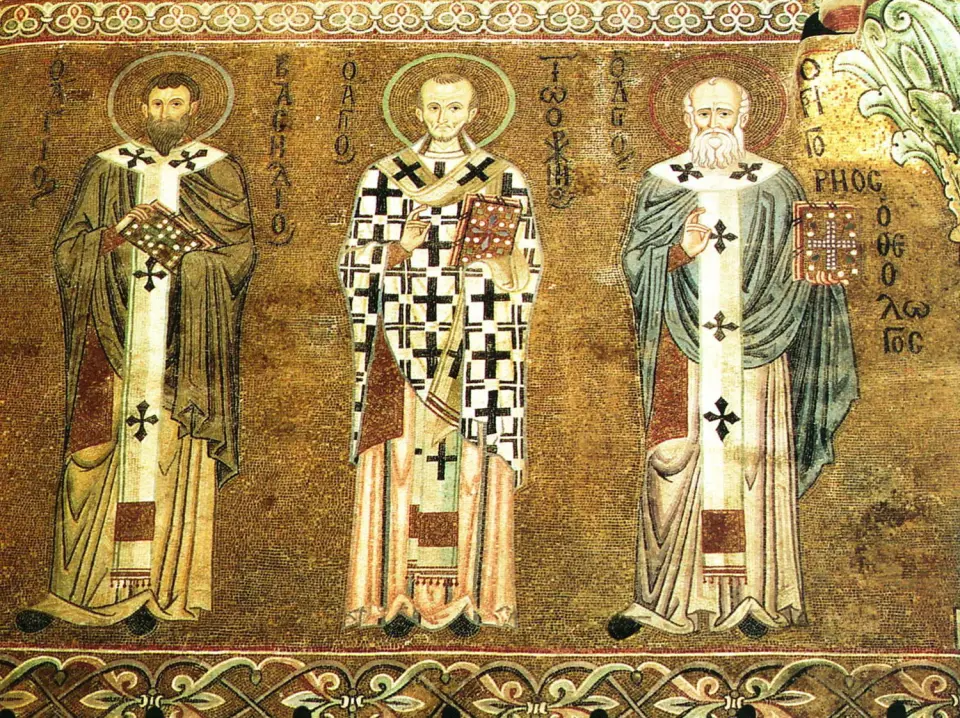
Positions
- The Arians
- God is a monad; there is no direct contact between God and creation; "if Christ were God, God would not have said, I alone" (Deut 6:4)
- The Anomoeans (Aetius, Eunomius)
- God is knowable; words about God are literal; the Son is unlike the Father in essence
- Basil, Gregory of Nyssa
- God's essence is unknowable; God is known by his works (Basil, Letter 234)
Key points
- Hall: the Anomoeans reasoned in the spirit of Aristotle; the Cappadocians' apophaticism resembles the Arian attitude to the mystery of God
- Pelikan: Arius, in asking about Christ, was asking about God
- Those who know God, according to Gregory of Nyssa, grow in the desire to seek him
- Anatolios: Eunomius, reading Luke 18:19, held that only the unbegotten God is truly good, the Son merely a softening mediator; Gregory of Nyssa objects: the sign of the Son’s goodness is his self-humbling (Phil 2:6), stooping to human nature out of love. The anaphora of the Apostolic Constitutions reflects Eunomianism: God is “the only unbegotten,” the Son “firstborn of creation”; Basil’s anaphora does not call God “unbegotten,” stresses his incomprehensibility and calls the Son “image of your goodness”
Outcome
Anomoeanism met the resistance of the Eastern majority; the theology of an unknowable essence together with knowledge of God by his works entered the Eastern tradition (Hall).
People
- Arius
- Aetius
- Eunomius
- Eudoxius
- Basil of Caesarea
- Gregory of Nyssa
Terms
- monad – μονάς
- The divine unity, unoriginate, "most unique"; in Marcellus, the eternal indivisible Being of God.
- unlike – anomoios
- For the Anomoeans: the essence of the Son is unlike the essence of the Father.
- apophatic and cataphatic approach
- Denial of the possibility of knowing and describing God's essence – against affirming its comprehensibility with complete precision.
Place
Alexandria; Caesarea
Sources disagree
Hall: Eudoxius elected in 357; the Cappadocians' struggle with Eunomius – 370–381 (by the lifespans of Basil, 329–379, and the Gregories); Pelikan: 4th century for the Arian doctrine of God.
Sources
Primary sources
- Basil the Great – Letters, letter 234
Textbooks
- Stuart G. Hall – Doctrine and Practice in the Early Church (Russian edition), p. 96–97, 103–104
- Jaroslav Pelikan – The Christian Tradition: A History of the Development of Doctrine, vol. 1 (Russian edition), p. 205–207
- The Oxford Handbook of Christology, ed. Francesca Aran Murphy (2015), p. 148, 150–151
- The Oxford Handbook of Sacramental Theology, ed. Hans Boersma, Matthew Levering (2015), p. 190–193
Related entries
- Develops: Arius: the Son as a perfect creature, and Arian christology (c. 320–325)
- Answered by: The Cappadocians: "one ousia and three hypostases" and the charge of tritheism (second half of the 4th century)
Data compiled: 2026-11-17