1917–1964 · 20th century
The Russian Orthodox Church under Soviet rule
After the February Revolution of 1917 the Local Council of the Russian Church restored the patriarchate abolished by Peter the Great. It elected Metropolitan Tikhon as patriarch.
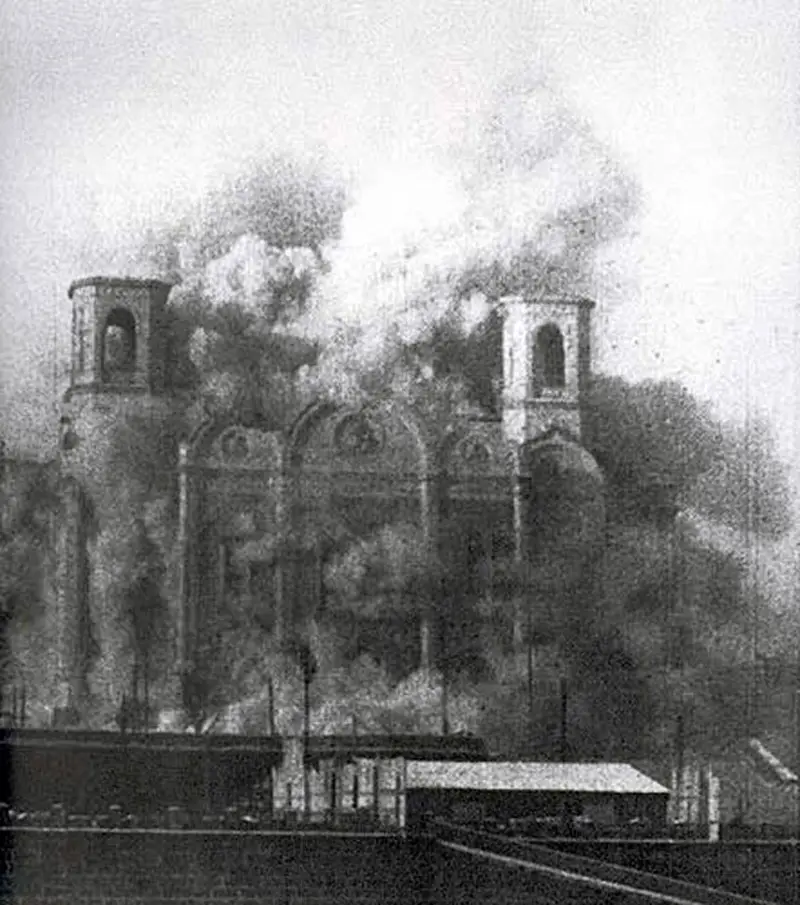
The Bolsheviks who came to power confiscated church property. They separated church from state (1918), closed seminaries and banned religious instruction in schools (1920). Persecution – executions and imprisonment of clergy – intensified especially during Stalin's terror.
In 1943, needing public support during the war, Stalin allowed the partial restoration of the Moscow Patriarchate's activity. But under Khrushchev, in 1958–1964, a new wave of antireligious campaigning brought mass closures of churches and monasteries.
In 1961 the Russian Orthodox Church joined the World Council of Churches.
Key points
- 1917 – restoration of the patriarchate, election of Patriarch Tikhon
- Confiscation of property, closure of churches, execution and imprisonment of clergy
- 1943 – partial restoration of the Moscow Patriarchate under wartime pressure
- 1958–1964 – Khrushchev-era persecution, mass closure of churches and monasteries
- 1961 – the Russian Church joins the World Council of Churches (New Delhi)
- Shelley: Marxism-Leninism held religion to be “false consciousness” that would die of itself, yet the communists actively fought it: the Bolsheviks seized church lands, abolished state subsidies, legalized civil marriage and forbade religious education for the young. Patriarch Tikhon declared war on the state in his first pastoral letter; in six years 28 bishops and over a thousand priests were killed. The 1929 law “On Religious Associations” strictly limited the churches; thousands of priests died or were imprisoned. The 1936 constitution restored clergy’s vote; by 1939 the Church was near destruction, Lutherans nearly exterminated. In the war Stalin valued the churches’ contribution to morale, to uniting seized territories and to foreign policy, and allowed them to form organizations, raise funds and teach children religion privately. In 1943 a Council for the Affairs of the ROC was created, a year later one for other religions; they enforced the laws. In 1945 the ROC and other bodies became legal corporations with the right to own property and produce liturgical items. After 1953 the Church, stressing “peaceful coexistence”, joined ecumenism and entered the WCC in 1961; church leaders sought jurisdiction over churches abroad, and travelling representatives pushed Moscow’s “line” and joined peace campaigns
People
- Patriarch Tikhon
- Vladimir Lenin
- Joseph Stalin
- Nikita Khrushchev
Place
Russia / USSR; New Delhi
Sources
- J. North – A History of the Church (Russian edition), p. 7–8, 401, 404
- Justo L. González – A History of Christian Thought in One Volume (Abingdon, 2014), p. 408–409
- Justo L. González – The Story of Christianity, vol. II (Russian edition), Part 4, ch. 31–32
- Bruce L. Shelley – Church History in Plain Language (Russian edition), Ch. 42, sec. «Русская революция»; Ch. 42, sec. «Влияние Второй мировой войны»
Data compiled: 2026-11-09