1934 · 20th century
The Dispute over Natural Theology: Brunner, Barth's "Nein!" and the Barmen Declaration (1934)
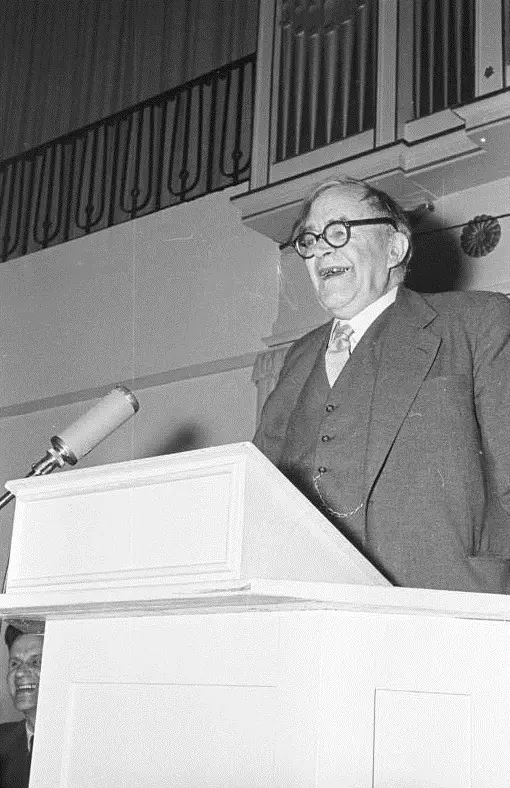
In 1933 Barth spoke out against the "strange gods" that pervert theology through the conjunction "and": "revelation and reason," "revelation and religious consciousness," "revelation and creation." Brunner objected in Nature and Grace (1934): the image of God in human beings formally survived the fall, and this is a "point of contact" for grace; there must be room for God's witness to the pagans, for "preserving grace" and for "orders of creation." Barth replied with a sharp "Nein!": natural theology is excluded, and he linked a "theology of compromise" with the German church's capitulation to Nazism. The first article of the Barmen Declaration (1934), drafted mainly by Barth, proclaimed Jesus Christ, as attested in Scripture, the one Word of God and rejected other "events, powers, figures and truths" as divine revelation alongside him.
Positions
- Barth
- Natural theology is excluded by definition; "and" is the first sign of idolatry; the Gospel needs no point of contact other than the work of the Holy Spirit
- Brunner
- The image of God is materially destroyed but formally exists; "grace does not destroy nature but perfects it" (Thomas); he rejected natural knowledge of God as a proof of God's existence
- Brunner on revelation (Truth as Encounter, 1938)
- Revelation is not the communication of information but an event of personal "I–Thou" encounter; the Bible is an indispensable witness and criterion of doctrine, but not God's inspired, infallible address
Key points
- González: Barth listed his predecessors’ “ands”: the 18th century – “revelation and reason”, Schleiermacher – “revelation and religious consciousness”, Ritschl – “revelation and the history of religions”
- Barth's analogy: a drowning man pulled from the water cannot claim a "capacity to be saved" (Grenz and Olson)
- The dispute led to the end of the journal Zwischen den Zeiten; reconciliation came only in the 1960s
- Lane: the Barmen Declaration became the rallying point of the Confessing Church but missed its aim – Lutherans could not accept Barth’s voice; it was influential as a theological document
- Shelley: the Barmen Declaration (May 1934), largely by Barth, called German churches back to central truths and rejected the state's totalitarian demands; it relied on revelation disclosed in Jesus, not on natural theology. Barth rejected natural theology completely: it inevitably becomes idolatry when we describe God in our own terms. A similar strategy appears in liberalism – seeing God through human lenses (“God not only loves us – He is like us!”); the outcome is the same as in Nazi theology – “unbridled idolatry”, and Nazi genocide is a demonic form of idolatry: “distorted theology has its consequences”
Outcome
A break between Barth and Brunner; the Barmen Declaration affirmed Christ as the one Word of God in the struggle against Nazism, and events forced Barth to leave Germany.
People
- Karl Barth
- Emil Brunner
- Martin Buber
- Ferdinand Ebner
Terms
- point of contact – Anknüpfungspunkt
- According to Brunner, that in the human being and society to which grace and God's action attach.
- general revelation
- The presence of revelation in nature and human experience according to Brunner.
- inner testimony of the Spirit – testimonium spiritus internum
- That by which alone it is confirmed that Scripture is the Word of God; for Brunner, the present revelation of Christ to the believer.
Place
Germany, Barmen, Switzerland
Sources disagree
González: Barth's article – 1933, Nature and Grace and Nein! – 1934; Grenz and Olson place the break in the "mid-1930s." The Barmen synod – May 1934 (Lane). Truth as Encounter – 1938 (English ed. 1943).
Sources
Primary sources
- Theological Declaration of Barmen, theses 1, 5
Textbooks
- Justo L. González – A History of Christian Thought, vol. III: From the Protestant Reformation to the Twentieth Century (Abingdon, rev. ed. 1987), p. 446–449
- Tony Lane – Christian Thinkers (Russian edition), p. 262
- Stanley Grenz, Roger Olson – 20th-Century Theology: God and the World in a Transitional Age (Russian edition), p. 110–118
- Bruce L. Shelley – Church History in Plain Language (Russian edition), Ch. 42, sec. «Христиане в дни власти Гитлера»
Related entries
- Develops: Karl Barth: Theology from Above and the Word of God in Three Forms (1919–1968)
- Developed in: The Barmen Declaration and the Confessing Church (1934)
In church history
- Karl Barth and neo-orthodoxy (1919–1968)
Data compiled: 2026-11-17