turn of the 20th century (1890s–1930s) · 19th century
The Fundamentalist–Modernist controversy in the US; the Niagara Bible Conference
By the late 19th century, historical criticism of the Bible and attempts to reconcile faith with Darwinism had penetrated American Protestantism. Defenders of the traditional "fundamentals" of the faith came to be called fundamentalists.
John Nelson Darby's dispensationalist ideas combined with Princeton's doctrine of biblical inerrancy. This led to the formulation of five "fundamentals" at the Niagara Bible Conference (1895): the inerrancy of Scripture, the virgin birth of Jesus, his substitutionary death, his bodily resurrection, and his imminent return.
Fundamentalism drew strength from revivalism. At times it allied with confessionalists, as when the Presbyterian General Assembly adopted the "fundamentals." But the seminaries of all the major denominations came under modernist control. After that, many conservatives left them and founded their own churches, Bible colleges, and seminaries. Fundamentalism withdrew into its own separatist "ghetto."
Key points
- Historical criticism and Darwinism entered American Protestantism
- The Niagara Bible Conference (1895) and the five "fundamentals"
- The influence of Darby's dispensationalism and Princeton theology
- Conservatives losing control of the seminaries and founding their own institutions
- Fundamentalism's separatism and its "ghetto"
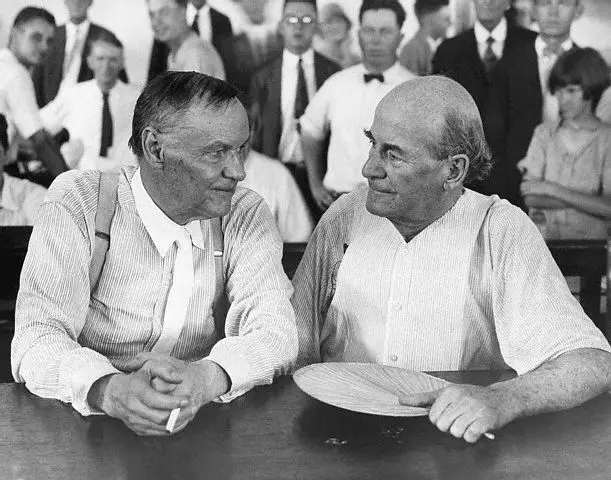
- Shelley: The Fundamentals (1910–1915) were twelve booklets; three million copies were sent free to divinity students, ministers and missionaries. The idea was oilman Lyman Stewart’s: after Amzi Dixon’s sermon in 1909 he won Dixon’s backing, and his brother Milton also gave money; 64 authors worked on it, mostly premillennialists and Keswick Convention participants, but also Mullins and Warfield. In 1920 Baptist Curtis Lee Laws gathered Northern Baptist Convention ‘fundamentalists’ at Buffalo; this group was first to call itself fundamentalist. The ‘fundamentalist fellowship’ was moderate: it faulted modernists for denying human sinfulness, Jesus’ central death and biblical authority. Laws won no confession of faith; in 1924 he wrote that schools had checked liberalism; militant Baptists formed the General Association of Regular Baptists. Among Presbyterians the champion of orthodoxy was Princeton’s J. G. Machen. In 1929 the Assembly approved a reorganisation of the seminary; judging that merged boards strengthened liberals, Machen and colleagues left Princeton and founded Westminster Seminary in Philadelphia. Machen was convicted by a church court of insubordination, and conservatives founded the Orthodox Presbyterian and Bible Presbyterian churches. The dispute rested on views of the Bible: the modernist Mathews (The Faith of Modernism, 1924) against Machen (1915). Fundamentalism grew from premillennialism and dispensationalism (Swampscott 1876; Gordon; conferences of 1878 and 1886). Marsden likens 20th-century evangelicals to rootless immigrants: they crossed no ocean but stood still while the country changed. After the Civil War defeatism ruled the South, while many in the North turned to premillennialism, belief in Christ’s imminent return. Moody preached a “lifeboat” ethic: the world is a wrecked ship, “save who you can”; T. Smith called the retreat from public life the Great Reversal. William Jennings Bryan was a progressive leader, not a mere “denier”, and backed the Eighteenth Amendment (Prohibition). He knew Darwin’s teaching as early as 1905; in spring 1921 a series of his speeches brought him to the front rank of fundamentalists. His objection was moral, not scientific: evolution is ‘very hurtful’ to believers, placing man with the beast and removing the motive to virtue. From 1921 to 1929 thirty-seven anti-evolution bills were introduced in twenty state legislatures. In 1925 teacher Scopes was tried at Dayton; Bryan won in court, Darrow in the country, and fundamentalists acquired an image of separatists.
- Clouse: “fundamentalists” (from 1920) were named after The Fundamentals (1910–1915): some 90 moderate-toned articles by respected scholars (Warfield, Orr). In 1919–1926 militant conservatives, fearing loss of denominations, attacked “Modernists”, and the dispute became a fight to ban evolution in schools; the Scopes “monkey trial” (1925) ended in a fine, but bad press made fundamentalism look like outdated, intellectually stifling dogmatism. From 1926 fundamentalism withdrew into separatism; from the mid-1940s neo-evangelicalism emerged from it (NAE, 1942).
- Holmes: Darby rejected clergy and denominationalism to restore a New Testament church order; this ‘restorationism’ stayed a minority in British evangelicalism. In Britain Keswick piety, premillennialism and hostility to higher criticism produced a brief fundamentalism that never became a major force. ‘Liberal evangelicals’ (1920–1940) split from conservatives over substitutionary atonement; after 1945 they turned liberal or joined the mainstream.
- George: in 1910 the Presbyterian Assembly adopted the “Five Fundamentals”: virgin birth, inerrancy, substitutionary atonement, bodily resurrection, miracles. Contributors to The Fundamentals included serious scholars (Orr, Moule, Mullins, Warfield), though fundamentalism was largely populist. In Christianity and Liberalism (1923) Machen said liberalism had “evolved” into another religion; the Rome–Geneva gulf was negligible beside it. In the 1920s–30s the fight became one for control of denominations: Northern Baptists and Presbyterians split; Southern and Black churches stayed calm. Augustus Strong reluctantly sided with fundamentalists but faulted both sides: liberals “see a fly on a barn door a half mile off” but not the door. The Canadian “battling Baptist” T. T. Shields declared “no compromise with the enemy”: he was “a soldier in the field” who would smite Modernism. Fundamentalism was transdenominational: Calvinists and Arminians, dispensationalists and others, united by the Bible’s inspiration and authority. In World War I fundamentalists linked liberal Bible criticism with German rationalism and the Kaiser; in Canada the movement stayed tiny. After the Scopes Trial (1925) fundamentalists withdrew (2 Cor. 6:17, “be ye separate”) yet built Bible schools, missions and presses (Carpenter).
- Frykholm: Darby’s ideas were codified in the Scofield Reference Bible (interpretation on the same page as the text) and spread by Bible schools
People
- John Nelson Darby
- William Jennings Bryan
- J. Gresham Machen
- Augustus H. Strong
Place
United States (Niagara Falls); Germany (parallel neo-confessionalism)
Sources
- Stanley Grenz, Roger Olson – 20th-Century Theology: God and the World in a Transitional Age (Russian edition), p. 434–435
- Justo L. González – A History of Christian Thought in One Volume (Abingdon, 2014), p. 397
- J. North – A History of the Church (Russian edition), p. 384–385
- Justo L. González – A History of Christian Thought, vol. III: From the Protestant Reformation to the Twentieth Century (Abingdon, rev. ed. 1987), p. 390–391
- Bruce L. Shelley – Church History in Plain Language (Russian edition), Ch. 43, sec. «Фундаментализм»; Ch. 43, sec. «Возвращение старой доброй религии»; Ch. 43, sec. «Уильям Дженнингс Брайан – символ перемен»
- The Oxford Handbook of Eschatology, ed. Jerry L. Walls (2008), Ch. 14, sec. «The Development of Fundamentalism»
- The Cambridge Companion to Evangelical Theology, ed. Timothy Larsen and Daniel J. Treier (2007), p. 259–260, 262–263, 263–264, 293, 293–294, 294, 294–295, 295
- The Oxford Handbook of Apocalyptic Literature, ed. John J. Collins (2014), p. 460
More on the doctrine
- The Infallibility of Scripture: The Princeton School, Fundamentalism and the Evangelical Debate on Inerrancy (1871–1983)
- New forms of millennialism: postmillennialism, premillenarianism, the Social Gospel (17th – early 20th century)
Data compiled: 2026-11-09