17th – early 20th century · 16th century
New forms of millennialism: postmillennialism, premillenarianism, the Social Gospel
In the 17th century some Lutheran and Reformed theologians, rejecting a visible reign of Christ on earth, defended a spiritual conception: before the end of the world there will be a period of unusual power of Christ's spiritual coming in the Church and general awakening – according to Berkhof, the original form of postmillennialism. In the 18th–19th centuries the doctrine of the millennium again aroused interest (Bengel's school, the Erlangen school, Hofmann, Delitzsch, Auberlen, the Bonars, Alford, Zahn) with a huge variety of opinions, and calculations of the time of Christ's return failed. In liberal circles a new postmillennialist form appeared – the Social Gospel: Walter Rauschenbusch, having realized under Ritschl's influence the corporate character of sin and the importance of the Kingdom of God, wanted to restore the hope of the millennial Kingdom as a new social order "in which the law of Christ will prevail." In response to the challenge of rationalism, fundamentalism arose in the USA, among whose five points (Niagara Falls, 1895) was the coming return of Christ.
Positions
- 17th-century Lutheran and Reformed theologians
- Not a visible reign of Christ but a period of spiritual power and awakening before the end
- 18th–19th-century premillenarians
- A revival of the doctrine of the millennial kingdom
- The Social Gospel (Rauschenbusch)
- The Kingdom as a new social order; change the laws and institutions of society, not only convert individuals
- Berkhof
- Serious theological opinion is against a visible reign of Christ on earth; the millennium is not reflected in any confession
Key points
- The doctrine of the millennium is not church dogma
- González: the Social Gospel arose in the USA as a response to unrestrained capitalism and urban slums; it is the contribution of the USA to Christian thought
- Shelley: Rauschenbusch wrote (A Theology for the Social Gospel, ch. 1): “The social gospel is the old message of salvation, but enlarged and intensified”. The individualistic gospel taught the heart’s sinfulness but not enough understanding of the social order’s sinfulness; the Social Gospel seeks repentance for collective sin, and its prophets saw the capitalist system as society’s chief example of sin
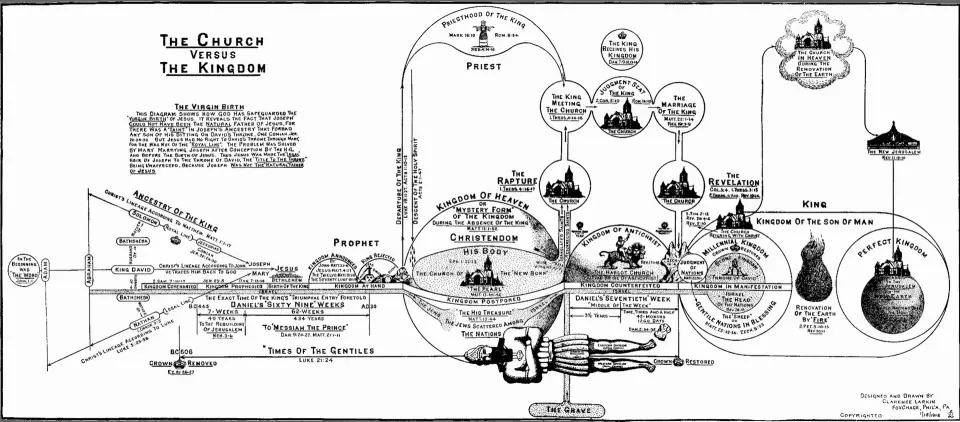
- Clouse: rejecting optimistic postmillennialism, dispensationalists taught that God deals with humanity through a series of eras (most counted seven), and that Christ’s return occurs in two stages – a secret rapture of the church before the tribulation, then his coming with the church. By the “postponement theory” Israel rejected the Messiah, God postponed the kingdom and formed the church from Gentiles, a “parenthesis” of ~2,000 years. Lindsey’s The Late Great Planet Earth (1970) became the bestselling nonfiction book of the 1970s (over 35 million copies); Lindsey predicted the rapture in 1981 and Christ’s return in 1988, reading a “generation” as forty years after 1948. The Left Behind novels by LaHaye and Jenkins have sold over 63 million copies. After 1949 an academic movement of “progressive dispensationalists” arose (a study group by 1986): in dialogue with amillennialists they reduced the dispensations, redefined the Davidic covenant and saw the church as the kingdom’s first manifestation; they began to study their movement’s history objectively for the first time and moved away from the classic dispensationalism of Scofield and Chafer. The Christian Right (Falwell, LaHaye) taught dispensational premillennialism but shared a postmillennial, patriotic view of America
- Weber: interpretations of Revelation fall into four approaches. Preterism (symbols point to Rome) is preferred by most modern interpreters; historicism, a church-history panorama, was favoured by many Reformers; Jesuits refined futurism after the Reformation to prove the Antichrist is not the pope; idealism sees a drama of the battle of good and evil. “Pre-” and “postmillennialism” came into use late (18th–19th c.); most Christians have preferred amillennialism since the 5th–6th century, postmillennialism is especially popular among the Reformed, and supersessionism is shared by amillennialism, postmillennialism and early premillennialism. In Britain premillennialism revived from the late 18th century; by the 1820s Edward Irving led it, his views spread by Albury Park conferences. Irving, a futurist, read prophecy literally and expected the Jews’ restoration; his early supporters included the Plymouth Brethren. In the 1830s Darby added the division of history into dispensations and the doctrine of two peoples of God, hence two phases of the Parousia; the pretribulation rapture became dispensationalism’s most distinctive and controversial doctrine. After the Civil War Darby visited North America seven times and won over leading evangelical pastors; the teaching spread through conferences, Bible institutes and the Scofield Reference Bible (1909), and by World War I was widely accepted in fundamentalist and Pentecostal circles. By the late 19th century the Civil War, social problems and Darwinism weakened faith in a coming millennium, and premillennialism seemed more realistic; liberals like Ritschl defined the kingdom ethically, and Social Gospelers kept the postmillennial agenda without millennialist categories. In the 1970s “Christian reconstructionism” (theonomy) became popular and got a hearing in the new Christian Right. After Israel’s founding (1948) and the Six Day War (1967) dispensationalists left the political disengagement of the 1930s: they formed organizations, pressured Congress and the White House, backed settlers and often allied with Israel’s far Right over the temple. Millennialism can still be deadly – Waco (1993, eighty Branch Davidians) and Heaven’s Gate (1997, thirty-nine suicides). Dispensationalists make up about a third of American evangelicals
- Holmes: Irving and Darby led the shift to premillennialism, which brought a social pessimism at odds with evangelical social engagement.
- Rowland: William Stringfellow (1928–1985) read the Apocalypse not as a timetable of the end but as a template for judging America, after Tyconius
- Frykholm: Darby is credited with the “secret rapture”: believers are taken before the Tribulation, then Christ returns and begins the Millennium. The Puritan jeremiad used doom to spur reform; dispensationalism says “reform to save yourself; everyone else is doomed anyway”
Outcome
The millennium remained outside church dogma, but in various forms – from pietist expectation to the Social Gospel and fundamentalism – it returned to Protestant thought.
People
- Bengel
- Hofmann
- Delitzsch
- Auberlen
- the Bonars
- Alford
- Zahn
- Walter Rauschenbusch
- Cyrus Scofield
- Hal Lindsey
- Tim LaHaye
- Jerry Falwell
- William Stringfellow
Terms
- postmillennialism
- The expectation of a period of Christ's spiritual triumph in the Church (later, of a social order) before his coming.
- fundamentalism
- A movement named after the five "fundamental" points of 1895, including the coming return of Christ.
Place
Germany, England, the USA
Sources disagree
Berkhof gives only centuries (17th; 18th–19th); González (HCT) dates the Social Gospel to the late 19th – early 20th century, Rauschenbusch to 1861–1918, and the Niagara Falls conference to 1895.
Sources
Primary sources
- Rauschenbusch – A Theology for the Social Gospel, ch. 1, p. 5
- Rauschenbusch – Christianity and the Social Crisis, ch. 3, p. 106
Textbooks
- Louis Berkhof – History of Christian Doctrines (Russian edition), p. 193
- Justo L. González – A History of Christian Thought in One Volume (Abingdon, 2014), p. 396–397
- Bruce L. Shelley – Church History in Plain Language (Russian edition), Ch. 41, sec. «Социальное евангелие» в Америке
- The Oxford Handbook of Eschatology, ed. Jerry L. Walls (2008), Ch. 14, sec. «The Development of Fundamentalism; The Problem of Date Setting; The Left Behind Series»; Ch. 14, sec. «Progressive Dispensationalism; Eschatology and the Christian Right»; Ch. 14, sec. «The Development of Fundamentalism»; Ch. 14, sec. «The Problem of Date Setting»; Ch. 14, sec. «The Left Behind Series»; Ch. 14, sec. «Eschatology and the Christian Right»; Ch. 20, sec. «Interpretive Issues; Two Millennialist Models»; Ch. 20, sec. «The Modern Period»; Ch. 20, sec. «The Modern Period; Conclusion»
- The Cambridge Companion to Evangelical Theology, ed. Timothy Larsen and Daniel J. Treier (2007), p. 260
- The Oxford Handbook of Apocalyptic Literature, ed. John J. Collins (2014), p. 435, 459, 461
Related entries
- Develops: Protestant Liberalism: Ritschl's Value Judgments and Harnack's Thesis of "Hellenization" (1870–1900)
- Grew out of: Subjective and mystical theories of the 19th century: Schleiermacher, Ritschl, Bushnell, Campbell – and Forsyth's response (19th – early 20th century)
- Rejected in: Reinhold Niebuhr: Collective Sin, Pride and The Nature and Destiny of Man (1932–1943)
In church history
- Urban revivalism and the Social Gospel in the United States (1861–1918)
- The Fundamentalist–Modernist controversy in the US; the Niagara Bible Conference (turn of the 20th century (1890s–1930s))
- Prophets of the Late 18th Century: Joanna Southcott, Richard Brothers and William Blake (1792–1814)
- American Apocalyptic Culture: Hal Lindsey, “Left Behind” and Harold Camping’s Failed Prediction (1972–2011) (1972–2011)
Data compiled: 2026-11-17