360–381 (council – 381) · 4th century
The Controversy with the Pneumatomachi (Macedonians), Basil's On the Holy Spirit and the Council of Constantinople (381)
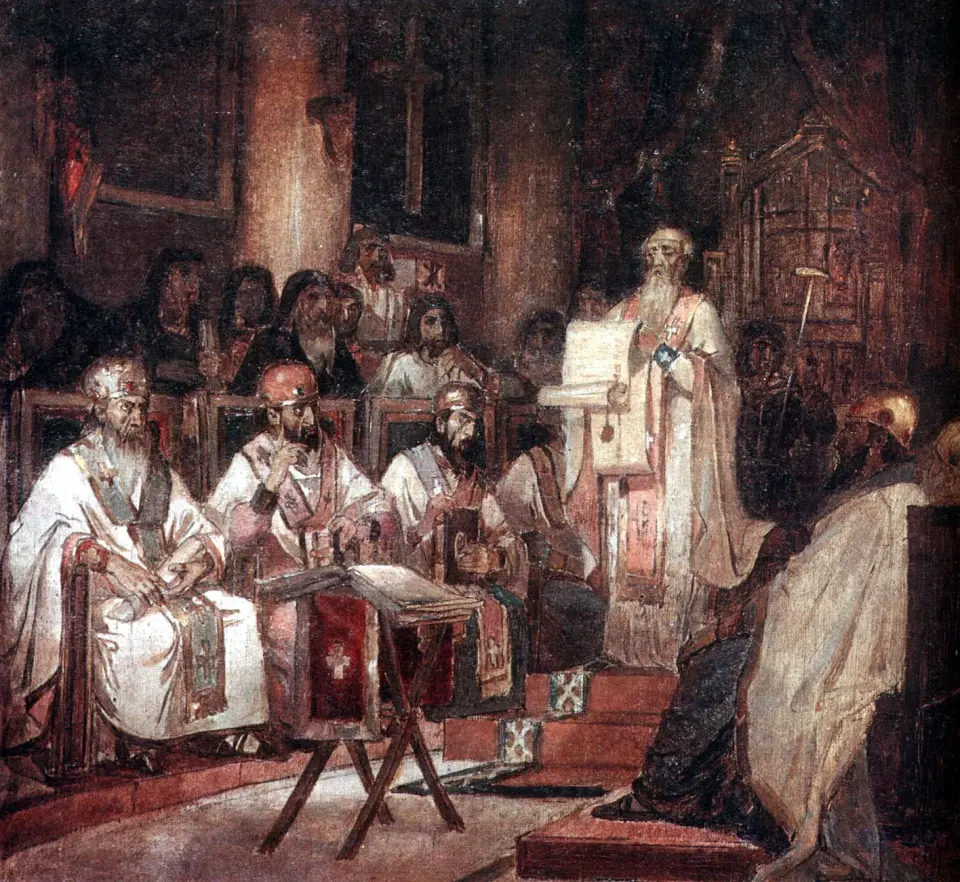
The Pneumatomachi, later associated with the name of Macedonius, accepted the Nicene Creed and the deity of the Son but held the Spirit to be a creature subordinate to the Son. Basil of Caesarea in his treatise On the Holy Spirit argued for the consubstantiality of the Spirit with the Father and the Son – from the baptismal formula of Matt. 28:19 (On the Holy Spirit 10), from the liturgical doxology "with the Holy Spirit" (ch. 1, 25–27) and from deification, which only God can bestow (ch. 9) – although he did not openly call the Spirit God; Gregory of Nazianzus was more outspoken. The Ecumenical Council of 381 in Constantinople, under Gregory's leadership, adopted the formula on the Spirit: "the Lord, the Life-giver, proceeding from the Father, glorified with the Father and the Son, speaking through the prophets." According to González, Basil helped turn the Arian question into a fully trinitarian one.
Positions
- Pneumatomachi, Macedonians
- The Nicene Creed and the deity of the Son are accepted; the Spirit is a creature of the Son, a ministering spirit or an "intermediate nature"
- Basil of Caesarea
- The Spirit sanctifies and is not sanctified; he is the fullness and source of gifts and therefore Creator, not creature; one must be baptized into the one Godhead of the Trinity
- Basil's opponents
- The doxology "with the Spirit" is an innovation placing the Spirit on the same level as the Father and the Son (On the Holy Spirit 1, 27)
- Gregory of Nazianzus
- Openly calls the Spirit God; the doctrine unfolded progressively: the Old Testament clearly proclaimed the Father, the New revealed the Son, and now the Spirit gives clearer knowledge of himself
- Marcellus of Ancyra
- The Spirit has no hypostasis of his own
Key points
- Pelikan: Gregory of Nazianzus (380) wrote that some regarded the Spirit as an activity, others as a creature, others as God, and "to be somewhat impious was considered piety"; Amphilochius (376) explained the silence of Nicaea by the fact that the question of the Spirit had not then arisen. The soteriological argument was decisive (Cyril): the Spirit who makes us God cannot differ from God in nature.
- Berkhof: the word "consubstantial" is not used of the Spirit in the formula of 381
- Hall: Chalcedon (451) treated the Creed of Constantinople as the same Nicene Creed with additions against "those who attack the Holy Spirit"
- Lebedev: the council was first presided over by Meletius of Antioch; the 36 Macedonian bishops agreed on almost everything except “consubstantial”, but in his view the Holy Spirit was not discussed with them, and in the creed the Spirit is not explicitly called God
- Barnes: Latins called the Spirit ‘one in substance’ before Greeks: Potamius of Lisbon wrote c. 360 that ‘the substance of Father, Son and Holy Spirit is one’, whereas no Greek c. 360 called the Spirit homoousios – for Athanasius homoousios was a one-way predicate (Son with Father, not the reverse). Ignorant of this technicality, the Latins freely said that Father, Son and Spirit were of one substance; Marius Victorinus and Hilary first described the Spirit within the Trinity, and Ambrose’s On the Holy Spirit follows Niceta and Didymus the Blind.
- Anatolios: Constantinople (381) declared the Spirit’s divinity not by homoousios but through worship: ‘co-worshipped and co-glorified with the Father and Son’. Defenders of the full divinity of Son and Spirit tied the shareability of divine being to human deification through baptism and the Eucharist, while those who rejected ontological continuity within the Trinity described the sacraments as glorifying God and acquiring knowledge of him.
Outcome
The council of 381 adopted the formula on the Spirit and condemned the Pneumatomachi; the deity of the Spirit was fixed in the creed, and liturgical practice became an argument in dogmatic debate.
People
- Basil of Caesarea
- Gregory of Nazianzus
- Amphilochius of Iconium
- Macedonius of Constantinople
- Eustathius of Sebaste
- Didymus the Blind
- Ambrose of Milan
- Hilary of Poitiers
- Potamius of Lisbon
- Niceta of Remesiana
Terms
- Pneumatomachi – pneumatomachoi
- "Enemies of the Spirit", who denied the equality of the Holy Spirit with the Father and the Son.
- deification
- The essence and final goal of salvation for the Greek Fathers: participation in the divine nature through union with Christ, becoming like God. "The Word became man so that we might be made divine."
Place
Asia Minor, Caesarea in Cappadocia, Constantinople
Sources disagree
Hall: the Macedonians from 360, turmoil in the 370s, condemnation at the council of 381; Lane: c. 370–381; González does not date Basil's treatise; Pelikan: Amphilochius's letter – 376, Gregory's words – 380; the council – 381 (Berkhof). Lebedev: the council – May–July 381.
Sources
Primary sources
- Basil the Great – On the Holy Spirit, ch. 1, 9–10, 25–27
Textbooks
- Stuart G. Hall – Doctrine and Practice in the Early Church (Russian edition), p. 101–102, 151–152
- A. P. Lebedev – History of the Ecumenical Councils, part I, p. 83–94, 103–113, 115, 119, 121–125, 153–154, 311
- Jaroslav Pelikan – The Christian Tradition: A History of the Development of Doctrine, vol. 1 (Russian edition), p. 224–226, 229–231
- Louis Berkhof – History of Christian Doctrines (Russian edition), p. 60–61
- Justo L. González – A History of Christian Thought in One Volume (Abingdon, 2014), p. 136, 144
- Tony Lane – Christian Thinkers (Russian edition), p. 45
- The Cambridge Companion to the Trinity, ed. Peter C. Phan (2011), p. 90
- The Oxford Handbook of Sacramental Theology, ed. Hans Boersma, Matthew Levering (2015), p. 183
Related entries
- Grew out of: Athanasius, Letters to Serapion: The Deity of the Holy Spirit and the Synod of Alexandria (362) (359/360)
- Develops: The Nicene definition: "consubstantial with the Father" (325)
- Grew out of: The Cappadocians: "one ousia and three hypostases" and the charge of tritheism (second half of the 4th century)
In church history
- The Second Ecumenical Council of Constantinople (May–July 381)
Data compiled: 2026-11-17