1861–1918 · 19th century
Urban revivalism and the Social Gospel in the United States
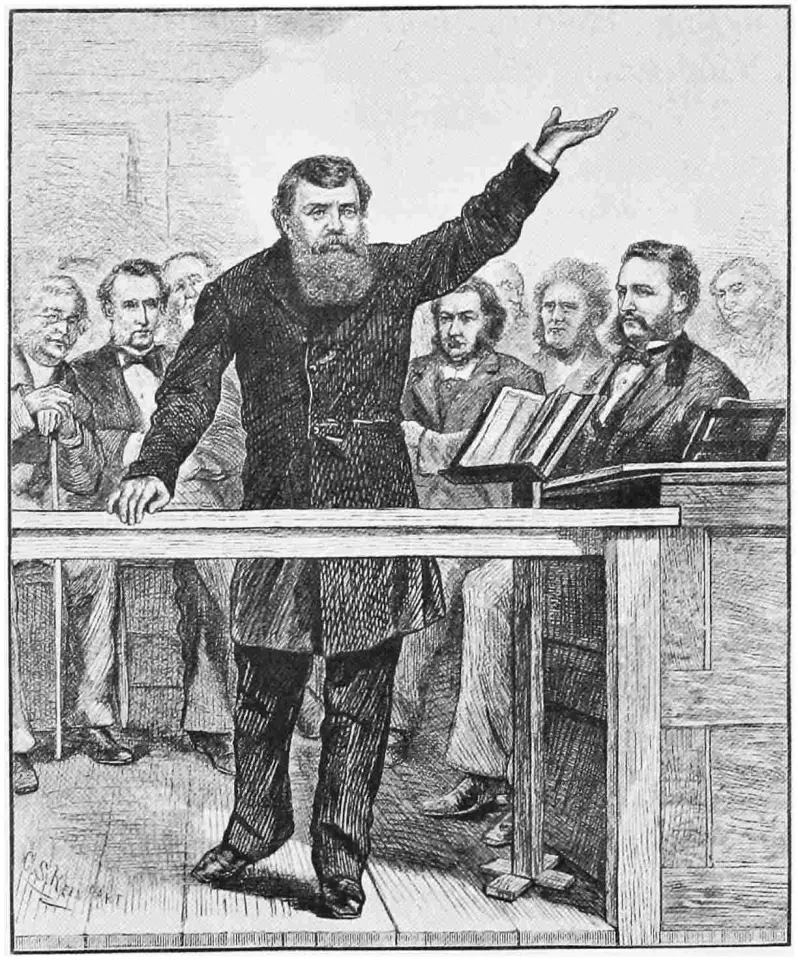
Responding to urban growth, Protestants built up the YMCA and Sunday schools. Dwight Moody left business in 1861 and became America's and England's leading urban evangelist. Later (1886) he inspired the founding of the Student Volunteer Movement. He was succeeded by the coarser Billy Sunday (converted 1886). Sunday's popularity faded by the 1920s amid the Scopes "monkey trial" (1925). In England, William and Catherine Booth founded the Salvation Army (1864).
Labor strikes in 1877, 1886, and 1892, along with rising social inequality, gave rise to the Social Gospel movement. Its leading theologian was Walter Rauschenbusch – a pastor in New York's slums, influenced by Ritschl. He taught the corporate nature of sin and the need to change social institutions in the name of the Kingdom of God. The movement was undercut by the collapse of liberalism after World War I and Rauschenbusch's death in 1918.
A different response to industrial wealth was Andrew Carnegie's "Gospel of Wealth" (1889). It urged the rich to give away their fortunes during their own lifetime.
Key points
- The YMCA, Sunday schools, and the Salvation Army (1864, W. and C. Booth)
- Dwight Moody (from 1861) and Billy Sunday (from 1886) – urban revivalism
- The strikes of 1877, 1886, and 1892 as a spur to the Social Gospel
- W. Rauschenbusch – corporate sin and the Kingdom of God as a just social order
- Andrew Carnegie's "Gospel of Wealth" (1889) as an alternative response to inequality
- Shelley: in the generation after the Civil War Moody was the chief city preacher, seeing his task as winning souls and preparing for the Second Coming. Beecher’s dream of a Christian America faded; more and more evangelicals cared only for the soul’s inner life. The brightest example of service to the disadvantaged was the work of the evangelical pietist William Booth (1829–1912). He began in the Methodist New Connexion but soon left it and worked among London’s poor; his street preaching in the East End in 1864 had phenomenal success. Within eleven years he founded thirty-two mission stations with Gospel preaching and social service among the destitute; his workers, organized on military lines, soon came to be called the Salvation Army (“the evangelical Booth became General Booth”). By 1888 the General had set up a thousand British corps and sent “patrols” to many other countries. In “In Darkest England and the Way Out” (1890) he likened English society’s darkness to the African darkness of Livingstone and cited London’s yearly figures: 2,157 found dead, 2,297 suicides, 30,000 in prostitution, 160,000 drunkards, 900,000+ below poverty line. The “Social Gospel,” the main US movement for social justice, united liberal Protestant pastors and theology professors; they created no notable organization but acted through existing denominations and political forces. Its core was the conviction that God’s saving acts concern corporate structures, not only individuals: if social good and evil are collective, Christians must act “in the name of rebuilding the social order”. Its ideas came from Moody-style revivalism and the dream of a moral Christian America: before the Civil War revival and reform went hand in hand, and Finney urged converts to a “crusade” against slavery. Other sources were the works of European Christian Socialists and the New Theology, the “progressive orthodoxy” of Andover Seminary as a common model of belief. The founding father of the Social Gospel was Washington Gladden (1836–1918); in 1876 he published the first of many books on it. He spent most of his years of influence at the First Congregational Church in Columbus, Ohio; his congregation had employers and employees, and he saw with alarm “the chasm between these classes widen”. In evening sermons Gladden addressed labor unrest, confident that Jesus' teachings contain the principles of right social order. He was no socialist and held to private property and enterprise, believing cooperation possible in many industries, but held that railroads, mines and city public-service organizations should operate under government control. The most influential prophet of the movement was Walter Rauschenbusch (1861–1918), a German-born Baptist: as young pastor in New York's poor “Hell's Kitchen” he sought a Christian answer to urban ills, later becoming a Rochester professor. His main books: Christianity and the Social Crisis (1907), Christianizing the Social Order (1912), A Theology for the Social Gospel (1917); he avoided the comforting doctrine of human progress and relied on the idea of the Kingdom of God. Social Gospel prophets saw capitalism as the chief social sin: individual salvation is impossible until the system changes; they differed on how much change was needed but agreed: “the Kingdom of God will not come without change”. The chief sign of the movement's influence on denominations was the founding of the Federal Council of Churches in 1908. One of the Council's first achievements was adopting the Social Creed of the Churches, which called for safety at work, protection of older workers, a minimum wage and the right to arbitration; many theological seminaries, responding to society's demands, redesigned their curricula. Such movements risked reducing the Gospel to mere social activism, yet reminded us that Christians cannot care for people's eternal destiny until they learn to protect their earthly needs.
- Holmes: Finney visited Britain twice in mid-century, but a native revivalist strand appeared only with Moody’s 1870s visits and never matched America’s.
- George: the evangelical consensus backed abolition, suffrage, temperance and child-labor laws; then came “the great reversal” (Moberg), a withdrawal.
People
- Dwight Moody
- Billy Sunday
- William Booth
- Catherine Booth
- Washington Gladden
- Walter Rauschenbusch
- Andrew Carnegie
- John D. Rockefeller
- Russell Conwell
Place
United States; England
Sources
- J. North – A History of the Church (Russian edition), p. 381, 382–386
- Justo L. González – The Story of Christianity, vol. II (Russian edition), Part 3, ch. 25–26
- Justo L. González – A History of Christian Thought, vol. III: From the Protestant Reformation to the Twentieth Century (Abingdon, rev. ed. 1987), p. 389–390
- Justo L. González – A History of Christian Thought in One Volume (Abingdon, 2014), p. 394, 396–397
- Stanley Grenz, Roger Olson – 20th-Century Theology: God and the World in a Transitional Age (Russian edition), p. 82–84
- Bruce L. Shelley – Church History in Plain Language (Russian edition), Ch. 39, sec. «Культурный шок христианской Америки»; Ch. 41, sec. «Вперед, солдаты христианства!»; Ch. 41, sec. «Социальное евангелие» в Америке
- The Cambridge Companion to Evangelical Theology, ed. Timothy Larsen and Daniel J. Treier (2007), p. 262, 292
More on the doctrine
- New forms of millennialism: postmillennialism, premillenarianism, the Social Gospel (17th – early 20th century)
Data compiled: 2026-11-09