1629–1672 · 17th century
The Confession of Cyril Lucaris and the Response of Dositheus: Scripture, Tradition, the Infallibility of the Church and Transubstantiation
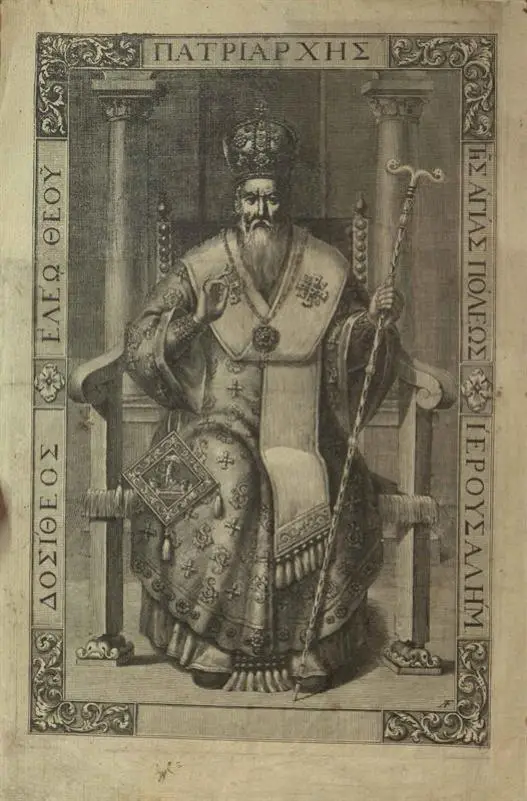
In the Eastern Confession of the Christian Faith (1629), Patriarch Cyril Lucaris combined the Orthodox dogmas on the Trinity and Christ with Protestant, especially Calvinist, tenets: Scripture is the infallible Word of God and above the authority of the Church, which can err; predestination, justification by faith and only two sacraments, with a spiritual presence in the Eucharist, while he called the Roman doctrine of transubstantiation false. The Council of Constantinople of 1638 anathematized Cyril, and the Council of Iași of 1643 condemned the Confession for Calvinism. The response came in the Eastern confessions of the 17th century, above all the Confession of Dositheus, approved by the Synod of Jerusalem in 1672: the witness of the catholic Church "has no less authority than the divine Scripture," since the author of both is one and the same Holy Spirit, and the Church cannot err. On the Eucharist Dositheus (article 17) proclaimed that after the consecration the bread "is changed, transformed, transubstantiated into the true body of the Lord himself," so that only the appearance and form of bread and wine remain. The Eastern confessions took the number of seven sacraments from late scholasticism and for the real presence used the term metousiosis, corresponding to the Latin "transubstantiation," while keeping reticence about the mode of presence.
Positions
- Cyril Lucaris
- Two sacraments; Christ is present in the Eucharist for the believer, spiritually; transubstantiation is false; two sacraments, Christ is present in the Eucharist for the believer, spiritually; transubstantiation is false
- Lucaris's opponents
- He is a "thief and a Lutheran," his teaching an innovation with respect to the East
- Dositheus and the Synod of Jerusalem (1672)
- To be taught by Scripture and by the catholic Church is one and the same; the Spirit teaches through the fathers, so the Church cannot err (points 2, 12); the bread is transubstantiated into the true body of the Lord, only the appearance and form of bread and wine remain
- The councils of 1638 and 1643 (according to Pelikan)
- Appealing to Scripture without interpretation by the fathers and Tradition was declared alien to the East
Key points
- González: Lucaris ascended the patriarchal throne seven times and was killed in 1638; he was venerated as a martyr. Some called his Confession a forgery, and the Synod of Jerusalem condemned Lucaris conditionally – "if he really was a Calvinist heretic"
- Pelikan: the response to Lucaris and to Trent was the official recognition of the biblical canon – for the first time in many centuries. In the confessions’ teaching on the Church he finds an echo of Latin ecclesiology, but the Church was not identified with a juridical corporation; Eastern sacramental theology acquired scholastic formulas
- Kritopoulos: the Church is the bride and body of Christ
- Lane: the Confession of Dositheus answered the eighteen chapters of Cyril's Confession point by point in eighteen articles
- The confessions distinguished the veneration of icons (time) from the worship of the Eucharist (latreia)
- Butcher: Jeremias II (1576) affirms the seven sacraments with scholastic precision: matter, form, instrumental cause; the Spirit changes the bread into Christ’s body by “epiclesis and grace,” not by the body descending from heaven; he prizes the Liturgy: hymns and readings prepare the soul for the gifts, and the rite sets the work of redemption before the eyes. Critopoulos (1625) sees the sacraments as pledges of predestination and sets up a triad: baptism, Communion, penance; he defends leavened bread and infant Communion; how the gifts change “is unknown to us and cannot be explained”; he lists a sevenfold clerical order (with door-keeper and exorcist), confession to a spiritual father, and unction. Lucaris (1629) admits two sacraments, requires the recipient’s faith, and rejects “arbitrarily invented” transubstantiation. Dositheus’ Synod of Jerusalem (1672) calls the bishop “a fountain of all the sacraments” and teaches their efficacy ex opere operato; Dositheus teaches transubstantiation (μετουσίωσις), concomitance and latria of the gifts, yet treats it as mystery, not explanation. Eugenios Bulgaris and the Horos of Cyril V (1755) reject Latin baptism; the 1875 Letter admits oikonomia. Nicolas Bulgaris’ Catechism justifies seven sacraments by analogy with bodily life and analyzes them by scholastic causes. Nicodemus the Hagiorite’s Pedalion (1800) holds extra ecclesiam nulla salus: Latin baptism is “falsely called baptism”; only a first marriage is sacramental, remarriage is a concession, and “defilement” bars from Communion.
Outcome
Lucaris's Confession was rejected, and Eastern doctrine gained confessional clarity: the authority of Scripture is understood within Tradition, the witness of the Church is equal to Scripture, and the Church is infallible; Eastern Orthodoxy fixed the doctrine of transubstantiation and the seven sacraments.
People
- Cyril Lucaris
- Dositheus of Jerusalem
- Peter Mogila
- Metrophanes Kritopoulos
- Jeremiah, Patriarch of Constantinople
- Eugenios Bulgaris
- Nicodemus the Hagiorite
Terms
- transubstantiation – metousiosis
- The change of the very substance of bread and wine into the substance of the Body and Blood of Christ by divine power; as a term, from the mid-12th century.
- effective instruments – organa drastika
- The definition of the sacraments in the Eastern confessions.
Place
Constantinople, Iași, Jerusalem
Sources disagree
Lucaris's Confession – 1629 (all books); his death – 1638; the councils – 1638 and 1643 (Pelikan); the Synod of Jerusalem and the Confession of Dositheus – 1672 (Lane). Pelikan does not date the confessions of Mogila and Kritopoulos precisely, placing the Eastern confessions in the 17th century.
Sources
- Jaroslav Pelikan – The Christian Tradition, vol. 2: The Spirit of Eastern Christendom (600–1700) (Russian edition), p. 432–440, 442–444
- Justo L. González – A History of Christian Thought in One Volume (Abingdon, 2014), p. 405–406
- Justo L. González – A History of Christian Thought, vol. III: From the Protestant Reformation to the Twentieth Century (Abingdon, rev. ed. 1987), p. 423–425
- Tony Lane – Christian Thinkers (Russian edition), p. 86–87
- The Oxford Handbook of Sacramental Theology, ed. Hans Boersma, Matthew Levering (2015), p. 398–399, 399, 399–401, 401–402, 402–403, 404, 405–406, 409–410, 410–411, 411–412, 412–413, 413, 413–414, 398
Related entries
- Develops: The Fourth Lateran Council: transubstantiation and obligatory confession (1215)
- Response to: The Council of Trent on Scripture and Tradition (Fourth Session, 1546) (April 8, 1546)
In church history
Data compiled: 2026-11-17