1215 · 13th century
The Fourth Lateran Council: transubstantiation and obligatory confession
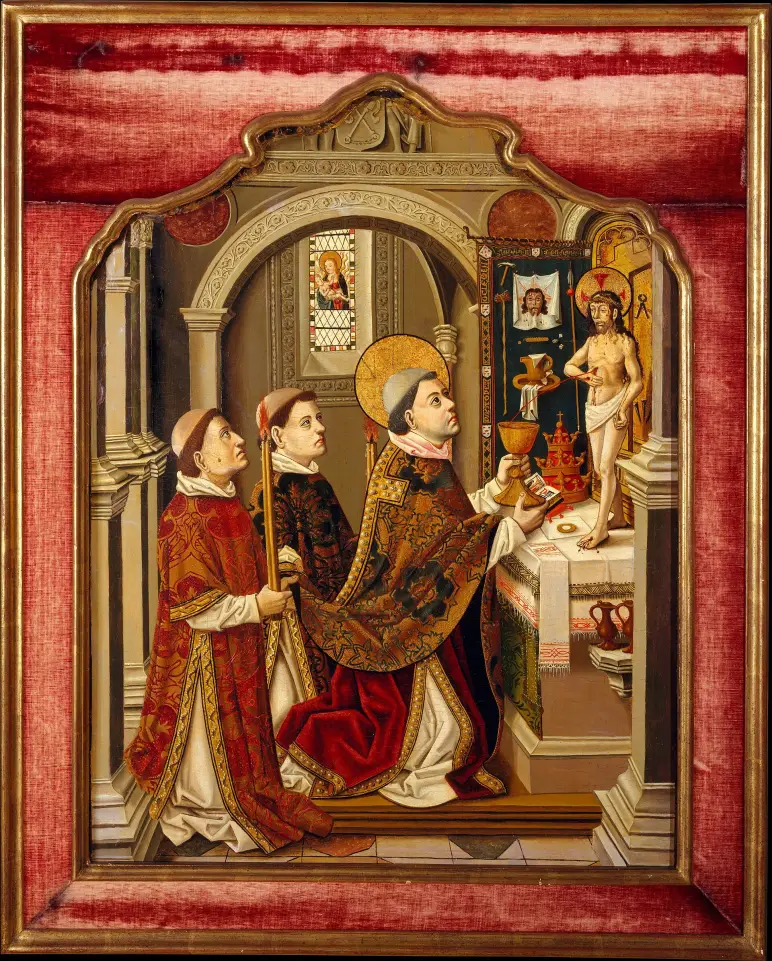
The Fourth Lateran Council (1215), convened by Innocent III, gave in canon 1 the first official definition of transubstantiation: the body and blood of Christ are truly contained in the sacrament of the altar under the appearance of bread and wine, the bread being transubstantiated into the body and the wine into the blood by divine power, and only a duly ordained priest can perform the sacrament. The council also required all the faithful to confess to a priest and to receive communion at least once a year, and protected the seal of confession (canon 21). Thomas Aquinas developed the doctrine by means of the Aristotelian distinction between substance and accidents: the substance of bread and wine is wholly converted, while the outward properties remain. In 1379–1380 Wyclif rejected transubstantiation as a recent innovation, philosophically incoherent and contrary to Scripture.
Positions
- The theory of coexistence (per Lane)
- The substances of bread and wine remain together with the body and blood; Thomas held it to be heresy (Summa Theologiae III, q. 75, a. 2)
- The theory of annihilation (Duns Scotus, per Lane)
- The substances of bread and wine are annihilated and replaced; Thomas rejected it: the bread is not annihilated but changed into the body of Christ (Summa Theologiae III, q. 75, a. 3)
- Thomas Aquinas
- The substance is wholly converted into the body and blood, only the "accidents" remain; Christ is not present "locally"
- Wyclif
- The bread remains bread and the wine wine; the body of Christ, physically in heaven, is present spiritually, as the soul in the body; he equated the denial of real bread with Docetism
- William of Ockham (per Levy)
- Consubstantiation is preferable but rejected on the authority of the canons; the bread is reduced to its existence in God’s power; Christ’s body is present “definitively,” without extension in the host; accidents without a subject
- William Woodford (per Levy)
- Conversion is a real transition of the bread’s substance into Christ’s body, in accord with the fathers and Lateran IV; the bread is not annihilated but remains in proximate potential; the words of institution are recitative
- Thomas Netter (per Levy)
- Transubstantiation is a single “wonderful conversion” of whole into whole, not an annihilation of the bread; it is the ancient faith of the apostles and fathers
Key points
- The council proclaimed the eucharistic sacrifice, condemned Joachim of Fiore’s Trinitarian teaching, vindicated Peter Lombard and forbade clandestine marriages
- González: in three sessions the council approved a program devised by the pope and the curia
- McGrath: the council firmly established the priest and the penance as part of a process in which God forgives sins through human representatives
- The hiding of the body under the appearance of bread is, according to Thomas, wise (Summa Theologiae III, q. 75, a. 5): it is "not customary, but horrible" for people to eat human flesh, the sacrament is not derided by unbelievers, and it redounds to the merit of faith
- Pelikan: the definitions did not canonize Aristotle’s philosophy in principle, but in practice this happened
- The Council of Trent in 1551 called the term “transubstantiation” correct and appropriate
- Wyclif held that before 1215 the tradition of Ambrose, Augustine and even Berengar affirmed that the bread and wine remain; his views were spread by the Lollards
- Scase: for Aquinas the accidents remain because quantity takes the place of substance; for Scotus, by miracle. Citing Scripture and the Fathers, Wyclif denied that accidents can exist without substance (the material world might then not exist) and reconciled real presence with denying transubstantiation: the host is both sign and presence of Christ’s body, co-existing ‘sacramentally’. Eucharistic doctrine was codified only at the Council of Constance, after Wycliffe’s death, as a reaction to his teaching; the Lollard Tractatus de oblacione iugis sacrificii (1413–14) calls accident, substance and transubstantiation “Antichrist’s language”.
- Bagchi: against the Unklarheit theory, transubstantiation, endorsed by Lateran IV, produced no united Catholic front against its detractors. Schatzgeyer refused the term – presumably because it dated only from the 13th century and was not traditional – and saw it as explaining the mystery of the real presence in scientific terms; his position was indistinguishable from Luther’s.
- Wawrykow: Lateran IV (1215) required every Christian to confess to a priest and receive communion at least once a year (canon 21). The sacraments marked Catholics off from other ‘Christians’: material elements rejected the Cathar contempt for matter, and limiting consecration and absolution to the ordained (canon 1) restored Augustine’s anti-Donatist teaching against the Waldensian view that grace depends on the minister’s holiness. For Thomas (ST III, qq. 73–83) the priest consecrates as Christ’s representative (in persona Christi) and instrument (q. 78, a. 1), with the priestly seal received at ordination. The words of consecration are Christ’s, not the priest’s: they both change and describe (‘this is Christ’s body’; q. 78, aa. 4–5). The priest’s faith and holiness do not matter for Christ’s presence – the Church’s intention suffices; the chief cause of the change is Christ acting by the Spirit’s power through the priest and the words. Aquinas distinguishes sacramentum tantum (accidents of bread and wine), res et sacramentum (Christ) and res tantum (grace, love, the mystical body). The unbeliever and mortal sinner eat “sacramentally” (sign and Christ) without fruit; with faith and love one eats “spiritually” and grows in grace. Aquinas’s favourite name for the Eucharist is the “sacrament of love” (ST III, q.73, a.3, ad3). For Thomas the Eucharist is also a sacrifice: following Augustine he asks to whom, by whom, what and for whom it is offered. It recalls the Passion (same ‘what’, ‘to whom’: Christ, pleasing to God) and is made over the present ‘crucified Christ’ (ST III, q. 73, a. 5, ad 2). Its benefit reaches only those united to Christ by faith and love (q. 79, aa. 5, 7), yet it is offered for the living and the dead, including souls in purgatory, and presence at the liturgy is not needed for it to bear fruit. Aquinas first speaks in his Eucharist treatise of the laity’s “spiritual priesthood”: a righteous layman is joined to Christ by faith and love and offers spiritual sacrifices (Ps 51:17; Rom 12:1; 1 Pet 2:5) but lacks the priest’s sacramental power. The priest acts also “in the person of the whole Church”; the Mass’s worth depends on his piety and on the spirit of Christ’s Body (q.82, a.6; q.83, a.4).
- Levy: Lateran IV (1215) used “transubstantiation” to affirm priestly power and real presence against memorialism, but endorsed no single scholastic theory; its creed entered Gregory IX’s Liber extra (1234) as Firmiter. Canonists from John Teutonicus to Hostiensis held change, annihilation and coexistence all orthodox, subsuming them under “transubstantiation”. Franciscans and Duns Scotus saw conversion as a possible, not necessary, route to presence; Scotus chose it on the strength of the Lateran Council. Ockham (d. 1347), like Scotus, found coexistence more satisfactory but rejected it on the Church’s authority (Gratian, Firmiter, Cum Marthae). For him quantity is not a separate ‘thing’, so Christ’s body is wholly present under the whole host and each part, without being extended in it, and accidents exist without a subject by God’s power. In 1324 Ockham was summoned to the papal curia at Avignon. Wyclif (d. 1384) judged transubstantiation untenable: accidents without a subject are a “deception,” and annihilating bread would unravel creation. His teaching rested on remanence, the “remainder” of bread’s substance, and he explained presence by a christological analogy: as Christ is at once God and man, so the sacrament is at once bread (by nature) and Christ’s body (sacramentally). For Wyclif Christ’s presence is threefold – virtual, spiritual, sacramental; bodily the body is only in heaven, so he rejected coexistence too. Wycliffites (‘Lollards’) were united by rejecting transubstantiation; per Hornbeck, remanence is the chief mark of their doctrine, found throughout treatises and trial records. John Purvey called it a ‘new dogma’ caused by Satan’s release; William Sawtrey, burned in 1401, would die for ‘the true body of Christ in the form of bread’; Thorpe accused Aquinas of ‘accident without subject’. The Wycliffites were answered by Woodford (d. 1397), who defended conversion as a real change of the bread’s substance into Christ’s body and rejected annihilation, and by the Carmelite Thomas Netter (d. 1430): transubstantiation is one continuous passage of a substance into another, a ‘wondrous conversion’ in which the bread’s substance is improved; the Church teaches a ‘transfer of whole into whole, without destroying the bread’. Netter held this the ancient faith of the Fathers, taught, he believed, also by Innocent III (Doctrinale 2: 413–421).
- Shelley: Aquinas held the Eucharist the highest sacrament, a true sacrifice continuing Christ’s sacrifice on the cross and moving God to mercy. In the sacrament the ‘substance’ of bread and wine is miraculously changed into Christ’s real Body and Blood, appearance unchanged; Aquinas gives the classic statement of this doctrine, transubstantiation.
Outcome
Transubstantiation became the official dogma of the West and received a philosophical grounding in Thomas, and annual personal confession to a priest became the norm; Wyclif's denial of transubstantiation outlived him: both Luther and Calvin appealed to him (Lane).
People
- Innocent III
- Thomas Aquinas
- John Duns Scotus
- John Wycliffe
- Joachim of Fiore
- William of Ockham
- William Woodford
- Thomas Netter
Terms
- transubstantiation
- The change of the very substance of bread and wine into the substance of the Body and Blood of Christ by divine power; as a term, from the mid-12th century.
- substance and accidents
- In Aristotle's terms (in Thomas): the essence is converted, while the outward properties – appearance, taste, weight, smell – remain.
- seal of confession
- The prohibition on a priest's revealing sins heard in confession, on pain of deposition.
Place
Rome (the Lateran), Oxford
Sources disagree
All the books date the council to 1215; Lane places Thomas' eucharistic sections in the last years of his life (before 1274); Lane dates Wyclif's De apostasia 1379 and De eucharistia 1380, González c. 1380. Berkhof names Hildebert of Tours (1133) as the one who defined transubstantiation.
Sources
Primary sources
- Fourth Lateran Council – Canons, canon 1, 21
- Thomas Aquinas – Summa Theologiae, pt. III, q. 75, art. 2–3, 5
Textbooks
- Jaroslav Pelikan – The Christian Tradition: A History of the Development of Doctrine, vol. 1 (Russian edition), p. 54–55
- Justo L. González – A History of Christian Thought in One Volume (Abingdon, 2014), p. 243, 268
- Alister McGrath – Reformation Thought (Russian edition: «Theological Thought of the Reformation»), p. 151–152
- Tony Lane – Christian Thinkers (Russian edition), p. 117–119, 128–130, 138–139
- The Cambridge Companion to Reformation Theology, ed. David Bagchi, David C. Steinmetz (2004), p. 27–28, 28, 239
- The Oxford Handbook of Sacramental Theology, ed. Hans Boersma, Matthew Levering (2015), p. 270, 279–280, 280–282, 282–285, 278–279, 286–287, 289–290, 290–291, 292–293, 293–294, 294–295, 295–296, 297–298, 298
- Bruce L. Shelley – Church History in Plain Language (Russian edition), Ch. 20, sec. «Вершина познания»
Related entries
- Develops: The eucharistic controversies of the 9th–11th centuries: Radbertus and Ratramnus, Berengar and Lanfranc (9th–11th centuries)
- Rejects: Joachim of Fiore: the three ages of history and the expectation of the Age of the Spirit (1177–1202)
- Rejected in: Luther, The Babylonian Captivity of the Church: two sacraments and real presence without transubstantiation (1520)
- Developed in: The Council of Trent on the sacraments and the Eucharist: seven sacraments, ex opere operato, transubstantiation and the sacrifice of the Mass (1547–1562)
- Developed in: The Confession of Cyril Lucaris and the Response of Dositheus: Scripture, Tradition, the Infallibility of the Church and Transubstantiation (1629–1672)
In church history
- The Fourth Lateran Council (1215)
Data compiled: 2026-11-17