April 8, 1546 · 16th century
The Council of Trent on Scripture and Tradition (Fourth Session, 1546)
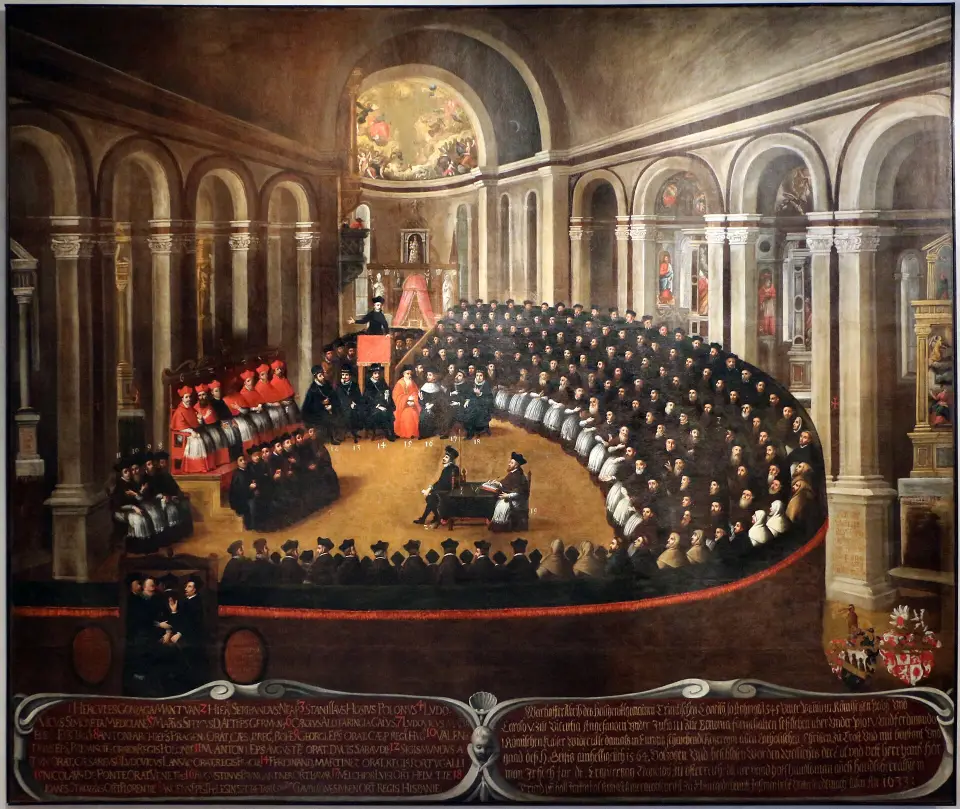
Responding to the principle of sola scriptura, the Council of Trent at its fourth session (April 8, 1546) placed tradition on a par with Scripture: the truth is contained "in the written books and in the unwritten traditions" received by the apostles from the mouth of Christ himself or from the apostles themselves, "the Holy Ghost dictating", and the council receives both with equal reverence. The council affirmed a complete list of canonical books, including the apocrypha, recognized the Vulgate as the authoritative text, reserved to the Church the right to judge the true sense of Scripture and forbade publications on the interpretation of Scripture without the approval of church authority. According to McGrath, the council thereby adopted the later medieval understanding of Tradition ("Tradition 2") – the two-source theory.
Positions
- Protestants
- Sola scriptura; the Old Testament canon is the books of the Hebrew Bible, the apocrypha are edifying but not for doctrine
- Council of Trent
- Scripture and traditions are received with equal reverence; the Vulgate is authoritative; interpretation belongs to the Church
- Lane
- Later "tradition" came to be understood as unwritten doctrinal propositions, although the decree was about rites and ceremonies (infant baptism, Sunday worship)
- Modern Catholic theologians (according to McGrath)
- The council did not assert that the Gospel is contained partly in Scripture and partly in Tradition
- Chemnitz; Calvin
- Trent departed not only from the faith of Scripture but also from early Christian tradition (Chemnitz); Calvin published the council's decrees with an "Antidote" (1547)
Key points
- Anathema on those who reject the canonical books "as they are read in the Catholic Church and contained in the old Latin Vulgate"
- McGrath: the dispute over the canon touched prayer for the dead – Catholics appealed to 2 Macc. 12:40–46; McGrath sees the price of this order in the long lag of Catholic biblical scholarship.
- Anonymous books on sacred matters were forbidden (Session IV: none may be printed without the author's name and the Ordinary's approval), such as the Beneficio di Cristo
- Lane: in his Disputations on the Controversies (1586–1593), Bellarmine gave one of the best expositions of Tridentine theology
- González: Báñez asserted that Scripture is "first of all in the heart of the Church and secondarily in books"; this did not become official teaching
- Bagchi: all Catholic writers before Trent rejected the Protestant elevation of Scripture over tradition: both came from one divine source. English writers (Henry VIII, More, Fisher, Powell) appealed to tradition on a par with Scripture; Schatzgeyer, leading first-wave continental polemicist, was accused of a Catholic sola scriptura, yet held to Scripture and tradition in agreement.
- Steinmetz: the fourth session (8 April 1546) reaffirmed the larger Old Testament canon with Sirach and Judith, which Protestants rejected as apocryphal, though they found many of them useful reading – Luther liked to quote Sirach 2:1. Rejecting these books would have cost the council dearly, since the later apocrypha supported the Catholic doctrine of purgatory. Trent declared the Vulgate authoritative for doctrine, while humanists and Protestants demanded recourse to the original languages. The same session decided that the truth is contained "in the written books, and the unwritten traditions" (the final text of the decree has no "partly… partly", partim-partim); both sources are offered to the faithful as equal in authority, and the council deliberately narrowed the question to unwritten apostolic traditions. The precedent was Augustine: infant baptism, lacking clear New Testament texts, showed Scripture and tradition complementing each other. The last point of the fourth session forbade private interpretation of the Bible – any, by individuals or groups, clashing with Church teaching: the right to judge “the true sense and interpretation of the holy scriptures” belongs to the Church alone, and contraveners are to be made known by their Ordinaries and "punished with the penalties by law established". Reformers who rejected unwritten traditions kept ancient tradition: they claimed to be “older than you” and more Augustinian on sin and grace, held that the Middle Ages brought innovations, and published patristic anthologies to support their views on the Eucharist and justification. For them tradition guided interpretation of Scripture but was no source equal to Scripture; infant baptism had to be defended exegetically. In the Antidote (1547) Calvin, citing Rufinus and Jerome, called the Apocrypha ‘ecclesiastical’, not canonical, books: no doctrine may rest on them. The decision for the Vulgate astonished him; he listed translation errors (Pss. 2, 32, 132) and recalled that God's oracles were delivered by Moses and the prophets in Hebrew and by the apostles in Greek (Antidote, pp. 55–58), accepting the humanist priority of the originals without discussion and without raising the difficulties of the Greek and Hebrew texts. Calvin objected that many ‘apostolic traditions’ were medieval novelties: scripture holds all ‘necessary and useful’, tradition is commentary. He feared the Church would justify later novelties as unwritten apostolic traditions that only it may judge, with no norms named; for him poor exegesis signalled groundless teaching claims: ‘apostolic succession must be accompanied by apostolic success’.
- Shelley: Protestants held Scripture the sole authority in religion, while the Council insisted on the teaching of the Church, popes and bishops; so Trent secured for modern Catholicism the idea of the “cooperation” of God and man.
Outcome
Tradition was placed on a par with Scripture, and the canon with the apocrypha, the Vulgate and ecclesiastical interpretation were fixed; the Catholic and Protestant canons diverged, and the meaning of the decree was still debated after the Second Vatican Council.
People
- Martin Chemnitz
- John Calvin
- Robert Bellarmine
- Domingo Báñez
Terms
- two-source theory
- Faith and doctrine are based on Scripture and oral Tradition as independent sources of equal authority.
- Vulgate
- The common, generally accessible Latin translation of the Bible; the old Latin edition of Scripture recognized by the council.
Place
Trent
Sources disagree
The council – 1545–1563 (González); the decision on Scripture and tradition – 1546 (Lane, McGrath), the fourth session ended on April 8, 1546 (McGrath). González does not date the session separately.
Sources
Primary sources
- Council of Trent – Decree of the Fourth Session on the Canonical Scriptures (1546), session 4
- Calvin – Acts of the Council of Trent with the Antidote (1547), p. 55–58
Textbooks
- Justo L. González – A History of Christian Thought in One Volume (Abingdon, 2014), p. 343, 348–349
- Justo L. González – A History of Christian Thought, vol. III: From the Protestant Reformation to the Twentieth Century (Abingdon, rev. ed. 1987), p. 219–221, 242–243, 256–257
- Alister McGrath – Reformation Thought (Russian edition: «Theological Thought of the Reformation»), p. 21, 207–208, 214–215, 226–227
- Tony Lane – Christian Thinkers (Russian edition), p. 218, 222
- The Cambridge Companion to Reformation Theology, ed. David Bagchi, David C. Steinmetz (2004), p. 236, 246–247, 247–248, 248–249, 249–250, 256–257, 257–258
- Bruce L. Shelley – Church History in Plain Language (Russian edition), Ch. 28, sec. «Облик современного католичества»
Related entries
- Response to: Sola Scriptura: The Formal Principle of the Reformation and the Dispute over the Right to Interpret Scripture (1520s)
- Develops: "Tradition 1" and "Tradition 2" in the Late Middle Ages (after Oberman) (14th–15th centuries)
- Answered by: The Confession of Cyril Lucaris and the Response of Dositheus: Scripture, Tradition, the Infallibility of the Church and Transubstantiation (1629–1672)
In church history
- The Council of Trent (1545–1563)
Data compiled: 2026-11-17