1147–1151 · 12th century
The seven sacraments: from Hugh of St Victor and Peter Lombard to the Council of Florence
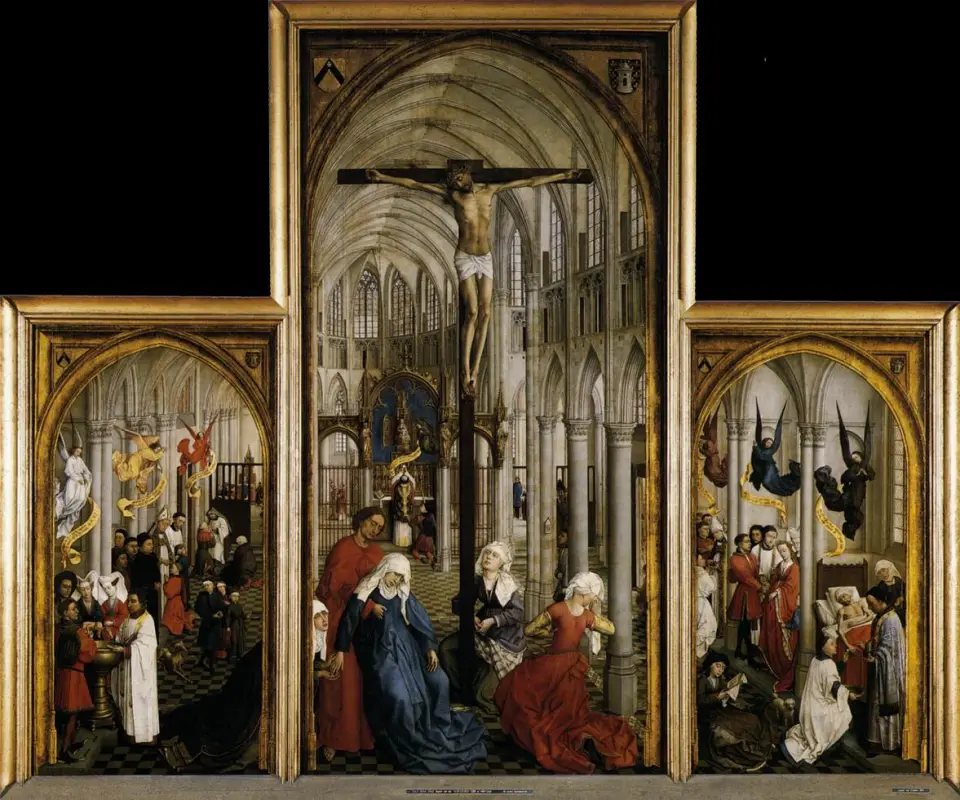
In the first centuries the word sacramentum was applied to everything sacred, and the number of sacraments ranged from two to twelve, and among the scholastics from five to thirty. Hugh of St Victor defined a sacrament as a material element that "represents by likeness, signifies by institution and contains by consecration" invisible grace, and concentrated on seven rites. Peter Lombard in the Sentences (1147–1151) was the first to draw up a list of seven sacraments and defined a sacrament, following Augustine, as "the visible form of invisible grace," which both signifies and causes grace. Thomas Aquinas accepted the number seven as the tradition of the Church, although according to González it had become fixed only recently. In 1439 the Council of Florence in the Decree for the Armenians defined the seven sacraments conciliarly for the first time.
Positions
- Bonaventure, Durandus, Duns Scotus (per Berkhof)
- The sacraments do not contain but only symbolize grace; God promised to accompany them with a direct action of grace
- Hugh of St Victor, Thomas Aquinas (per Berkhof)
- Grace truly resides in the sacrament as a spiritual power produced by the words of institution; this view was adopted by the Church
- Robert Kilwardby and others (per Wawrykow)
- The sacraments are only the occasion without which God, by his pact, does not give grace (sine qua non causality); grace itself is caused by God alone
- Thomas Aquinas (per Wawrykow)
- The sacraments are instrumental efficient causes of grace, dependent on God as principal cause; the recipient has no share in the causality, but his disposition determines the fruit
Key points
- The seven sacraments: baptism, confirmation, Eucharist, penance, extreme unction, ordination, marriage
- Lombard: the sacraments were instituted for humility, instruction and exercise; God can give grace without the sacraments
- McGrath: the early Church distinguished two "dominical" sacraments – baptism and the Eucharist; Augustine saw an allegory of them in the Samaritan's two coins
- Decree for the Armenians: the sacraments of the New Law not only contain grace but confer it on those who receive them worthily
- Decree for the Armenians: baptism, confirmation and ordination leave an indelible mark and are not repeated
- Lane: no definition can be framed that would justify including just these seven and excluding other rites
- Ferguson: anointing of the sick was first called a sacrament in the 9th century and counted among seven by the Lombard; Origen cited James 5:14–15 for penance. The early Church believed God works through material means but denied any automatic link between grace and the means
- Coolman: by the 12th c. sacramentum narrowed to consecrated material elements; the Lombard defined it as “sign of grace” and its “cause”, and Simon of Tournai and Ralph Ardens added “sacred” to distinguish New Testament sacraments from Old Testament ones. The same century initiated the idea that a sacrament is composed of “matter” and “form” – the material element and the words of institution: water is just water, but with the invocation of the Trinity it can become the sacrament of baptism. The threefold scheme after Augustine: sacramentum tantum (appearance), res et sacramentum (Christ’s presence), res tantum (fruit) – spiritual grace and the unity of the Church; real presence is necessary but without grace “of no benefit”. The terms probably first appear in the Summa sententiarum; the Lombard and Innocent III (Cum Marthae, 1202) took them up; Berengar spurred them. The Eucharist becomes the “center of gravity” of the sacraments, laying the base for Thomas’s view of it as perfecting the other six. Baptism was understood through Christ’s presence as “common baptizer”; per Bandinus it is equally good from a good or a bad priest. Damian put the Spirit in the sacrament’s definition, Honorius Christ’s paschal mysteries in the baptized’s experience, the Lombard the Trinity’s work and union with Christ. The Lombard has “three anointings”: chrism, of catechumens and newly baptized, and of the sick with oil; confirmation belongs to bishops. The anointing of the sick passed from laity to clergy, brought bodily and spiritual benefit, and unlike confirmation could be repeated. By the late 12th c. private confession to a priest became the norm; the Lombard named three parts of penance – contrition, confession, satisfaction; Abelard stressed contrition, Gratian confession; in the threefold scheme outward penance is “sacrament only,” absolution “reality only”. The Lombard calls orders sacraments “because a sacred thing is conferred in the receiving of them, that is, grace”; the seven spiritual offices (door-keeper to priest) were correlated with events in Christ’s life and the sevenfold grace of the Spirit, while only deacon and priest were “holy orders” in the narrower sense, following the Council of Benevento of 1091. By the end of the century, perhaps under eucharistic influence, the idea of a “mark” (character) left in the soul by certain sacraments appears; in the Lombard it is connected with ordination. Hugh of St. Victor and the Lombard gave marriage more attention than any other sacrament – it alone was instituted before the Fall. Hugh saw in it a sacrament of the spiritual union of God and the soul and the bodily union of Christ and the Church in the Incarnation; Peter of Poitiers explained why marriage does not effect what it signifies: it is older than all sacraments, instituted in paradise
- Wawrykow: 13th-century scholastics, from the Lombard, defined a sacrament as cause and sign of a sacred reality and counted seven. The common image is the sacrament as “medicine”: baptism drives out sin’s sickness, penance restores health, confirmation and Eucharist sustain it. Bonaventure names four causes of a sacrament (efficient – divine institution), yet the efficient cause was usually central. A sacrament’s chief effect is grace; baptism, confirmation and ordination also leave a “character” and so are not repeated. Baptism is normally by an ordained priest, but in emergency, per the scholastics (Lateran IV, canon 1), a layperson, even a non-Christian, can baptize: it suffices that by words and action the baptizer intends what the Church intends, even without personal belief. The threefold formula (sacramentum tantum, res et sacramentum, res tantum) also fitted baptism: washing, character, grace and union with Christ’s body. Everyone receives the first two, so character sacraments are not repeated; a mortal sinner receives the res tantum “fictively” (ficte). Scholastics agreed a sacrament’s grace does not depend on the recipient’s faith, yet not everyone gets it; the minimum is placing no obstacle (obex): mortal sin blocks grace as drawn shades block the sun; fuller is living faith formed by love, in infant baptism the Church’s faith. Kilwardby saw the cause of sacraments in God’s will: he made a “pact” (pactum) to bind grace to signs, and sacraments are only an occasion. Thomas held sacraments instrumental causes of grace: Christ’s humanity a conjoined instrument, the sacrament a separate one, all subordinate to God
- Avvakumov: Byzantine theology had no concept like sacramentum (“mystērion” did not become a liturgical term), nor a “scholastic” treatise on the sacraments as in Latin universities, so no “sacramental theology”. Theodore Studite (early 9th c.) names six: baptism, communion, chrismation, ordination, tonsure, burial; the monk Job the Sinner (probably late 13th c.) lists seven, including tonsure and “anointing of the sick, or penance”. Symeon of Thessalonike (d. 1429) counts the Latin seven but treats tonsure as penance, with another septenarium of episcopal rites; Metropolitan Joasaph of Ephesos in the 1430s: “there are not seven mysteries of the Church, but more” (he named ten). The Byzantines were on their own path to a septenarium but did not fix it; seven mattered more as “the church of seven councils” (Photios). Byzantine sacramentality centres on a holy thing uniting the visible and the spiritual; the mysteries are twofold (Symeon of Thessalonike). The sacramental area included more than six or seven rites: consecration of chrism and temple, the cross, icons, relics – on an incarnational basis. The Synodicon of Orthodoxy in one breath condemns the Bogomil rejection of baptism, cross, Eucharist, icons and churches: the Bogomils called baptism “just water”, communion “mere bread and wine”, the cross “a gallows”, icons “works of men’s hands”. Marriage is not treated this way in the Synodicon and held far less place in Byzantine theology than holy images. Constantine V’s Inquiries accused the iconodules of undermining the Eucharist as the only true image of Christ. Byzantine theology was closely tied to monasticism, and monk-theologians long sought to count monastic tonsure among the mysteries, while Michael Glykas in the twelfth century protested against the claim that tonsure, like baptism, remits sins. The monk-“commentator” (Symeon of Thessalonike: ritual purity, allegory) differs from the “enthusiast” (Symeon the New Theologian: personal purity); the “imperial” line (Photios, Theodoros Balsamon) saw rituals as tools for maintaining orthodoxy and order, and so was closer to Western scholasticism with its “substance” and “accidents” of a sacrament. There was tension between the monastic and imperial lines, but they joined efforts mostly to identify and condemn heresies, and intolerance could then be extremely high: iconoclasm (9th c.), the attack on dualists (10th–12th), persecution of Lyons-union defenders (13th) and of Palamas’s adversaries (14th)
- Shelley: Thomas Aquinas, following the Lombard, held seven sacraments; penance, the sacrament of spiritual healing for sins after baptism, consists of contrition, confession to a priest as spiritual physician, and satisfaction (penance)
Outcome
The sevenfold system of sacraments became the norm of medieval theology and of the Roman Catholic Church; the Council of Florence officially adopted it in 1439, and the Reformers later called it into question.
People
- Hugh of Saint-Victor
- Peter Lombard
- Thomas Aquinas
- Bonaventure
- John Duns Scotus
- Otto of Lucca
- Peter Damian
- William of Auxerre
- Robert Kilwardby
Terms
- sacrament – sacramentum
- The sign of a sacred thing, the visible form of invisible grace, having causal power (Augustine, Peter Lombard). In the pre-Nicene period, a broad notion that covered much more than the later "sacraments".
- matter, form, intention
- According to the Decree for the Armenians: things are the matter, words the form, and the third element is the minister's intention to do what the Church does.
Place
Paris, Florence
Sources disagree
Lane dates the Sentences 1147–1151; González gives Lombard's active years as c. 1130–1159; McGrath speaks only of consolidation "by the end of the 12th century"; the Council of Florence adopted the seven sacraments in 1439 (Berkhof, Lane).
Sources
- Louis Berkhof – History of Christian Doctrines (Russian edition), p. 178–179
- Justo L. González – A History of Christian Thought in One Volume (Abingdon, 2014), p. 222–224, 256
- Alister McGrath – Reformation Thought (Russian edition: «Theological Thought of the Reformation»), p. 83
- Tony Lane – Christian Thinkers (Russian edition), p. 117–118, 142–143
- The Oxford Handbook of Sacramental Theology, ed. Hans Boersma, Matthew Levering (2015), p. 179, 252, 253, 253–255, 256–258, 258–260, 261–262, 263, 264–266, 252–254, 259, 267, 271–273, 273–274, 277, 274, 274–275, 276–277, 275–276, 275, 306–307, 310–312, 312–314, 314–315
- Bruce L. Shelley – Church History in Plain Language (Russian edition), Ch. 20, sec. «Вершина познания»
Related entries
- Rejected in: Luther, The Babylonian Captivity of the Church: two sacraments and real presence without transubstantiation (1520)
In church history
- Peter Lombard's 'Sentences' and the Rise of the Universities (1090s–mid-13th century)
Data compiled: 2026-11-17