1781–1788 · 18th century
Kant: The Critique of Pure Reason, the Limits of Knowledge and the Religion of Practical Reason
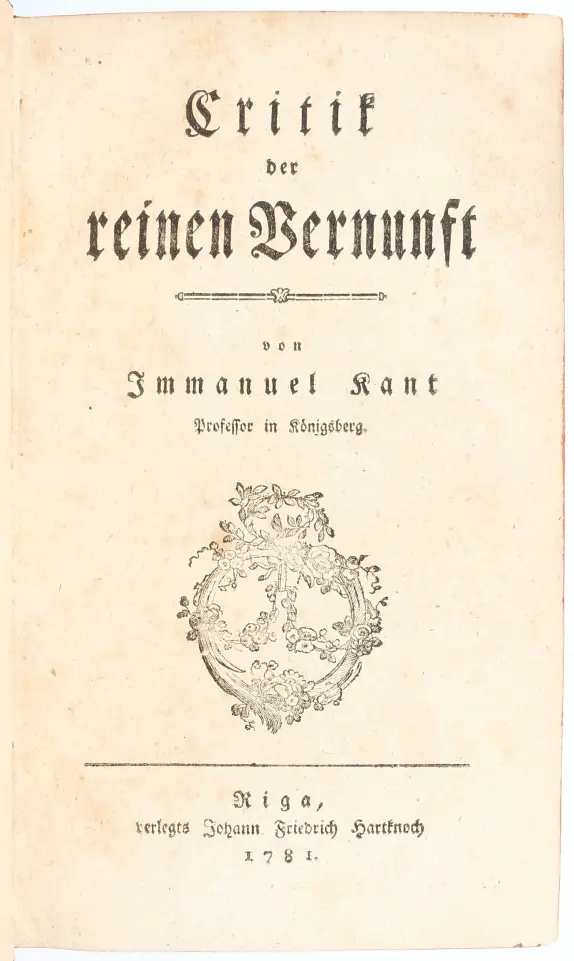
The Enlightenment made reason, nature and autonomy the court of final appeal; British empiricism found expression in deism, but Hume, by showing that experience yields neither causality nor substance, undermined its arguments. Awakened by Hume (in the Prolegomena, preface, Hume "first interrupted my dogmatic slumber"), Kant argued in the Critique of Pure Reason (1781) that the mind orders the data of experience by its own structures – space, time and the categories; phenomena are given to us, while the "thing in itself" is inaccessible. God, immortality and freedom passed beyond theoretical knowledge ("I must, therefore, abolish knowledge, to make room for belief" – preface to the 2nd ed. of the Critique of Pure Reason) and were grounded in practical reason as its postulates (Critique of Practical Reason, 1788, book II, ch. 2, sect. 4–5). Grenz and Olson write that theology became derivative of morality. González sees three paths after Kant: another basis for religion, a return to revelation, Hegel's idealism.
Positions
- The deists
- Natural religion is rational; special revelation is superstition
- Hume
- Experience does not yield causality (events "seem conjoined, but never connected" – Enquiry Concerning Human Understanding 7.2) and substance – the arguments of deism are not so rational
- Kant
- The data come from experience, but the mind has necessary structures; religion is based on practical reason
- Paths after Kant (González)
- Ritschl and Schleiermacher – another basis for religion; Kierkegaard and Barth – a return to revelation; Hegel – rationality as the nature of things
Key points
- "Have the courage to use your own understanding!" – the motto of the Enlightenment according to Kant
- The "Copernican revolution": reason is given the central place in the theory of knowledge
- "I found it necessary to deny knowledge in order to make room for faith" (2nd ed.)
- The traditional proofs of God's existence lost their force; the end of superficial rationalism and deism
- Grenz and Olson: the transcendent God "was lost in the shadow of the categorical imperative"
Outcome
The main question of 19th-century theology, according to González: how to understand the place of Christianity when reason has come to doubt its own presuppositions.
People
- Immanuel Kant
- David Hume
- John Locke
Terms
- phenomena and noumena
- Objects of perception and the "thing in itself," inaccessible to experience.
- practical reason
- The moral sphere of human life and the moral values inherent in it.
- categorical imperative
- A principle of action that we would wish to be a universal rule.
Place
Königsberg
Sources disagree
Critique of Pure Reason – 1781 (2nd ed. 1787); Grenz and Olson in one place give 1791 – apparently a misprint; Critique of Practical Reason – 1788 (González). Hume – 1711–1776, Locke's Essay – 1690.
Sources
Primary sources
- Hume – An Enquiry Concerning Human Understanding, sec. 7, pt. 2, para. 58–59
- Kant – Prolegomena to Any Future Metaphysics, preface
- Kant – Critique of Pure Reason, preface
- Kant – Critique of Practical Reason, bk. II, ch. 2, sec. 4–5
Textbooks
- Justo L. González – A History of Christian Thought in One Volume (Abingdon, 2014), p. 384–388
- Justo L. González – A History of Christian Thought, vol. III: From the Protestant Reformation to the Twentieth Century (Abingdon, rev. ed. 1987), p. 345–349, 351–353
- Stanley Grenz, Roger Olson – 20th-Century Theology: God and the World in a Transitional Age (Russian edition), p. 20–23, 29–32, 36–38
Related entries
- Developed in: Hegel: Spirit, Dialectic and Christianity as the Absolute Religion (1770–1831 (Hegel's lifespan))
- Develops: Descartes: Method, the "Cogito" and Cartesianism in Theology (1637–1641)
- Rejects: Deism and the Enlightenment: Natural Religion against Revealed Religion (17th–18th centuries)
- Answered by: Schleiermacher: Religion as Feeling and Theology as the Expression of Religious Self-Consciousness (1799–1830)
In church history
Data compiled: 2026-11-17