1637–1641 · 17th century
Descartes: Method, the "Cogito" and Cartesianism in Theology
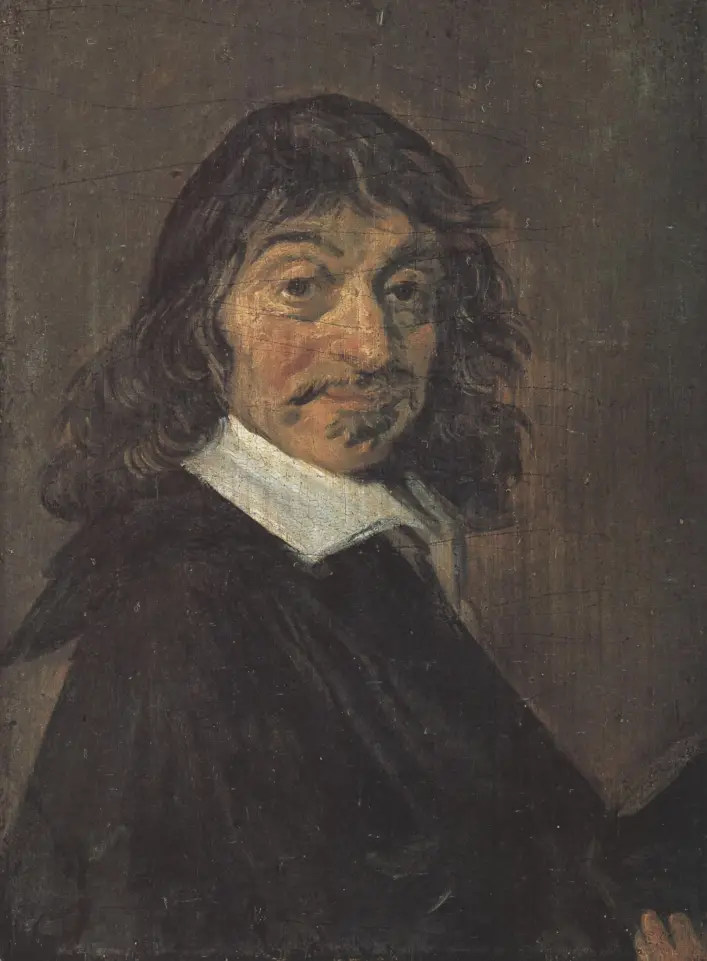
Descartes's method (Discourse on Method, 1637; Meditations, 1641) starts from universal doubt about sensory knowledge together with the absolute certainty of purely rational knowledge; doubt is not skepticism but a sieve. From "cogito, ergo sum" ("I think, therefore I am" – the first principle of his philosophy, Discourse on Method, part 4) he passes to God, proving his existence from the idea of "a nature more perfect than myself", and then establishes the existence of the world and the body. Grenz and Olson write that the thinking subject, not revelation, became the starting point of philosophy. Descartes did not wish to deny the faith, but most Catholic theologians condemned his method. Some theologians adopted Cartesianism: Wittich (1659) and Malebranche, who taught that all ideas are known in God and that God is the only efficient cause.
Positions
- Descartes
- Philosophy is compatible with the Catholic faith; reason is the foundation of certainty
- Utrecht and other universities; most Catholic theologians
- In 1642 Utrecht forbade teaching his views; the method was condemned as rationalist
- Malebranche
- Soul and body communicate only through God; secondary causes are merely "occasional"
Key points
- The four rules of the method: accept nothing unproved, divide difficulties, proceed from simple to complex, enumerate completely
- González: a proof of God intermediate between Anselm and Thomas
- Theologians had to choose: accept the supremacy of reason or dispute its ability to know the eternal on its own
- Grenz and Olson: the voice of reason came to sound more distinctly than "the voice of God," which strengthened the orientation toward immanence
Outcome
González sees Descartes as the founder of rationalist idealism; Grenz and Olson call him the father of modern philosophy; Malebranche's Cartesianism became the most widespread in France.
People
- René Descartes
- Christoph Wittich
- Nicolas Malebranche
- Gottfried Wilhelm Leibniz
Terms
- I think, therefore I am – cogito, ergo sum
- The certainty of the existence of the doubting subject.
- thinking thing and extended thing – res cogitans, res extensa
- The soul and the body occupying space; Descartes did not explain their interaction.
Place
Netherlands; France
Sources disagree
González: discovery of the method – 10 November 1619, Discourse – 1637, Meditations – 1641; Grenz and Olson give only his lifespan (1596–1650).
Sources
Primary sources
- Descartes – Discourse on Method, pt. 4
Textbooks
- Justo L. González – A History of Christian Thought in One Volume (Abingdon, 2014), p. 382–383
- Justo L. González – A History of Christian Thought, vol. III: From the Protestant Reformation to the Twentieth Century (Abingdon, rev. ed. 1987), p. 330–336
- Stanley Grenz, Roger Olson – 20th-Century Theology: God and the World in a Transitional Age (Russian edition), p. 18–19
Related entries
- Develops: Anselm: The Proofs of God's Existence in the Monologion and the Ontological Argument of the Proslogion (1077–1078)
- Developed in: Kant: The Critique of Pure Reason, the Limits of Knowledge and the Religion of Practical Reason (1781–1788)
In church history
Data compiled: 2026-11-17