1770–1831 (Hegel's lifespan) · 18th century
Hegel: Spirit, Dialectic and Christianity as the Absolute Religion
Hegel considered himself a theologian, but he sought not an exposition of doctrine in traditional formulas but a comprehensive understanding of reality and of Christianity's place in it. He carried Kant's view of the mind's active role to its conclusion: reality is the unfolding of the principle of rationality, Spirit (Geist); "the real is the rational," and logic is dynamic and dialectical. History is not a truth hidden behind it but is itself dynamic truth. Rejecting the rationalist theory of a universal natural religion, Hegel saw Christianity as the culmination of the unfolding of Spirit – the "absolute religion": the incarnation expresses the final union of God and humanity, the Trinity the dialectical character of reality.
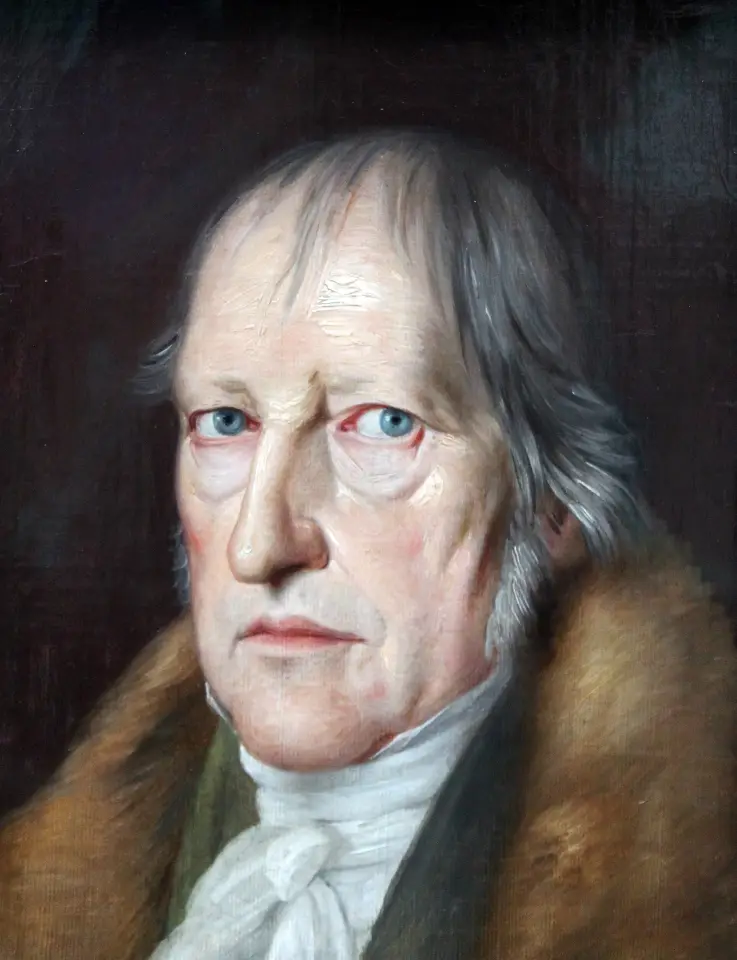
Positions
- The rationalists; the Enlightenment thinkers
- A universal natural religion underlies all positive religions; nature is a static reality from which the Creator is inferred
- Hegel
- All religions reveal the nature of reality in the historical process of the unfolding of Spirit; its culmination is Christianity
Key points
- Thought and being are identical (Grenz and Olson)
- The scheme "thesis – antithesis – synthesis" is a convenient description that Hegel himself may not have used (Grenz and Olson)
- Previously despised dogmas are profound representations of the nature of reality
- Hegel's philosophy of history gave impetus to historical research (Baur, Strauss)
- Helmer: for Hegel the Trinity is the system’s primary ontological structure; via finitum capax infiniti, history becomes constitutive of the eternal Trinity. On Joachim of Fiore’s scheme the Father is the undifferentiated Trinity, the Son its extension into history, the Spirit history’s return to divine life. The psychological basis of Hegel’s Trinity is a model of self-consciousness, in continuity with Augustine (vestigium Trinitatis); yet Hegel is more optimistic than Augustine (whose De Trinitate Helmer reads as a failure of the mind) about the mind’s power to grasp the Trinity
Outcome
Theology was incorporated into the philosophy of the history of Spirit; the system soon collapsed because of its all-inclusiveness, but its elements were taken up by Darwin and Marx (González).
People
- Georg Wilhelm Friedrich Hegel
- F. C. Baur
- D. F. Strauss
Terms
- Spirit – Geist
- The active subject and process, the inner being of the world, the Absolute.
- dialectic
- A process in which each stage is negated and at the same time preserved in the next.
- sublation – aufgehoben
- Thesis and antithesis are at once cancelled and preserved in the synthesis.
Place
Tübingen; Berlin
Sources disagree
All three books give only Hegel's lifespan (1770–1831); the works are not dated.
Sources
- Justo L. González – A History of Christian Thought in One Volume (Abingdon, 2014), p. 390–391
- Justo L. González – A History of Christian Thought, vol. III: From the Protestant Reformation to the Twentieth Century (Abingdon, rev. ed. 1987), p. 369–372
- Stanley Grenz, Roger Olson – 20th-Century Theology: God and the World in a Transitional Age (Russian edition), p. 38–44
- The Cambridge Companion to the Trinity, ed. Peter C. Phan (2011), p. 172–173, 173
Related entries
- Developed in: The Historical Criticism of the Bible: From Reimarus and Lessing to the Tübingen School and Strauss (18th–19th centuries (Strauss – 1835))
- Develops: Kant: The Critique of Pure Reason, the Limits of Knowledge and the Religion of Practical Reason (1781–1788)
- Develops: Joachim of Fiore: the three ages of history and the expectation of the Age of the Spirit (1177–1202)
- Developed in: Khomiakov and the Slavophiles: sobornost (mid-19th century)
In church history
Data compiled: 2026-11-17