711–732 (invasion and Battle of Poitiers) – 751–756 (Pepin as king, "Donation of Pepin") – 767, 772–774 · 7th century
The rise of the Carolingians, the Battle of Poitiers, and the "Donation of Pepin"
Already in 687 the mayor of the palace Pepin of Herstal had defeated rival noble families. He became the effective ruler of the Franks. The Merovingian kings by then were powerless and reigned only in name. After Pepin's death (714) power passed to his son Charles Martel.
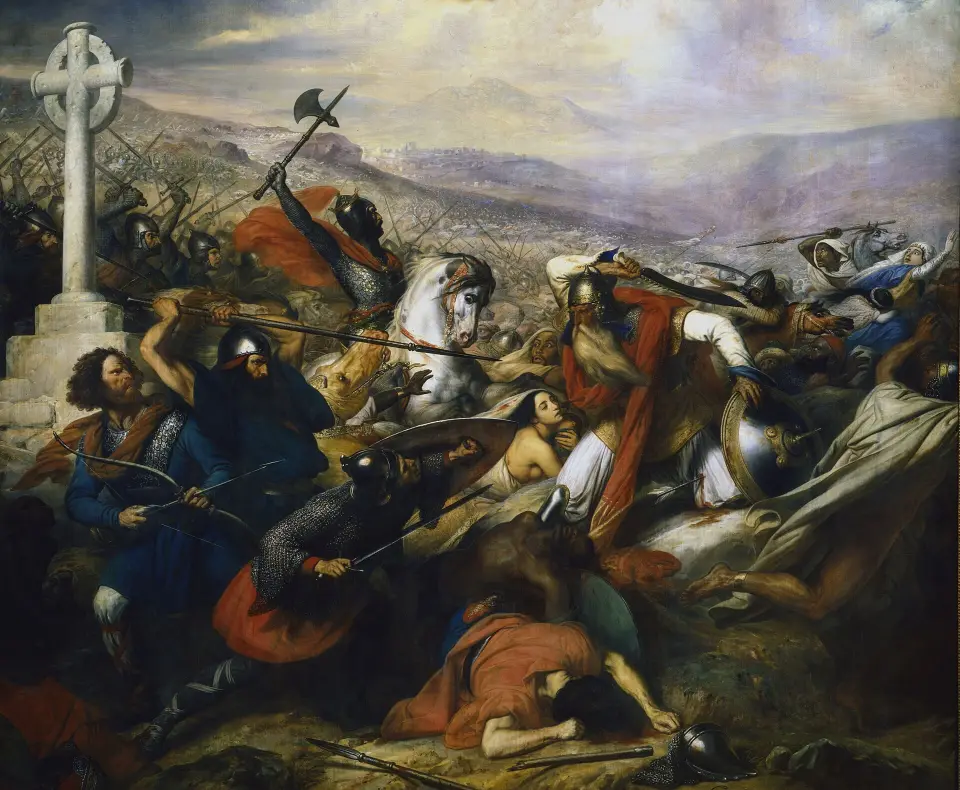
In 711 Muslims under Tariq invaded Spain and quickly conquered the Iberian Peninsula. They then advanced into southern Gaul. In 732 Charles Martel stopped them in the seven-day Battle of Poitiers (Tours). It was a turning point for the fate of Christian Europe.
In 751 his son Pepin the Short, with the consent of Pope Zachary, sent the last Merovingian, Childeric III, to a monastery. Bishop Boniface anointed Pepin king. In 754 Pope Stephen II personally crowned him in Gaul, seeking help against the Lombards. In 756 Pepin defeated the Lombards and handed the pope the lands of central Italy taken from them (the "Donation of Pepin"). This laid the foundation for the papacy's temporal power, the Papal States.
In 767, according to some chronicles, Pepin convened a council. It discussed disputes between the Franks and Greeks over the Holy Trinity and the veneration of icons. This was one of the early signs of the future conflict over the filioque and icon veneration.
Pepin's son Charlemagne continued the alliance with the papacy. In 772–774 he subdued the Lombards and annexed their kingdom. He also reaffirmed his father's donation to the pope.
Key points
- Pepin of Herstal becomes the effective ruler of the Franks (687); Charles Martel inherits his power (714)
- Muslim invasion of Spain (711) and Charles Martel's victory at Poitiers (732)
- Deposition of Childeric III and Pepin the Short's anointing as king (751)
- Pepin's coronation by Pope Stephen II (754)
- Defeat of the Lombards and the "Donation of Pepin" (756) – the founding of the Papal States
- Pepin's council (767) on the Trinity and icons – an early trace of the future filioque dispute
- Charlemagne subdues the Lombards and reaffirms his father's donation (772–774)
- Shelley: Charles Martel, mayor of the palace from 714, fought the Muslims near Tours in 732 and they no longer threatened Central Europe. Pepin the Short asked the pope who is the lawful ruler; in 751 Boniface, with the pope’s blessing, crowned him. The pope needed a strong protector: in 751 the Lombards subdued Ravenna and demanded tribute from the pope; three years later the pope personally anointed Pepin king in the Old Testament manner. Pepin promised to return the Ravenna region to the papacy, and in 756 the Franks forced the Lombards to yield the lands: the “Donation of Pepin” made the pope temporal ruler of the Papal States – “Peter got his sword back”. The Frankish alliance hastened the Latin–Greek split (previously only the Byzantines had protected popes from the Lombards) and created the Papal States, which played a role in Italian politics until the late nineteenth century; anointing gave Western kings a religious sanction that later entered the rivalry of popes and emperors
People
- Pepin of Herstal
- Charles Martel
- Tariq
- Pepin the Short (son of Charles Martel)
- Zachary
- Boniface
- Stephen II
- Childeric III
- Charlemagne
- Desiderius
- Adrian I
Place
Frankish kingdom, Spain, Poitiers, Italy
Sources
- J. North – A History of the Church (Russian edition), p. 125, 127–131, 133
- Justo L. González – The Story of Christianity, vol. I (Russian edition), Ch. 20, sec. 20.1, 20.3
- A. P. Lebedev – History of the Ecumenical Councils, part II, p. 312, 329
- Bruce L. Shelley – Church History in Plain Language (Russian edition), Ch. 18, sec. «Идеи умирают медленно»
Data compiled: 2026-11-09