690s – 754 · 7th century
The missions of Willibrord and Boniface among the Germans
The English missionary Willibrord (658–739) preached in Frisia for fifty years. He had the support of the Frankish mayor of the palace Pepin of Herstal.
His assistant Boniface (680–754) evangelized Germany from 719 – Bavaria, Thuringia, Hesse. He reorganized the church there and secured allegiance to Rome across Central Europe. For this he is regarded as the greatest missionary of the early Middle Ages. In 751 he also anointed Pepin the Short as king.
Key points
- Willibrord preaches in Frisia (c. 690s–739)
- Boniface evangelizes Bavaria, Thuringia, and Hesse (from 719)
- Establishment of allegiance to Rome across Central Europe
- Boniface anoints Pepin the Short as king (751)
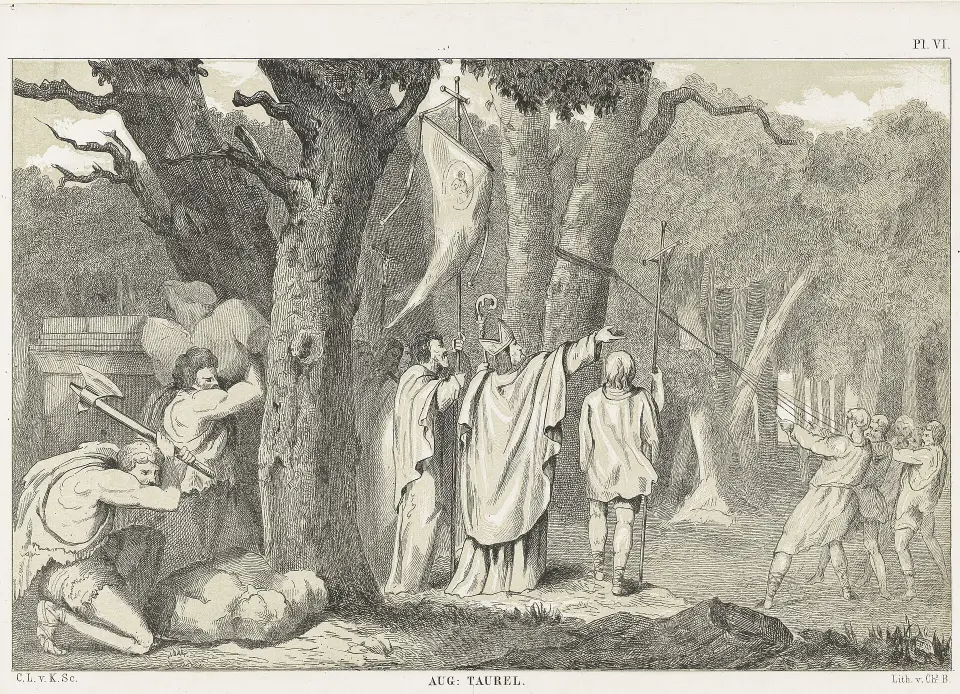
- Shelley: by legend Boniface felled Thor’s oak, wind toppled the tree, the pagans converted, and he built a chapel of St Peter from it. Boniface converted people en masse and tied the church to Rome; as archbishop of Mainz he died a martyr in Frisia (754)
People
- Willibrord
- Boniface
- Pepin of Herstal
- Pepin the Short
Place
Frisia, Germany (Bavaria, Thuringia, Hesse)
Sources
- J. North – A History of the Church (Russian edition), p. 128–130
- Bruce L. Shelley – Church History in Plain Language (Russian edition), Ch. 16, introduction и sec. «Евангелие в Англии»
Data compiled: 2026-11-09