3rd quarter of the 7th c. – mid-8th c. · 7th century
John of Damascus – the last of the Greek Fathers
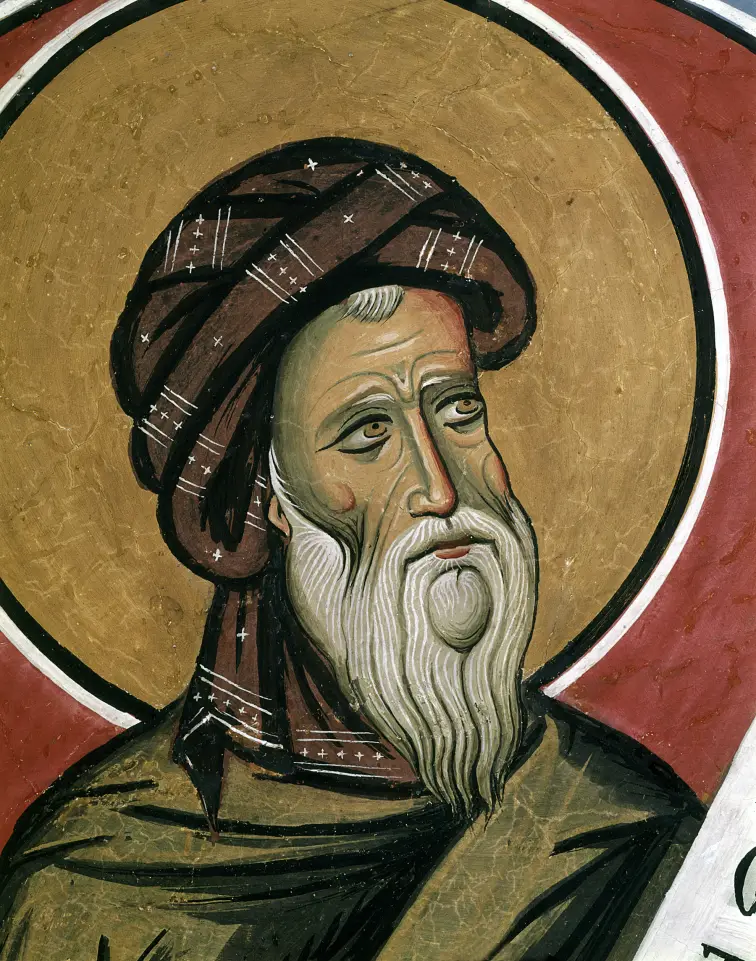
John Mansur was born in Damascus under Muslim rule and, like his father, served for a time at the caliph's court. He then became a monk and priest at the Lavra of St. Sabbas near Jerusalem. His principal work, the "Fount of Knowledge" (the Dialectic, the Book of Heresies, and An Exact Exposition of the Orthodox Faith), brought together philosophical premises, the history of heresies (including Islam among them), and Orthodox dogmatics.
John became the first great apologist for icons and in his "Three Treatises in Defense of the Holy Icons" spoke out against iconoclasm. His writings were anathematized by the iconoclast council of 754, and the Seventh Ecumenical Council of 787 vindicated them. An early Latin translation of the "Fount of Knowledge" later influenced Western scholasticism.
Key points
- Born in Damascus under Muslim rule, served at the caliph's court, then became a monk of the Lavra of St. Sabbas
- "Fount of Knowledge": Dialectic, Book of Heresies, Exact Exposition of the Orthodox Faith
- First great apologist for icons: "Three Treatises in Defense of the Holy Icons"
- Condemned by the 754 council, vindicated by the Seventh Ecumenical Council (787); the Latin translation influenced scholasticism
- McGuckin: John of Damascus, one of the last creative theologians in Gregory’s line; his systematized Fathers became the East’s handbook and Thomas’s source. Damascene describes the Trinity as one essence, deity, power, will and action, known in three perfect hypostases
- Gunton: John of Damascus’s eighth-century work formalised the Fathers; Orthodoxy has made no serious attempt to move beyond John and Palamas.
People
- John of Damascus
- Nikephoros of Constantinople
- Theodore the Studite
- Leo III the Isaurian
Place
Damascus, Lavra of St. Sabbas (Palestine)
Sources disagree
Louth: John was born in Damascus around 675; probably following his father and grandfather in the fiscal administration, he left the civil service and became a monk in or near Jerusalem probably in the early years of the eighth century; the tradition naming the monastery of Mar Sava is late and unreliable
Sources
- Tony Lane – Christian Thinkers (Russian edition), p. 70, 78–80
- Louis Berkhof – History of Christian Doctrines (Russian edition), p. 61–62, 75–76
- Jaroslav Pelikan – The Christian Tradition, vol. 2: The Spirit of Eastern Christendom (600–1700) (Russian edition), p. 232–237, 244, 255, 368
- Justo L. González – A History of Christian Thought in One Volume (Abingdon, 2014), p. 232
- A. P. Lebedev – History of the Ecumenical Councils, part II, p. 131–137
- The Cambridge Companion to the Trinity, ed. Peter C. Phan (2011), p. 79
- The Oxford Handbook of Christology, ed. Francesca Aran Murphy (2015), p. 194–195
- The Cambridge Companion to Christian Doctrine, ed. Colin E. Gunton (1997), p. 30
More on the doctrine
- John of Damascus, The Fount of Knowledge: A Compendium of Eastern Dogmatics (8th century)
- The Iconoclastic Controversy: Christology, Tradition and the Seventh Ecumenical Council (787) (725–842)
Data compiled: 2026-11-09