622 (Heraclius's plan) – 638 ("Ekthesis") – 649 (Lateran council) – 680–681 (Sixth Ecumenical Council) – 691/692 (Quinisext Council) · 7th century
The Monothelite controversy and the Sixth Ecumenical Council (Third Constantinople, 680–681)
Emperor Heraclius sought to reconcile the Monophysites with the empire on both religious and political grounds. Beginning in 622, during his eastern campaigns, he and Patriarch Sergius of Constantinople put forward a doctrine of "one activity" (monoenergism) in Christ. Sophronius, the future Patriarch of Jerusalem, protested. They then put forward a doctrine of "one will" (Monothelitism).
On this basis Cyrus of Alexandria concluded in 633 a compromise "watery union" with the Egyptian Monophysites. In 638 Heraclius promulgated the "Ekthesis," composed by Sergius. It forbade speaking of either one or two activities but proclaimed one will in Christ. It was approved by Pope Honorius I as well.
Heraclius's successor Constans II banned discussion of the question altogether by the 648 edict "Typos." But Pope Martin I convened the Lateran Council in 649. The council condemned Monothelitism and both imperial edicts and proclaimed the doctrine of two wills and two activities.
For this Martin was arrested in 653, taken to Constantinople, condemned, and exiled to Cherson. He died there in 655. His associate, the theologian Maximus the Confessor, won a debate with the deposed Patriarch Pyrrhus in 645. He was later tortured – his tongue and right hand were cut off – and exiled to Colchis, where he died.
Finally, Emperor Constantine IV Pogonatus convened the Sixth Ecumenical Council at Constantinople (680–681). On the basis of Pope Agatho's dogmatic letter, it confirmed the doctrine of two natural wills and two activities in Christ. They are undivided and unconfused, with the human will subordinate to the divine. The council anathematized the leading Monothelites, including Patriarch Sergius and Pope Honorius I. The posthumous condemnation of the pope was later used in debates over papal infallibility.
The Quinisext (Trullan) Council (691/692) supplemented the Fifth and Sixth councils. It adopted 102 canons on church discipline.
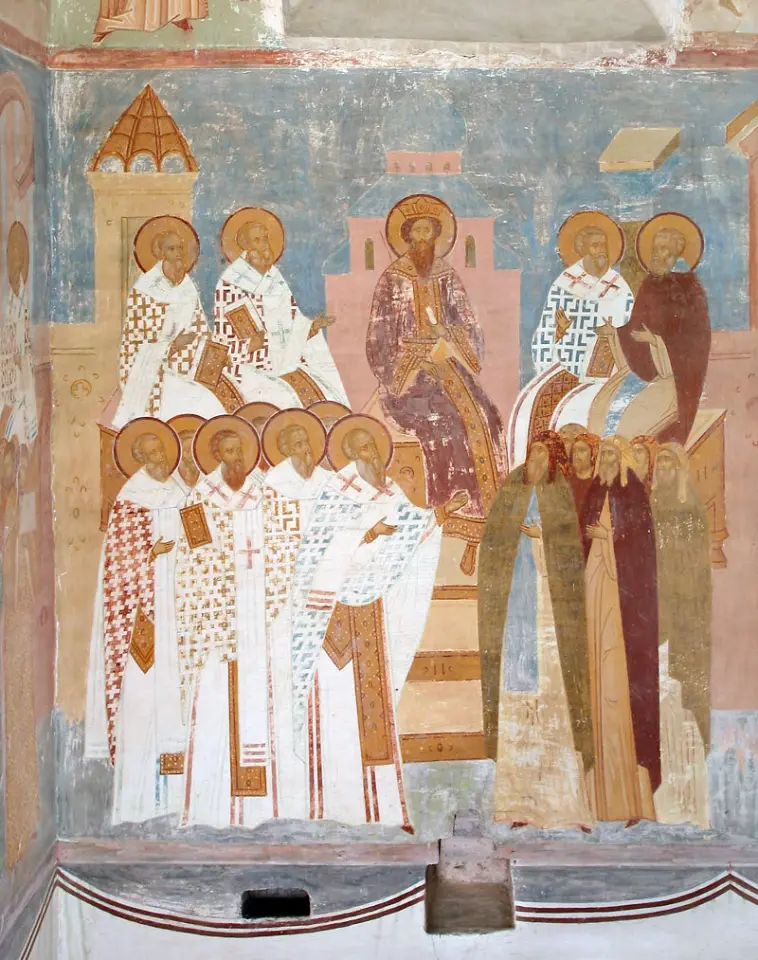
Key points
- Monoenergism, then Monothelitism – Heraclius's and Sergius's attempt to reconcile the Monophysites
- The "Ekthesis" (638): one will in Christ; approved by Pope Honorius I
- Constans II's "Typos" (648) bans all discussion of the question
- Pope Martin's Lateran Council (649): condemnation of Monothelitism and both edicts; Martin's arrest and exile (653–655)
- The debate and martyrdom of Maximus the Confessor (645–662)
- The Sixth Ecumenical Council (680–681): two wills and two activities in Christ; anathema on Sergius and Honorius
- The Quinisext (Trullan) Council (691/692): 102 canons on church discipline
People
- Heraclius
- Sergius of Constantinople
- Sophronius of Jerusalem
- Honorius I
- Constans II
- Martin I
- Maximus the Confessor
- Pyrrhus
- Agatho
- Constantine IV Pogonatus
- Cyrus of Alexandria
- Justinian II
Place
Constantinople, Alexandria, Rome, Cherson, Colchis
Sources
- Louis Berkhof – History of Christian Doctrines (Russian edition), p. 74–76
- Justo L. González – A History of Christian Thought in One Volume (Abingdon, 2014), p. 196–198
- Jaroslav Pelikan – The Christian Tradition, vol. 2: The Spirit of Eastern Christendom (600–1700) (Russian edition), p. 68, 94–99, 103, 107–115, 155, 161–177, 270–276, 288
- A. P. Lebedev – History of the Ecumenical Councils, part II, p. 68–114
- J. North – A History of the Church (Russian edition), p. 116–117
- Justo L. González – The Story of Christianity, vol. I (Russian edition), Ch. 21, sec. 21.2; ch. 20, sec. 20.3
- Tony Lane – Christian Thinkers (Russian edition), p. 67, 76–78
More on the doctrine
Data compiled: 2026-11-09