1583–1615 · 16th century
Matteo Ricci's mission to China and the method of cultural accommodation
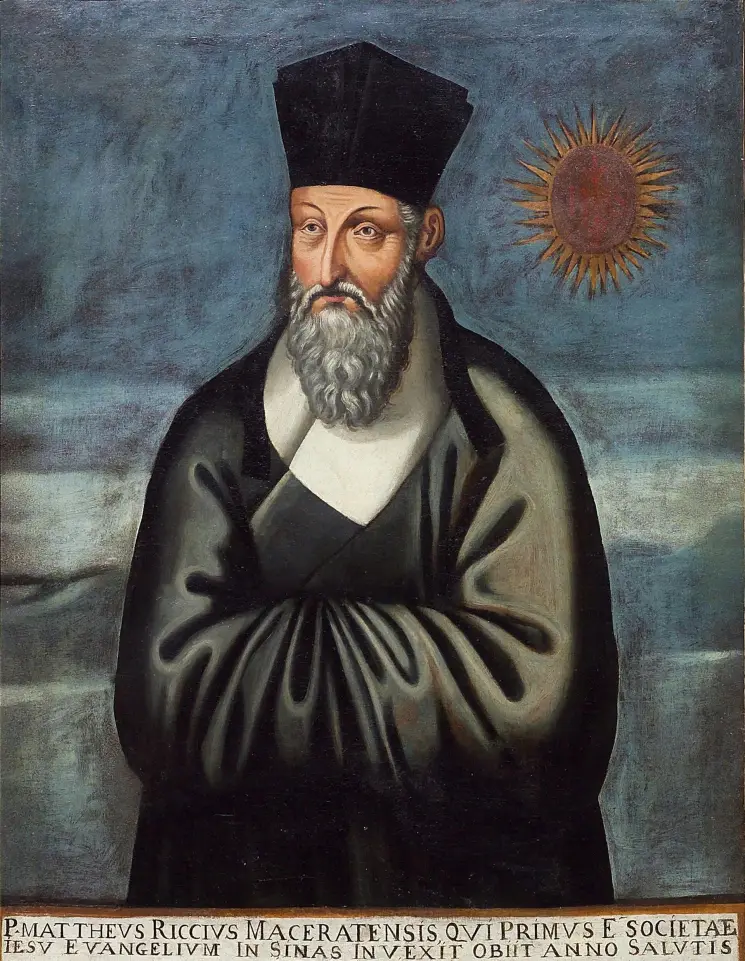
Unlike earlier missionaries, the Jesuit Matteo Ricci developed a strategy of cultural accommodation. He learned Chinese and studied the Confucian tradition. His world map and knowledge of astronomy earned him a reputation as the "Wise Man from the West".
In 1601 he was invited to the court in Beijing. He lived there until his death in 1615, converting a narrow circle of educated Chinese. A similar strategy of accommodation to local culture was pursued in India by the Jesuit Roberto de Nobili. He dressed as a Brahmin and studied Sanskrit.
Disputes later arose over whether converts could keep venerating ancestors and Confucian rites (the "Chinese Rites Controversy"). These disputes angered the Chinese emperor and divided missionaries of different orders.
Key points
- Study of the Chinese language and Confucian tradition
- Invitation to the court in Beijing (1601)
- A parallel: Roberto de Nobili in India
- The dispute over ancestor veneration and Confucian rites
- Shelley: Xavier died in 1552 near China’s coast without reaching the mainland; the door to China opened for Matteo Ricci (1552–1610). Macao became Portuguese in 1567, but the Ming dynasty ignored the outside world and Confucianism governed state and family. Tradition says in 1579 Valignano cried “Rock, rock, when will you open?” and summoned Ricci, who had studied mathematics and astronomy in Rome. Ricci studied language and customs; in 1583 he settled in Zhaoqing and, dressed as a mandarin, drew the Chinese a world map and gave a calendar. He understood Christianity could not win from a remote province and in 1601 obtained permission to enter Beijing; he won the emperor’s favour with gifted clocks and for ten years lived in the capital as mathematician and astronomer, heading the Astronomical Service. He presented Christianity as fulfilling ancient Chinese piety: “the Lord of Heaven” is God, ancestor veneration a social act. In 1650 Schall built a church in Beijing, in 1657 freedom to preach was announced; the 1692 edict of toleration rewarded the Jesuits for their service. After Schall’s death there were about 270,000 Christians in China
People
- Matteo Ricci
- Roberto de Nobili
Place
China (Zhaoqing, Beijing); India
Sources
- J. North – A History of the Church (Russian edition), p. 12
- Justo L. González – The Story of Christianity, vol. I (Russian edition), Ch. 31, sec. 31.2
- Bruce L. Shelley – Church History in Plain Language (Russian edition), Ch. 29, sec. «Дверь в Китай»
Data compiled: 2026-11-09