1577 (published 1580) · 16th century
The Formula of Concord and the "Book of Concord"
After Luther's death, Lutheranism split. On one side stood the strict-line "Gnesio-Lutherans", led by Matthias Flacius. On the other were the more moderate "Philippists", followers of Melanchthon. The disputes concerned adiaphora, free will, good works, the sacrament and other issues.
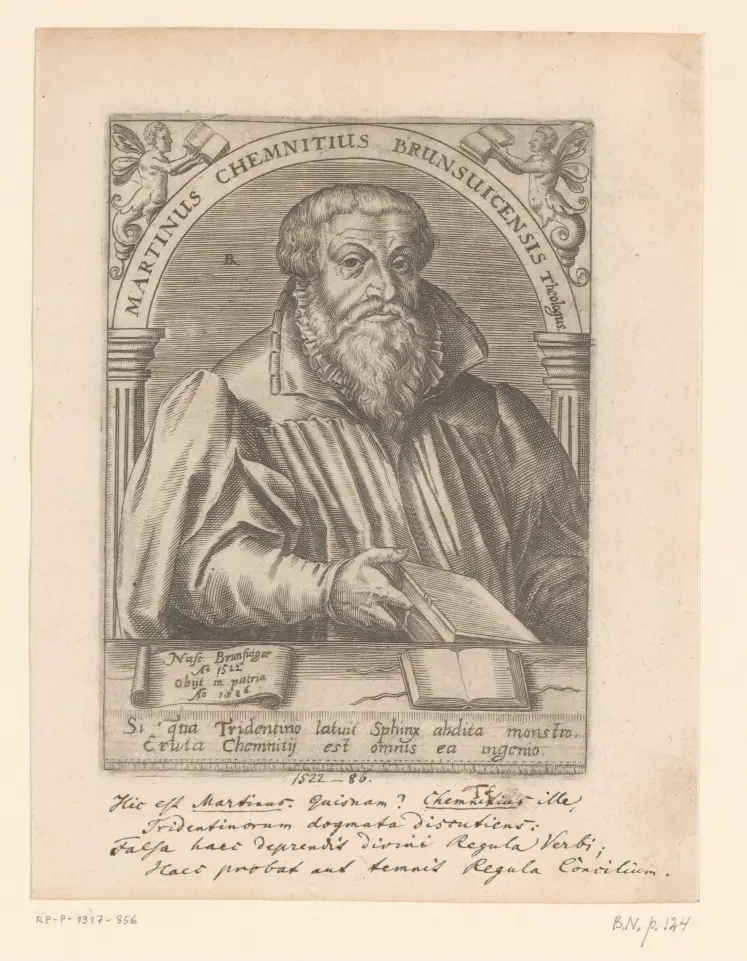
The Formula of Concord was drafted chiefly by Jacob Andreae and Martin Chemnitz and largely completed in 1577. It resolved these disputes, generally in the spirit of strict Lutheranism. It also drew a sharp line against Calvinism, calling its adherents "subtle sacramentarians".
The Formula entered the "Book of Concord", published in 1580, together with the ancient creeds, the Augsburg Confession, the Apology, the Schmalkald Articles and Luther's catechisms. This book united the Lutheran churches for more than four centuries.
Key points
- Split into Gnesio-Lutherans (Flacius) and Philippists (Melanchthon's followers)
- The adiaphorist, Majorist, synergist, Osiandrian and other disputes resolved
- A strict line drawn against Calvinism ("subtle sacramentarians")
- The "Book of Concord" (1580): the three ancient Creeds, the Augsburg Confession with its Apology, the Smalcald Articles, both of Luther's Catechisms (Preface 23) and the Formula
- Kolb: after a quarter-century of dispute the Formula of Concord (1577) settled the disputed issues for most German Lutherans; the agenda came from Gnesio-Lutheran and Philippist charges: free will, good works, original sin, election, law, Lord’s supper, Christology. The Formula arose from the diplomacy of Jakob Andreae of Tübingen and, theologically, above all from Martin Chemnitz: devoted to Melanchthon yet close to the Gnesio-Lutherans, he revised Andreae’s text and took Philippist concerns seriously. A remnant of Flacius’ followers repudiated the Formula’s teaching on original sin, and some Philippists and the German Calvinists its articles on the Lord’s supper and Christology. The Formula set the standard of “Lutheran orthodoxy” and stayed the public faith of much of Germany, Scandinavia, Finland, Estonia and Latvia, and also of frequently persecuted minority churches in central Europe
People
- Jacob Andreae
- Martin Chemnitz
- Philip Melanchthon
- Matthias Flacius Illyricus
Place
Germany
Sources
Primary sources
- Book of Concord, preface, para. 23
Textbooks
- Alister McGrath – Reformation Thought (Russian edition: «Theological Thought of the Reformation»), p. 341, 353
- Justo L. González – A History of Christian Thought in One Volume (Abingdon, 2014), p. 353–358
- Tony Lane – Christian Thinkers (Russian edition), p. 167–169
- Justo L. González – A History of Christian Thought, vol. III: From the Protestant Reformation to the Twentieth Century (Abingdon, rev. ed. 1987), p. 107, 116–134
- Louis Berkhof – History of Christian Doctrines (Russian edition), p. 79–80
- The Cambridge Companion to Reformation Theology, ed. David Bagchi, David C. Steinmetz (2004), p. 83–84, 90
More on the doctrine
- Controversies in Lutheranism after Luther – Antinomian, Synergist, Majorist, Osiandrian – and the Formula of Concord (1528–1577)
- The Lutheran controversy over the Supper, "crypto-Calvinism" and the Formula of Concord (1577)
Data compiled: 2026-11-09