216–277 (preaching 242–247) · 3rd century
Mani and the rise of Manichaeism
Mani was born in 216 in Babylonia and grew up among the Jewish-Christian sect of the Elkesaites. After a series of "revelations," he created, between 242 and 247, his own "universal" religion. It combined Persian dualism with elements of Christianity and gnosticism.
Mani taught of an eternal struggle between the kingdoms of Light and Darkness. He also taught of liberating particles of light trapped in matter through the strict asceticism of the "Elect" – celibacy and vegetarianism. Ordinary believers faced milder requirements. He honored Buddha, Zoroaster and Jesus as earlier, incomplete revelations of the same Light.
Mani was a talented missionary who used poetry, music and illustrated books. He adapted his preaching to different religious settings, and his teaching spread quickly westward from Persia.
When the Zoroastrian state religion reasserted itself in Persia, Mani was imprisoned. He died in 277. Manichaeism continued to exist for centuries and later influenced the young Augustine.
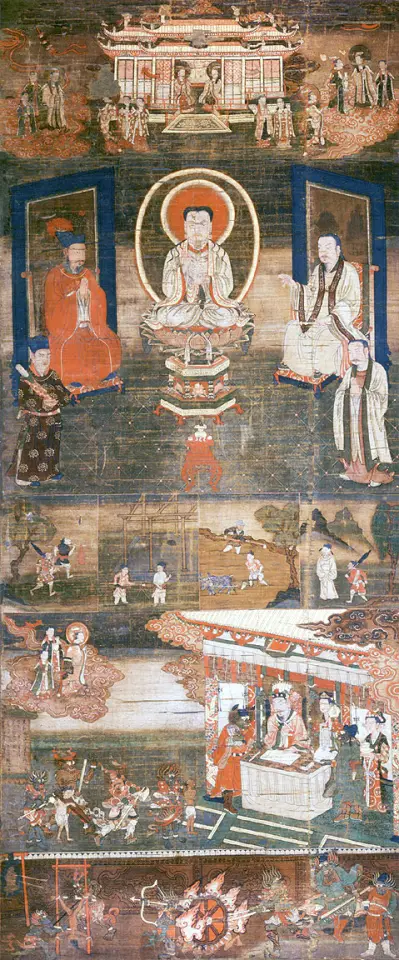
Key points
- A synthesis of Persian dualism, Christianity and gnosticism
- Teaching of the struggle of Light and Darkness; freeing particles of light through the Elect's asceticism
- Buddha, Zoroaster and Jesus as earlier, incomplete revelations
- A successful adaptive mission (poetry, music, illustrated books)
- Imprisoned and died in 277 amid a revival of state Zoroastrianism; later influenced Augustine
- Burns: Mani declared Jewish apocalypses of Adam, Enoch, Shem and others to legitimate his revelation; his corpus includes a Book of the Giants. Yet in a letter (Cologne Mani Codex) Mani says his revelation of the cosmos came “not from men” nor from study of scripture. Gnostic myth informs the Manichaean without encompassing it: the demiurge is benevolent, history is under the high God’s providence. The Platonist Alexander of Lycopolis faulted the Manichaeans for reading their myths literally rather than as images
People
- Mani
- Augustine
- Alexander of Lycopolis
Place
Babylonia; Persia
Sources disagree
One book places Mani's main activity in 242–247 while giving his overall lifespan as 216–277.
Sources
- Stuart G. Hall – Doctrine and Practice in the Early Church (Russian edition), p. 31, 34, 127–128
- The Oxford Handbook of Apocalyptic Literature, ed. John J. Collins (2014), p. 384, 385
More on the doctrine
- Dualism against the Good Creator: Gnostics, Manichees, Paulicians, Bogomils, Cathars – and the Doctrine of Creation out of Nothing (2nd–13th centuries)
Data compiled: 2026-11-09