248/249 – 252 · 3rd century
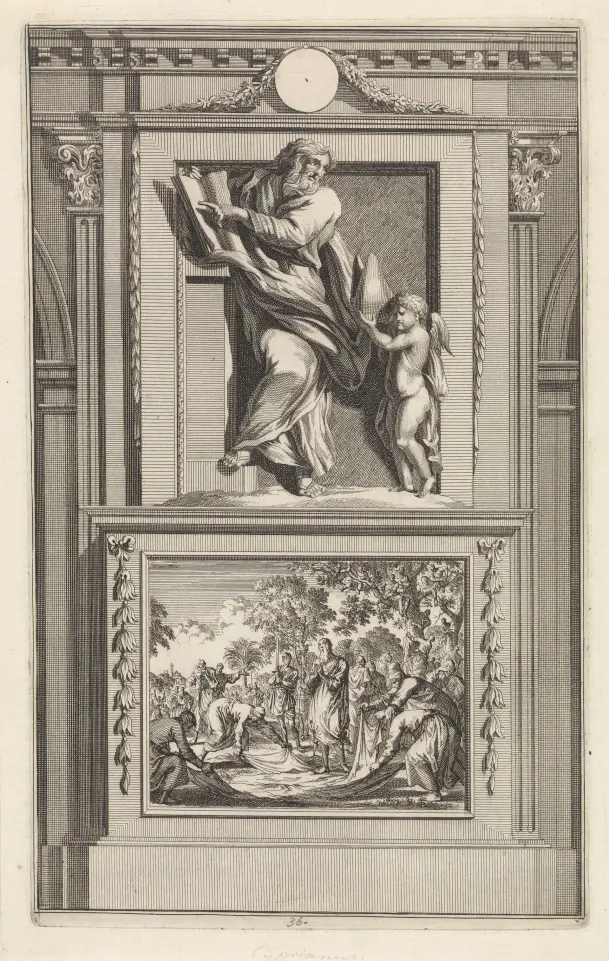
Cyprian of Carthage and the controversy over the "lapsed"
The wealthy rhetorician Cyprian converted around 246. Already in 248/249 he was elected bishop of Carthage by popular vote.
During the Decian persecution he went into hiding and governed his community by letters. After the persecution he faced the mass question of readmitting the "lapsed." These were people who had recanted or bought a false certificate of sacrifice.
Confessors issued "letters of peace" (libelli pacis) and demanded immediate, unconditional reconciliation. Against them, Cyprian insisted that the decision on readmitting the lapsed belonged to the bishop. A council at Carthage in 251 decreed that degrees of guilt be distinguished and the penitent readmitted gradually (Cyprian, Epistle 51.6). A council in 252, under threat of renewed persecution, eased the conditions (Epistle 53.1).
In the treatises On the Lapsed and On the Unity of the Church, Cyprian developed the teaching that there is no salvation outside the Church (On the Unity of the Church 6; Epistle 72.21). Her unity, he taught, rests on the concord of bishops (On the Unity of the Church 5). Those who disagreed with his policy split off and set up their own bishop, Fortunatus (Epistle 54.9).
Key points
- Cyprian hid during the Decian persecution, governing the church by letters
- Confessors issued "letters of peace" (libelli pacis), demanding immediate reconciliation of the lapsed
- The Council of Carthage (251): distinguishing degrees of guilt; the 252 council eased conditions under threat of renewed persecution
- On the Unity of the Church (chs. 5–6): no salvation outside the Church, unity resting on the concord of bishops
- A schism of part of the clergy and confessors, who set up Fortunatus as bishop (Cyprian, Epistle 54.9)
- Shelley: Cyprian of Carthage said bluntly “Outside the Church there is no salvation”, and many agreed, but people demanded the lapsed be received back. In Carthage the confessors were declared to hold God-given power to deliver from sins, and Cyprian was urged to proclaim a general pardon
People
- Cyprian of Carthage
- Decius
- Fortunatus
- Tertullian
Place
Carthage
Sources
Primary sources
- Cyprian of Carthage – Epistles, letters 51, 53, 54, 72
- Cyprian of Carthage – On the Unity of the Church, ch. 5–6
Textbooks
- Tony Lane – Christian Thinkers (Russian edition), p. 30–34
- Stuart G. Hall – Doctrine and Practice in the Early Church (Russian edition), p. 58–61
- Justo L. González – A History of Christian Thought in One Volume (Abingdon, 2014), p. 103–105
- Jaroslav Pelikan – The Christian Tradition: A History of the Development of Doctrine, vol. 1 (Russian edition), p. 165
- Louis Berkhof – History of Christian Doctrines (Russian edition), p. 167
- Justo L. González – The Story of Christianity, vol. I (Russian edition), sec. «Вопрос о малодушных: Киприан и Новациан»
- Bruce L. Shelley – Church History in Plain Language (Russian edition), Ch. 7, sec. «Так что же с непростительным грехом?», «Рождение святых»
More on the doctrine
- The lapsed after the Decian persecution and the schism of Novatian (251)
- Cyprian: the unity of the Church in the episcopate and "no salvation outside the Church" (251–258)
Data compiled: 2026-11-09