8th century · 7th century
John of Damascus, The Fount of Knowledge: A Compendium of Eastern Dogmatics
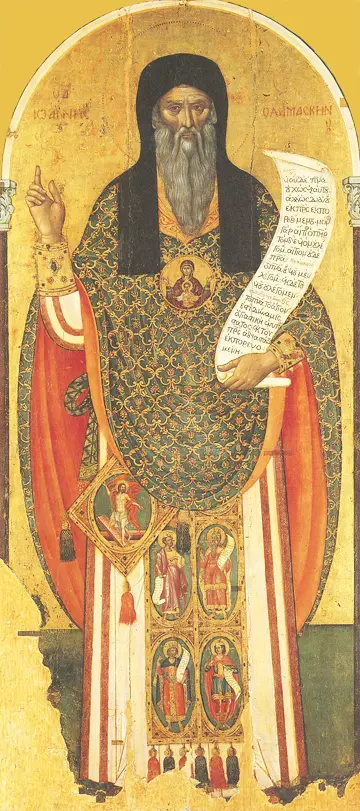
John of Damascus, according to Lane the last of the Greek fathers, systematized the teaching of his time in The Fount of Knowledge, in three parts: the Dialectic (the philosophical terms of the doctrines of the Trinity and Christ), the Book of Heresies (103 heresies) and the Exact Exposition of the Orthodox Faith (100 chapters). He stressed that he offered not his own conclusions but what had been gathered from the theologians: "like a bee, I must gather all that accords with the truth." In Christology he sets out the Chalcedonian definition with Maximus the Confessor's addition on the two wills and energies. Pelikan notes that the formula "I believe in order to understand" applies also to Maximus and John.
Key points
- In the doctrine of the Trinity – the teaching of the Cappadocians
- Lane: the danger of the approach is discussing Christ apart from the Gospels
- Pelikan: the Exposition became one of the few bridges by which scholasticism gained access to the Greek fathers; in the East the context of faith seeking understanding was worship
- Louth: John begins the Christology of On the Orthodox Faith not with terms but with the history of salvation (oikonomia). Fallen humans are stripped of grace and παρρησία, clothed in “garments of skin” of mortality and excluded from Paradise; but God did not abandon them: by the flood, angels, theophanies, Law and prophets he educated them and called them to conversion (45.14–16). The redeemer must be sinless and nature must be renewed and taught virtue by his example (45.20–24). As in Athanasius, the Incarnation works in two ways: it rids us of death and renews us; it is “the newest of all new things, the only new thing under the sun” (45.36–45). Perfect God became perfectly human, obedient to the Father, and healed our disobedience by what is ours and from us; the Word became the hypostasis of the flesh, so John speaks not of a deified human but of God become human (ch. 46). After Gregory of Nyssa, John of Damascus teaches bread and wine become Christ’s body and blood by the Word’s power and the Spirit’s overshadowing; he calls the gifts not a type (typos) but the deified body of the Lord; the sacraments’ materiality reflects man’s dual nature
- Shelley: John Mansur (c. 730–760) explained that an icon merely recalls its prototype; denying Christ’s image denies the incarnation. Worshiping an icon is wrong, but icons should be honored like the Bible or the Cross; this prepared icons of Mary, apostles and saints
Outcome
The classic exposition of Eastern dogmatics, influential on East and West until the Reformation; according to Lane, John closed the period of the Church Fathers.
People
- John of Damascus
- Maximus the Confessor
- Epiphanius of Salamis
- Theodoret of Cyrrhus
Terms
- I believe in order to understand
- The formula of faith seeking understanding; attributed to Anselm, but according to Pelikan applicable also to Greek-speaking theologians.
Place
Damascus
Sources disagree
The work is undated. Lane: John was born in the third quarter of the 7th century and died in the mid-8th century; Pelikan: 8th century.
Sources
- Jaroslav Pelikan – The Christian Tradition, vol. 2: The Spirit of Eastern Christendom (600–1700) (Russian edition), p. 127–129, 255
- Tony Lane – Christian Thinkers (Russian edition), p. 78–79
- The Oxford Handbook of Christology, ed. Francesca Aran Murphy (2015), p. 195–196
- The Oxford Handbook of Sacramental Theology, ed. Hans Boersma, Matthew Levering (2015), p. 225–227
- Bruce L. Shelley – Church History in Plain Language (Russian edition), Ch. 15, sec. «Конфликт по поводу икон»
Related entries
- Develops: Monoenergism, Monothelitism and the Sixth Ecumenical Council: two wills in Christ (638–681)
In church history
- John of Damascus – the last of the Greek Fathers (3rd quarter of the 7th c. – mid-8th c.)
Data compiled: 2026-11-17