725–842 · 8th century
The Iconoclastic Controversy: Christology, Tradition and the Seventh Ecumenical Council (787)
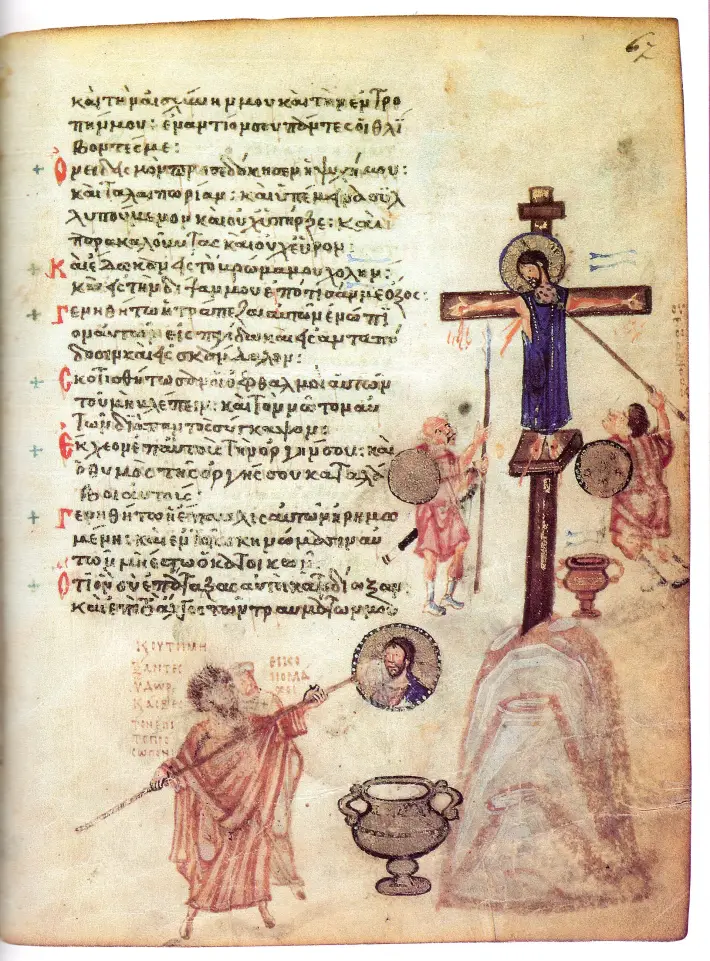
Leo III ordered the destruction of an image of Christ, beginning the iconoclastic policy; the Second Council of Nicaea (the Seventh Ecumenical Council) in 787 restored the icons, iconoclasm returned in 815, and on 11 March 842 the icons were finally restored. The iconoclasts appealed to antiquity and to Scripture – the prohibition of Exod. 20:4 and the words "God is spirit" (John 4:24) – while Constantine V and the council of 754 held that a true image is consubstantial with what it depicts, so that the only image of Christ is the Eucharist; in depicting Christ one either circumscribes the uncircumscribable divinity or separates the humanity from the person, falling into Nestorianism. The Orthodox, acknowledging the scarcity of written evidence, appealed to the "unwritten tradition, which is stronger," and John of Damascus, Theodore the Studite and Nicephorus replied that an image is a likeness of the prototype differing in essence, that in Christ God became visible and circumscribable in his human nature, and that iconoclasm is a kind of docetism. Pelikan treats the controversy as a new dimension of the christological discussions. The council of 787 allowed images to be given "honor and veneration, though not true latria, which must be given to the Godhead alone."
Positions
- Iconoclasts (Constantine V)
- The veneration of images does not come from Christ, the apostles and the fathers (Eusebius, Epiphanius); the image is consubstantial with what it depicts; the Eucharist is the only true image; depicting Christ leads to Nestorianism or to confusion of the natures
- Iconodules
- The unwritten tradition is stronger; images are not an innovation, and none of the six councils condemned them; an idol depicts what does not exist, an icon depicts real persons
- John of Damascus
- The Old Testament prohibition was due to the absence of an image of God and lost its force after the incarnation; iconoclasm is docetism
- Theodore the Studite
- Christ and his image are one in hypostasis and different in nature, so the veneration is one
- Synod of Frankfurt (794)
- Rejected both iconoclasm and the decisions of Nicaea 787: icons are to be used but without any veneration
Key points
- Pelikan: both sides appealed to the Fathers and accused each other of Nestorianism and Eutychianism; the iconoclast arguments are known from the quotations of the victors. The same pastoral concern for ordinary believers led to opposite conclusions: icons as "books for the unlearned" or as an occasion for idolatry. The Orthodox relied on Basil of Caesarea's "unwritten tradition": the custom of praying toward the east, the word "Trinity"
- González: Germanus distinguished the relative veneration of icons from the worship due to God alone; Theodore the Studite, the veneration of the icon from the veneration of the prototype. The restoration of the icons in 842 became the symbol of Orthodoxy in the East – the Feast of the Triumph of Orthodoxy
- Nicephorus: accept the icons or reject the Gospels; icons and Gospels tell the same story of Christ
- Lebedev: iconoclasm is independent of the Christological heresies and not directly linked to Monothelitism; icon opponents existed before the 8th century. The circle of Leo III hoped to purify the Church of superstition, ease Muslim conversion and strengthen the state
- Nichols: before iconoclasm broke out Germanus of Constantinople wrote three letters (to Constantine of Nikoleia, Thomas of Claudiopolis, John of Synada) conveying the full congruence of the Incarnation with a Christological (and partly Mariological and hagiological) art: “We form in images the portrait of [Christ’s] holy flesh; we salute it and render it fitting honour”. Mary and the saints are not loved equally: Christ is the Master who distributes salvation’s blessings, Mary prays as Mother, the saints are co-servants. The outward likeness of image-cult gestures to pagan worship should not lead to faulty inference: the interior sentiment is utterly different. Images are an aid to right worship, which could in principle proceed without them, yet the Church possesses them. The lengthy “Narration of Heresies and Synods”, traditionally ascribed to Germanus (possibly written in retirement after 730), links the defence of icons with the Church’s Christological doctrine. John of Damascus was dead before the council at Hiereia (754) ended; he wrote three short treatises with florilegia in defence of images. The first is the widest: the analogical range of “image” in Scripture, and προσκύνησις as against λατρεία (worship of God alone); the second, prompted by Germanus’ deposition, is simpler and more pugnacious; the third a serene systematic account. The florilegia of the last two seem to have guided the patristic enquiries at Nicaea II. John founds image veneration on the Incarnation (“I depict the invisible God as he became visible for us”); the ban did not cover all images. He holds a high doctrine of matter: “I reverence it not as God, but as filled with divine energy and grace”; yet, unlike Nicephorus and Theodore, John does not yet attain a sharp Christological focus. In his Enquiries Constantine V argued that icon veneration leads either to Nestorianism (only the human nature depicted, natures separated) or to monophysitism (divinity pictured through the human nature it is confused with). The Iconophiles at Nicaea II replied that the simultaneous accusation of both was implausible: what the icon of Christ shares with Him is not His natures but His name – it “participates in the name of the archetype”; Constantine’s argument had no purchase on images of Mary and the saints. The Hiereia bishops, dropping consubstantiality of the Eucharist with Christ, called it “the God-given icon of his flesh”; the Iconophiles replied that the Lord did not say “This is the image of my body” but “This is my body”. The ὅρος of Nicaea II does not enter these issues, merely declaring the Word’s becoming man “real and not just imaginary”. Theodore of Stoudios’ Antirrhetici belong to the Second Iconoclasm; he cites the 692 Council in Trullo more often than Nicaea II. To deny that “visible” and “tangible” apply to the divinity in Christ is to deny that the Word became flesh (I.3–4): the incarnate Logos is seen, and the unity of the hypostasis guarantees that what is shown in the humanity discloses the divinity. Divinity and humanity are “in” icons only by “relative participation” in the prototype’s honour (I.12); many icons do not mean many Christs (I.9). In the second Refutation Theodore cites unwritten patristic teachings (homoousios, Spirit’s Godhead, Theotokos): else “our worship is denied” (II.7). In his letters he distinguishes “relative” and “adoring” προσκύνησις – the language of Nicaea II, abandoned by Latin scholastics. The icon “manifests Christ himself to us” and so is more honourable than the sign of the Cross (Antirrhetici III.35); its Christological value lies in the relation (πρὸς τί, an Aristotelian category) it sets up to Christ. Nicephorus of Constantinople’s Christology is Chalcedonianism consciously refined by the Fifth and Sixth Councils. He was spokesman for Irene and Constantine VI at the Seventh Council and later set out his view of the Seven Councils in The Twelve Chapters. After Constantine V’s challenge he saw that the issue was to prove the hypostasis of the incarnate Word, not just its human nature, can be depicted. Denying that Christ can be circumscribed makes His humanity defective and betrays a belief that the divine remains incompatible with the human; through the hypostatic union the whole hypostasis is “circumscribed” and the divine nature “co-circumscribed” only as to its unity (a bold formula). The 692 Council in Trullo decreed that Christ be depicted preferably in human form, not symbolically (as a lamb).
- Louth: the iconoclasts (Constantine V, council of 754) held consecrated bread and wine the true icon of Christ – “type” and “image” of his body. They did not deny real presence: “type” language comes from Basil’s anaphora, and the dispute concerned the nature of the icon. Nicephorus held bread becomes the body the Word assumed at the incarnation; “antitypes” was said only before consecration. This may have displaced the anaphora of Basil in favor of Chrysostom’s; the epiclesis came to be seen as the moment of consecration
Outcome
The icons were restored and the definition of 787 was accepted in the East; christology became the foundation of icon veneration, and the question of icons became a christological one. In the West, according to González, the decisions of Nicaea were accepted only gradually, as Carolingian power declined. According to Lebedev, the Seventh Council examined the definition of 754: that council was not ecumenical, since neither the pope nor the Eastern patriarchs were present, the charges of Nestorianism and Monophysitism exclude each other, and the Eucharist is not an image but the true Body and Blood.
People
- Leo III the Isaurian
- Constantine V Copronymus
- Leo V the Armenian
- Theodora
- John of Damascus
- Theodore the Studite
- Nikephoros of Constantinople
- Germanus of Constantinople
- Eusebius of Caesarea
- Epiphanius of Salamis
- Basil of Caesarea
Terms
- prototype – prototypos
- The original to which the image refers.
- circumscribability – perigraptos
- The capacity to be circumscribed or depicted.
- unwritten tradition – agrafos
- What entered the liturgy apart from Scripture.
- latria
- Absolute worship, due to God alone; the reserved sacrament is also to be honored with it.
Place
Constantinople, Nicaea, Frankfurt
Sources disagree
González: beginning in 725, restoration of icons in 787, return of iconoclasm in 815, final restoration on 11 March 842; Germanus – 715–729, the Synod of Frankfurt – 794. Pelikan: 8th–9th centuries; iconoclast councils in 754 and 815; he places the early evidence about images in the 2nd–4th centuries. Lebedev: Leo III's first iconoclast edict – 726, the second – 730; the council of Hieria – 10 February – 27 August 754; the Seventh Council opened on 24 September 787; the first Triumph of Orthodoxy – 19 February 842. Nichols: three periods of iconoclasm – 726/730–754, 754–787 and 813–843; the Christological aspect predominated in the second and third phases; theologically (the political history is another matter) he sees the decisive turn in the second phase of the 'First Iconoclasm', the reception of the 'Constantinian' Christology of the image at the Council of Hiereia (754)
Sources
- A. P. Lebedev – History of the Ecumenical Councils, part II, p. 116–137, 139–150, 155, 165, 170–194, 198–199, 202–205, 306, 312
- Jaroslav Pelikan – The Christian Tradition, vol. 2: The Spirit of Eastern Christendom (600–1700) (Russian edition), p. 198–200, 202–203, 205–212, 216–222, 227–235, 238–241, 243–250
- Justo L. González – A History of Christian Thought in One Volume (Abingdon, 2014), p. 231–233
- The Oxford Handbook of Christology, ed. Francesca Aran Murphy (2015), p. 219–220, 220–222, 224–225, 225–228, 229–230, 230–231
- The Oxford Handbook of Sacramental Theology, ed. Hans Boersma, Matthew Levering (2015), p. 227–229, 229–230
In church history
- John of Damascus – the last of the Greek Fathers (3rd quarter of the 7th c. – mid-8th c.)
- The Iconoclast controversy and the Seventh Ecumenical Council (Second Nicaea, 787) (723 (emir Yazid's edict) – 726–730 (Leo III's first edicts) – 754 (council of Hieria) – 787 (Seventh Ecumenical Council at Nicaea))
- The Second Iconoclasm and the Triumph of Orthodoxy (813–843)
Data compiled: 2026-11-17