347–420 · 4th century
Jerome and the Latin Translation of the Bible (the Vulgate)
Jerome was educated and baptized in Rome and then traveled to the East. Living as a hermit at Chalcis in Syria, he experienced a dream-vision reproaching him: "You are a Ciceronian, not a Christian". After this he took up the study of Hebrew.
In 382 he became secretary to Pope Damasus I in Rome, and a circle of learned women gathered around him – Marcella, Paula, Eustochium. After Damasus's death in 384 he left Rome. In 386, together with Paula, he founded two monasteries at Bethlehem, where he lived until his death in 420.
There he translated the Old Testament directly from the Hebrew original ("hebraica veritas") rather than from the Septuagint. This initially troubled even Augustine. The resulting Latin translation, known as the Vulgate, became the normative text of Scripture for the medieval Latin church. Yet it survived into the Middle Ages in many divergent copies.
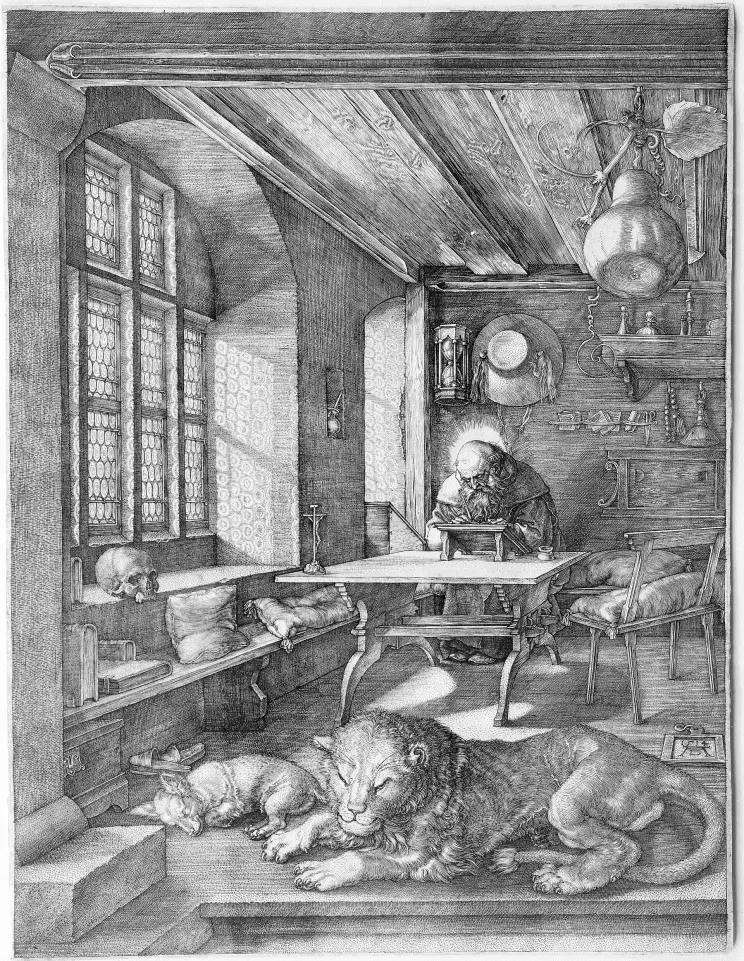
Key points
- Secretary to Pope Damasus I from 382
- Monastery at Bethlehem from 386
- The Old Testament translated directly from Hebrew rather than the Septuagint
- The Vulgate – the normative Bible of the Latin West, transmitted in many divergent copies
- Shelley: in Lent 374 the sick Jerome heard in a vision before the Judge: “You are not a Christian, you are a Ciceronian!” – the vision reflected the early Church’s struggle with pagan literature: Jerome loved the Lord but also Cicero, Virgil and Horace. Jerome (340–420) began as a hermit in Syria, occupied his mind with Hebrew, then in Rome advised Damasus and a circle of noblewomen; at Bethlehem he translated both Testaments into literary Latin – the Vulgate, authoritative in Rome until recently
People
- Jerome
- Damasus of Rome
- Paula
- Eustochium
- Marcella
- Siricius of Rome
- Augustine
Place
Rome, Antioch, Bethlehem
Sources disagree
The years of his hermitage at Chalcis are given differently (372–378 or 373/74); McGrath places the translation generally at the turn of the 4th–5th centuries, without specific dates.
Sources
- Tony Lane – Christian Thinkers (Russian edition), p. 51–53
- Stuart G. Hall – Doctrine and Practice in the Early Church (Russian edition), p. 120–122
- Justo L. González – The Story of Christianity, vol. I (Russian edition), Ch. 16
- Alister McGrath – Reformation Thought (Russian edition: «Theological Thought of the Reformation»), p. 201
- J. North – A History of the Church (Russian edition), p. 86
- Bruce L. Shelley – Church History in Plain Language (Russian edition), Ch. 8, introduction; Ch. 12, sec. «Переход к общинной жизни»
More on the doctrine
- The Canon in the Fourth Century: Athanasius's Festal Letter, the African Councils and Jerome's "Hebraica Veritas" (367 – c. 405)
Data compiled: 2026-11-09