1528–1577 · 16th century
Controversies in Lutheranism after Luther – Antinomian, Synergist, Majorist, Osiandrian – and the Formula of Concord
After Luther, Lutherans divided into "strict Lutherans" and "Philippists" – followers of Melanchthon, who in new editions of the Loci communes (from 1521) seemed to move away from original Lutheranism. Agricola denied the law a place in the preaching of the gospel; Melanchthon, and after him Pfeffinger (1555) and Strigel (1560), saw three causes in conversion – the Word, the Spirit and the human will, which opponents called "synergism"; Major asserted that good works are necessary for salvation, and Amsdorf that they are harmful to it; Osiander (1550) taught that it is the divinity of Christ dwelling in the believer that justifies. Luther himself had been called an "antinomian" by critics, since for him good works are the consequence, not the cause, of justification. The Formula of Concord (1577) rejected the extremes of all sides.
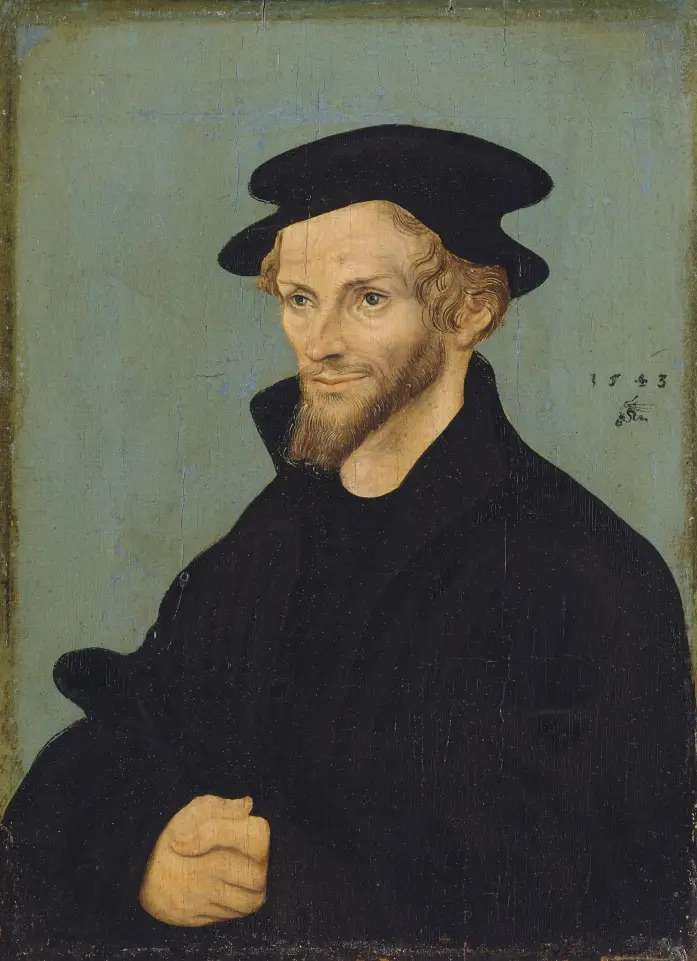
Positions
- Agricola
- The law has no function in the preaching of the gospel; its place is in the courthouse, not the pulpit; repentance follows faith
- Melanchthon, Pfeffinger, Strigel (Philippists)
- The Word, the Spirit and the will are three concurring causes of conversion; a human being is not "a block of wood"
- Flacius, Amsdorf (strict Lutherans)
- The will does not cooperate in conversion; Amsdorf: good works are harmful to salvation
- Major
- Good works are necessary for salvation and for its preservation
- Osiander
- Justification is not imputed but found in us, since Christ dwells in us: the ocean of His divine righteousness swallows the drop of our sin
- The Formula of Concord
- There are only two causes of conversion – the Holy Spirit and the Word; the "third use of the law" is affirmed; both the necessity and the harmfulness of works for salvation are rejected; Christ is our righteousness according to both natures
Key points
- The antinomian controversy had three stages: Torgau (1528), Agricola’s theses (1537), Amsdorf and Poach, who rejected the third use of the law
- Article VI of the Formula of Concord condemned antinomianism: it rejects the teaching that the Law is not to be urged upon true believers (Epitome VI.8)
- The Formula (art. I) rejects both the teaching that original sin is the very substance of man and the notion of it as "a slight, insignificant spot" (Epitome I.14, 19); by art. II, God does not coerce the will, but the Spirit, through the Word, "opens hearts" (Epitome II.5, 8)
- Melanchthon and Calvin accused Osiander of abandoning imputed righteousness; Flacius said he separates Christ’s satisfaction from justification
- Stancaro held Christ to be mediator only according to his humanity
- The Formula (art. XI) teaches that election should be considered a posteriori – sought not in God's secret counsel but in the Word, in Christ, "the Book of Life" – and that double predestination should not be elaborated: election extends only over the godly (Epitome XI.5–7, 19)
- Berkhof: antinomians leave almost no room for the subjective application of redemption; the seventeenth-century Lutheran order of salvation contains the germ of synergism
- Hendrix: the law–gospel controversy arose in the mid-1520s between two former students of Luther – Melanchthon and Agricola. Melanchthon argued that the law should be preached to effect contrition and repentance before forgiveness; for Agricola repentance is the new heart given by the Spirit through the gospel, not remorse caused by the law. In the Visitation Articles (1527), approved by Luther, Melanchthon cited Luke 24:47 and urged teaching the Ten Commandments as a guide to good works. Luther defended preaching the law while distinguishing it sharply from the gospel, mediating in 1527, at the catechisms (1529) and in the late 1530s; whether he, like Melanchthon, taught the “third use of the law” remains disputed
- Kusukawa: Melanchthon insisted on the “necessity” of good works as a result, not a cause, of justification; Amsdorf found it confusing, and Georg Major declared good works necessary to keep the believer in salvation, igniting the Majorist controversy. In his Scholia on Colossians Melanchthon developed the concept of law: in 1534 he formulated the third use of the law and stressed good works. In the 1543 Loci communes the law coerces, terrifies by exposing sin, and demands obedience, which the righteous owe even after justification
- Kolb: after Luther's death (1546) and the Augsburg Interim (1547), the followers of Luther and Melanchthon divided into two parties. They differed on four matters: doctrinal formulation (justification, anthropology, the Lord's Supper), ritual practice, church and state, and the public profile of confession. Gnesio-Lutherans simplified rites, resisted any reconciliation with Rome and defended the church's teaching independent of government; the Philippists were ready to cooperate with Catholic bishops and authorities for public harmony. In the adiaphora quarrel Gnesio-Lutherans held that parishioners' impressions outweigh theologians' intentions: concessions blur differences from Rome; once the threat of persecution receded, concern with the significance of liturgy abated. Agricola held that the law has no role for believers; Luther and Melanchthon twice rejected this as undermining daily repentance. Melanchthon’s and Amsdorf’s differences on good works, free will and the Supper hardened after Luther’s death owing to Charles V’s politics. In the 1550s both parties honed their teaching on justification in response to Andreas Osiander, who fled the Interim from Nuremberg to Königsberg (1550). He taught that sinners become righteous when faith brings Christ’s essential divine righteousness to dwell in them; his Neoplatonic early training, with kabbalistic studies, kept him from grasping Luther’s premise of the Word’s power to re-create sinners. He held that a “merely” forensic justification would make God a liar, calling righteous those who are not. Critics such as Chemnitz replied that God’s Word of absolution, based on Christ’s obedience, itself creates the reality of a new birth. Trust (fiducia) is the natural human response to God’s love; the Spirit effects it through the “means of grace”: oral, written and sacramental Word. Lutherans continued Luther’s critique of the scholastic doctrine of grace as habitus and of co-operation between will and Spirit. Melanchthon defended Luther’s bondage of the will against Erasmus but later began to describe the will’s openness to grace: Catholic charges of “Stoicism,” fear of a determinism making God responsible for evil, and concern for responsible human action, sharpened by the visitation of 1527–1528, which showed the dissolute state of peasant life. The Leipzig Interim’s language on the will’s ability to open itself to grace caused sharp controversy in the Wittenberg camp after 1555. The Philippists attacked Cyriakus Spangenberg, who repeated Luther’s views on the bondage of the will and eternal election: God elected certain individuals who would be converted, whereas the revealed Word says He wants mercy for all. The Formula held that the will acts psychologically but resists God until the Spirit moves it to faith; human contribution to conversion is passive; it distinguished God’s foreknowledge from his eternal election, which determined who would come to faith in Christ. Defending the Leipzig Interim, Georg Major espoused its proposition that “good works are necessary for salvation”; Amsdorf accused him of returning to papal doctrine, while himself holding good works a necessary part of Christian living. The Eisenach synod (1556) condemned Major’s proposition but held good works “theoretically necessary in the doctrine of the law”; Amsdorf, Otho and Poach rejected this formula too: it posited a human righteousness before God based on works. Poach, Otho and Musculus allowed only two uses of the law and rejected Melanchthon’s third use. The Formula affirmed the informative use of the law but stated that pious living springs from faith in Christ alone
Outcome
The Formula of Concord (1577) rejected synergism, antinomianism, both extreme formulations about good works and the teaching of Osiander; the dispute over predestination between Lutherans and Reformed was settled peacefully in Strasbourg (1563). In the seventeenth century Lutheran theologians worked out an order of salvation centered on faith and justification.
People
- Philip Melanchthon
- John Agricola
- John Pfeffinger
- Victorinus Strigel
- Matthias Flacius
- Nicholas von Amsdorf
- Andreas Poach
- George Major
- Andreas Osiander
- Francesco Stancaro
- Heinrich Bullinger
Terms
- synergism
- The teaching that in conversion and regeneration the human will and divine power act together.
- third use of the law – tertius usus legis
- The law as a rule revealing God's will to believers, by which the regenerate shape and regulate their whole life (alongside exposing sin and restraining the wicked).
- antinomian
- One in whose religious life there is no place for the law.
Place
Wittenberg, Torgau, Jena, Königsberg, Eisenach
Sources disagree
González (vol. III): Torgau – 1528, Agricola's theses – 1537, the Leipzig Interim – 1548, Osiander's Disputation on Justification – 1550, Pfeffinger's theses – 1555, the Strigel–Flacius disputation – 1560, the Formula of Concord – 1577; the beginning of the Majorist controversy is not dated.
Sources
Primary sources
- Formula of Concord, pt. 1, art. 1, 2, 6, 11
Textbooks
- Louis Berkhof – History of Christian Doctrines (Russian edition), p. 161, 164
- Justo L. González – A History of Christian Thought in One Volume (Abingdon, 2014), p. 353–356
- Justo L. González – A History of Christian Thought, vol. III: From the Protestant Reformation to the Twentieth Century (Abingdon, rev. ed. 1987), p. 111, 114–121, 125–128, 133
- Alister McGrath – Reformation Thought (Russian edition: «Theological Thought of the Reformation»), p. 148–149
- The Cambridge Companion to Reformation Theology, ed. David Bagchi, David C. Steinmetz (2004), p. 63–64, 70–71, 71, 74, 82–83, 82, 84–85, 85–86, 87
Related entries
- Develops: Luther: The Discovery of the "Righteousness of God" and Justification by Faith Alone (c. 1515 (1513–1521))
- Develops: Justification in Protestantism after Luther: Zwingli, Melanchthon's Forensic Justification, Bucer's Double Justification (1520–1571)
In church history
- The Formula of Concord and the "Book of Concord" (1577 (published 1580))
Data compiled: 2026-11-17