1545–1563 · 16th century
The Council of Trent
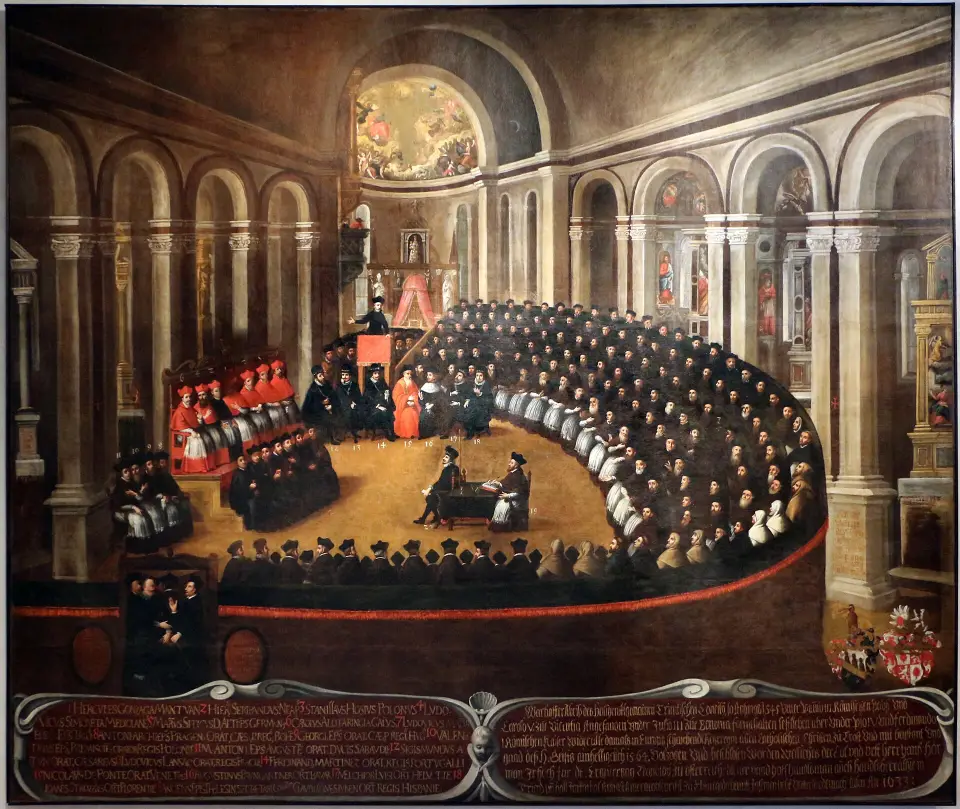
The council was convened by Paul III and met with long interruptions – in 1545–1547, 1551–1552 and 1562–1563 – in the imperial city of Trent. By the Catholic count it was the nineteenth ecumenical council. It worked on two fronts: a precise definition of doctrine against Protestantism, and reform of church discipline.
At Session IV in 1546 it placed Tradition on a par with Scripture, and in the decree on justification (Session VI, January 1547) it condemned sola fide. It later reaffirmed the seven sacraments, transubstantiation, and the sacrificial character of the mass.
At the same time the council introduced major disciplinary reforms. It required bishops' residence in their dioceses, banned plurality of benefices, and established seminaries.
In 1563–1564 Pius IV confirmed all the council's decrees. This closed the age of conciliarism and laid the foundations of modern Catholicism for more than three centuries to come.
Key points
- Tradition placed alongside Scripture; the Vulgate as the authentic text (Session IV, 1546)
- The decree on justification: condemnation of sola fide (Session VI, January 1547)
- Reaffirmation of the seven sacraments, transubstantiation and the sacrifice of the mass
- Disciplinary reforms: episcopal residence, seminaries; confirmation by Pius IV (1563–1564)
- Steinmetz: the council first met in 1545 at Trent, between imperial and papal power, so the place suited both sides. In 1547, for political reasons, it was moved to Bologna – quite unacceptable to Charles V: fourteen bishops loyal to the emperor stayed at Trent, and on 13 September 1547 Paul III suspended the council. Julius III, successor of Paul III (d. 1549), reassembled it at Trent in 1551 (penance, eucharist, extreme unction), but Maurice of Saxony's attack on Charles V endangered Trent, and on 23 April 1552 the pope suspended the council. Paul IV (Carafa) thought reconciliation with Protestants a dangerous illusion; Pius IV (1559) revived the council, which met on 18 January 1562 and, led by Borromeo, Gonzaga and Hosius, adjourned on 4 December 1563; Pius IV confirmed its decrees on 26 January 1564. The council arose from old abuses (absentee bishops, lax celibacy, unqualified appointments) and the reformers’ new critique of church authority. Apart from radicals, Protestants kept the Trinity and two natures of Christ – in the Smalcald Articles Luther disputed neither; but by the council’s opening Luther had been excommunicated for over twenty years, and Cardinal Carafa saw Protestants as permanent outsiders. Calvin was first to answer Trent (Acta Synodi Tridentini cum Antidoto, 1547); the fullest reply was Chemnitz's Examen (1565). Catholics were far more receptive to Trent's doctrinal decisions than to its moral and institutional reforms. Trent gave a clear statement on disputed questions; reconciliation is possible only on its basis, so Trent finalized the split.
- Shelley: Paul III agreed to call the Council at Trent, but Francis I, fearing Charles’s growth, obstructed, and two wars delayed it to 1545. Sessions ran in 1545–47, 1551–52 and 1562–63; Italians predominated, almost no French attended, and Protestants came to the second series without result. Two influential Jesuits, Laynez and Salmerón, gradually convinced the council that Loyola’s followers had a “truly churchly attitude”. Trent kept the pope, seven sacraments, sacrificial Mass, saints, confession and indulgences; its tone toward Protestants was reactionary. The West’s religious unity was broken for good, yet each side thought itself the true Church and the other false. A second stage followed: conflict seen as deadlocked, truth still definable, and resistance to false faith meant inquisitions and persecutions.
- Walter: Trent required a form of marriage (Tametsi, against clandestine unions); the Roman Catechism, Missale (1570) and Rituale (1614) followed.
People
- Paul III
- Julius III
- Pius IV
- Charles V
Place
Trent
Sources
- Alister McGrath – Reformation Thought (Russian edition: «Theological Thought of the Reformation»), p. 21, 137, 167–174, 207–208, 214, 226–227, 264–265, 270–271, 379–380
- Justo L. González – A History of Christian Thought in One Volume (Abingdon, 2014), p. 345, 347–352
- Justo L. González – A History of Christian Thought, vol. III: From the Protestant Reformation to the Twentieth Century (Abingdon, rev. ed. 1987), p. 241–244, 247–250, 254
- Justo L. González – The Story of Christianity, vol. II (Russian edition), Part 1, ch. 12
- Tony Lane – Christian Thinkers (Russian edition), p. 152, 220–223
- J. North – A History of the Church (Russian edition), p. 281–283
- Louis Berkhof – History of Christian Doctrines (Russian edition), p. 157–158, 171, 179, 186–187, 191
- Jaroslav Pelikan – The Christian Tradition: A History of the Development of Doctrine, vol. 1 (Russian edition), p. 54
- The Cambridge Companion to Reformation Theology, ed. David Bagchi, David C. Steinmetz (2004), p. 245, 245–246, 244–245, 255, 258
- Bruce L. Shelley – Church History in Plain Language (Russian edition), Ch. 28, sec. «Призыв к Вселенскому Собору», «Общество Иисуса»; Ch. 28, sec. «Облик современного католичества»
- The Oxford Handbook of Sacramental Theology, ed. Hans Boersma, Matthew Levering (2015), p. 392–393
More on the doctrine
- The Council of Trent on Scripture and Tradition (Fourth Session, 1546) (April 8, 1546)
- The Tridentine Decree on Justification and the Anathemas against Protestant Teaching (1547)
- The Council of Trent and Bellarmine: the Catholic definition of the Church and papal authority (1545–1563)
Data compiled: 2026-11-09