1545–1563 · 16th century
The Council of Trent and Bellarmine: the Catholic definition of the Church and papal authority
According to Berkhof, the Roman conception of the Church was not officially formulated before the Reformation: Trent itself did not venture to define the Church, since the curia wanted recognition of the papal system while many bishops held that their authority came directly from Christ. González shows that by the end of the council Pius IV was "unquestionably master of the assembly": the council asked him to confirm its decrees, and the pope became the source of the council's authority and its final interpreter. The Tridentine Catechism defines the Church as the assembly of the faithful "with one invisible Head, Christ, and one visible head, the successor of Peter"; Bellarmine, as a society bound by the profession of one faith, the same sacraments and submission to lawful pastors, especially the Roman pontiff. He ascribed to the pope only indirect temporal power.
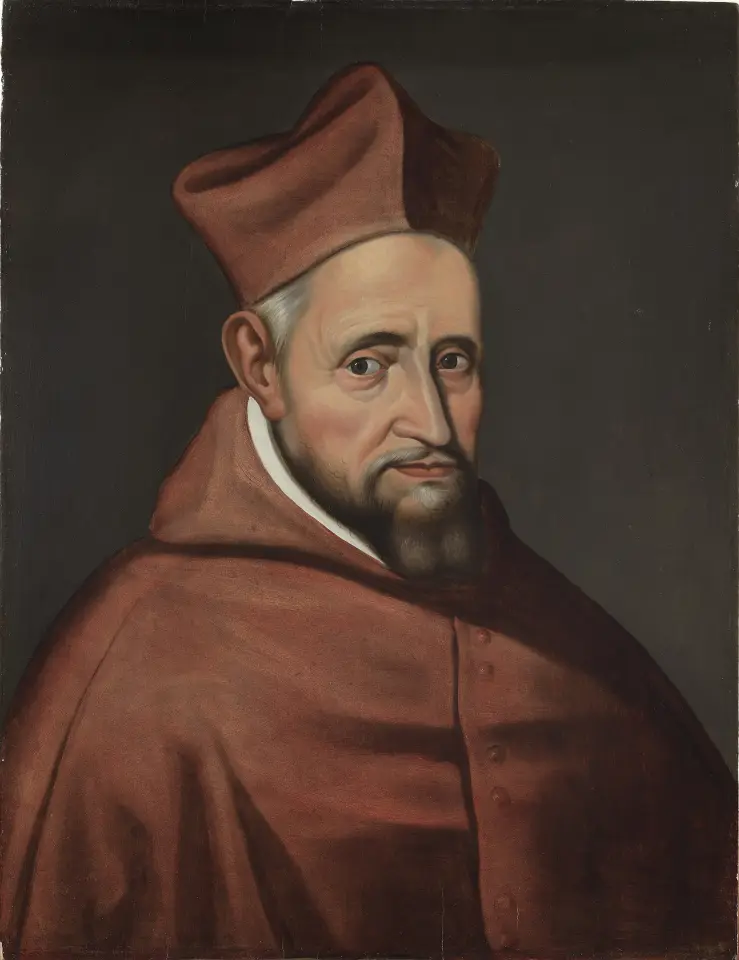
Positions
- The curia
- Recognition of the papal system
- Episcopalists at the council
- The bishops' authority comes directly from Christ
- Bellarmine
- The pope has no direct temporal power over the world but has indirect power: he may intervene and depose a ruler who hinders the salvation of his subjects
- Sixtus V
- The theory of indirect power is insufficient; the first volume of the Disputations placed on the Index (1590)
Key points
- Pius IV declared the council ecumenical by a bull and forbade publishing commentaries on its decisions without the approval of the Holy See
- Berkhof: Bellarmine's marks exclude unbelievers, catechumens, the excommunicated and schismatics; the Church leads people to the Word, not the other way round
- Lane: Ignatius of Loyola in the Rules for Thinking with the Church taught obedience to “the true Spouse of Christ our Lord, which is our holy Mother the Church Hierarchical” (rule 1) and to hold “that the white which I see, is black, if the Hierarchical Church so decides it” (rule 13)
- González: Bellarmine's Disputations (1586–1593) became for several centuries the chief weapon of anti-Protestant polemics. Pigge (1538) claimed that no pope had ever erred – a step toward the dogma of the First Vatican Council
- Bagchi: papal absolutism had defenders among sixteenth-century polemicists (Prierias, Pighi), but fewer than supposed: they denied a pope could be heretical. Catharinus supported papal infallibility and denied councils independent authority; most Catholic theologians did not go so far. Humanists inclined to concord: Thomas More was no papalist, and Clichtove subjected the pope to canon law. Cajetan held that Peter received the keys in persona ecclesiae, as representative of all apostles, not as a leader set over them. After the bull Pastor aeternus gregem (1516) outlawed conciliarism, full-blooded conciliarism was not to be expected among Rome's defenders. Among Franciscan defenders, whose order had friction with the holy see, there is coolness toward defending papal power: Thomas Murner's treatment of the papacy was the driest of his anti-Lutheran polemic, and the provincial Kaspar Schatzgeyer did not deal with papal primacy at all. Alveldt in Super apostolica sede (1520) made the pope head of a church that is first the company of the faithful, not the hierarchy. To the early evangelical appeal to secular authority Catholic writers answered with Ockham, the two swords (Luke 22:38) and the Donation of Constantine
- Steinmetz: Luther replaced hierarchy with one ministry of Word, the Reformed with a fourfold one; Trent affirmed hierarchical priesthood: ordination imprints an indelible mark, priesthood is an ontological change, and only a priest can celebrate the Eucharist
Outcome
According to González, the conciliar movement of the late Middle Ages came to an end and the modern Roman Catholic Church was born; Trent, according to Lane, dominated Catholicism for almost 400 years, until the Second Vatican Council.
People
- Paul III
- Pius IV
- Charles V
- Robert Bellarmine
- Sixtus V
- Ignatius of Loyola
- Albert Pigge
Place
Trent, Rome
Sources disagree
The council 1545–1563 (González, Lane; convened in 1542); Lane: Pius IV confirmed its decisions in 1564; Bellarmine 1542–1621, the Disputations 1586–1593.
Sources
Primary sources
- Ignatius of Loyola – Spiritual Exercises, para. 353, 365
Textbooks
- Louis Berkhof – History of Christian Doctrines (Russian edition), p. 171–172
- Justo L. González – A History of Christian Thought in One Volume (Abingdon, 2014), p. 347–348, 351–352
- Justo L. González – A History of Christian Thought, vol. III: From the Protestant Reformation to the Twentieth Century (Abingdon, rev. ed. 1987), p. 209–211, 249–250
- Tony Lane – Christian Thinkers (Russian edition), p. 215–219, 223
- The Cambridge Companion to Reformation Theology, ed. David Bagchi, David C. Steinmetz (2004), p. 235, 235–236, 252–253
Related entries
- Rejects: Conciliarism: the authority of the council over the pope (1378–1417)
In church history
- The Council of Trent (1545–1563)
Data compiled: 2026-11-17