May 1542 – 1552 · 16th century
Francis Xavier's mission to India and Japan
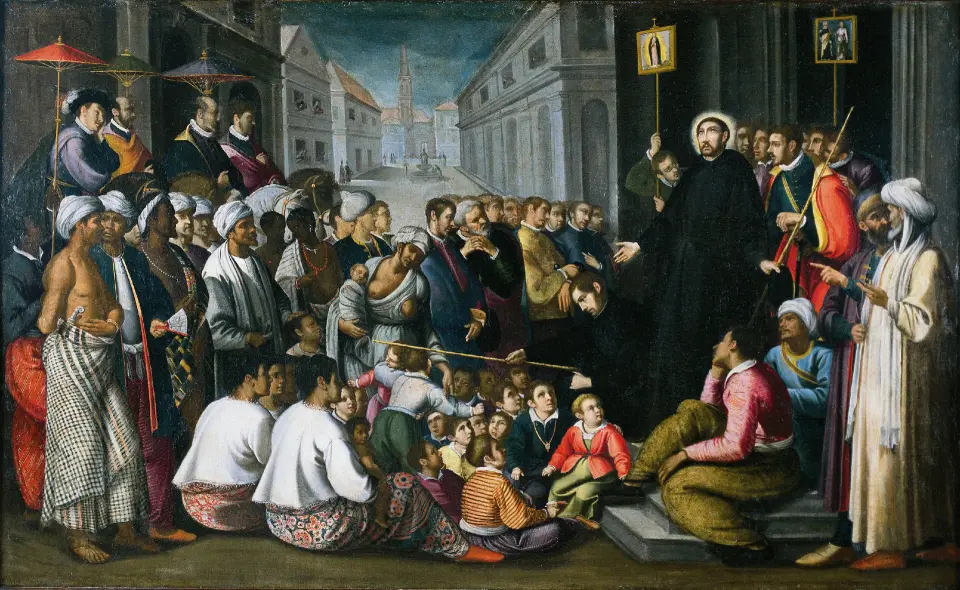
At the request of the Portuguese king John III, the Jesuit Francis Xavier arrived at Goa in May 1542. There he gathered children for catechesis with a handbell. He then preached along India's Pearl Fishery Coast, where converts came mostly from the lower castes.
In 1549 he sailed to Japan and planted a church there. Despite brutal persecution after his death, it survived underground: three centuries later some hundred thousand secret Christians were found in Nagasaki.
In 1552 Xavier set out for China but died on an island off its coast, never reaching the mainland. He had become head of the new Jesuit province east of the Cape of Good Hope.
Key points
- Catechizing children in Goa and preaching on the Pearl Fishery Coast
- The mission to Japan from 1549
- The hidden survival of the Japanese church after persecution
- Death off the coast of China (1552) without reaching the mainland
- Shelley: Francis Xavier (1506–1552), Loyola's assistant, landed at Goa in 1542 as papal legate in the service of the king of Portugal. Goa seemed to him full of the scum of a thousand coasts, and he turned his eyes to southern India: some thirty thousand Paravar fishermen, baptized in 1534 for Portuguese protection, had had no teacher for eight years. The “little dark man” rang a bell, read the Creed, Lord's Prayer, Ten Commandments and Rosary aloud, and baptized by the hundreds; after three years the church was organized and survived as an island in a sea of Hinduism. Christianity stayed within one caste; Jesuits with Portuguese support gathered Paravars into villages and shaped their life by Christian standards. Catholics and Protestants praise Xavier’s zeal, but he was a man of his age: in 1546 he asked Portugal’s king to bring the Inquisition to India against Muslims; the king granted it, and the Goa Inquisition lasted until the early nineteenth century. In 1546 Xavier went to Malaya, and in 1549 he sailed to Japan and landed on 15 August with two companions. Japan, ruled by feudal lords and wishing to trade, welcomed the travellers; Buddhism was out of favour and no national religion resisted stubbornly. In India Xavier had held to imperialism and thought polytheism had nothing to do with true faith, but in Japan, meeting many aristocrats, he saw that the Gospel must transform the Japanese, not throw away all their life and culture. The Jesuits who followed him developed a trait uncharacteristic of the Counter-Reformation – compromise in religious matters. In 1577 one Jesuit wrote: “Ten more years, and all Japan will be Christian, if we have enough missionaries”; in 1579 the Jesuits built Nagasaki, and by the end of the century had 300,000 converts, hundreds of churches and two colleges. But from 1614 to 1642 at least 4,045 martyrs bore witness; Christian work disappeared, surviving only in the hills near Nagasaki
People
- Francis Xavier
- John III of Portugal
- Ignatius of Loyola
Place
Goa; the Pearl Fishery Coast; Japan; China
Sources
- J. North – A History of the Church (Russian edition), p. 12
- Justo L. González – The Story of Christianity, vol. I (Russian edition), Ch. 31, sec. 31.2
- Bruce L. Shelley – Church History in Plain Language (Russian edition), Ch. 29, sec. «Франциск Ксаверий»
Data compiled: 2026-11-09