1870 · 19th century
The First Vatican Council: the dogma of papal infallibility
Pius IX's bull Ineffabilis Deus (1854) was, for the first time in the history of the Church, a dogmatic definition made by the pope alone, and it convinced the ultramontanes that the proclamation of papal infallibility was near. At the First Vatican Council, convened in 1868, some wanted a definition without limits, the majority a definition that took into account popes who had fallen into heresy (Liberius, Honorius), some bishops considered the moment inopportune, and a minority led by the archbishops of Vienna and Prague rejected the teaching. On 18 July 1870 (session 4) the constitution "The Church of Christ" (ch. 4) proclaimed that the Roman pontiff, speaking ex cathedra, possesses the infallibility with which the Redeemer willed His Church to be endowed, and that his definitions are "irreformable of themselves and not from the consent of the church." The same decree (ch. 3) affirmed the pope's direct jurisdiction over the whole Church: it is "both episcopal and immediate".
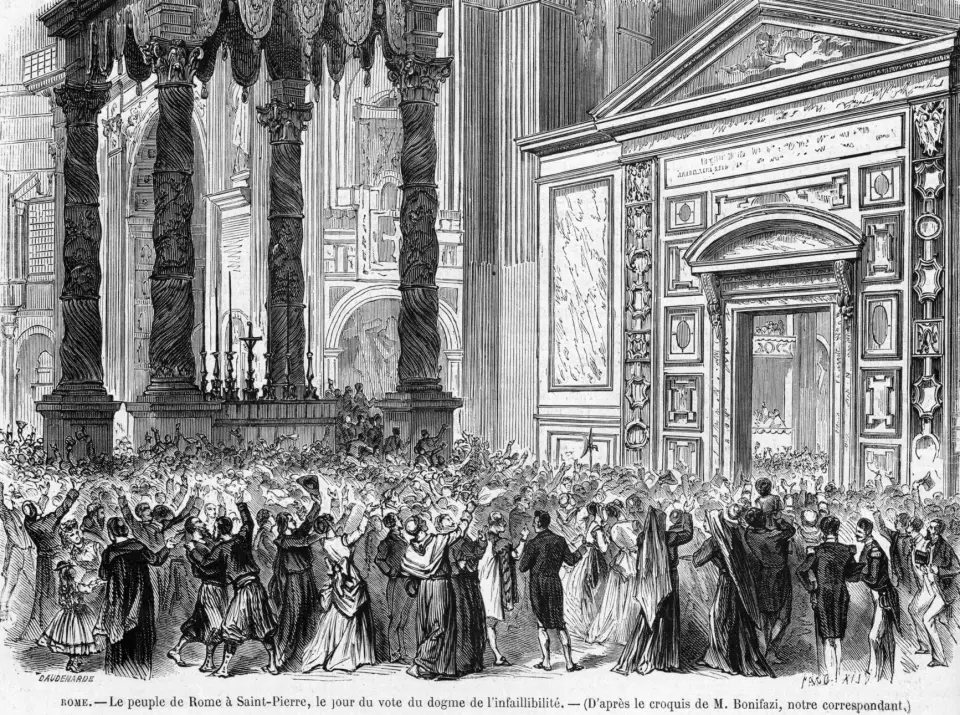
Positions
- Extreme ultramontanes (Ward)
- Infallibility without limits; "when the pope thinks, God thinks in him"
- The majority and Pius IX
- Infallibility is a divinely revealed dogma, defined in a way that takes into account the falls of some popes
- The minority (the archbishops of Vienna and Prague, Döllinger)
- Rejected the teaching or considered the definition inopportune
- Newman
- The definition would cause fear and aversion through "excessive zeal"
Key points
- Lane: the final decision was adopted by 533 votes to 2. To the charge of departing from tradition Pius IX answered: "Tradition? I am tradition". In Ineffabilis Deus Lane sees "the triumph of dogma over tradition" and a "trial balloon" for the dogma of 1870
- González: the decision was adopted by 522 to 2 with more than a hundred abstentions; the conciliar movement finally died, and it was this council that dealt the decisive blow
- Berkhof: for two hundred years the Gallican party held that the pope can err and is subject to the council; in 1791 fifteen hundred English Catholics denied that infallibility is a dogma
- Shelley: the Council affirmed primacy: the pope, Peter’s successor, has full, direct power over the whole Church and its bishops in faith, morals, discipline and government. The second doctrine is infallibility: a pope’s ex cathedra decision on faith and morals for the whole Church is infallible in itself, not by consent.
Outcome
Döllinger refused to accept the definition and was excommunicated; the Old Catholic Church was formed from those who dissented. The Orthodox and Protestants did not accept the dogma, and the rift between Rome and other churches widened (Lane); González calls the papacy's victory "hollow": two months later the pope lost Rome. Since 1870 only one infallible decision has been made – in 1950 (Lane).
People
- Pius IX
- Henry Edward Manning
- W. G. Ward
- Johann Joseph Ignaz von Döllinger
- John Henry Newman
Terms
- ex cathedra
- When the pope, in his office as pastor and teacher of all Christians, defines a doctrine of faith or morals for the whole Church.
- infallibility
- The property of the pontiff's decisions of being irreformable of themselves.
Place
Rome
Sources disagree
González: the council was convened in 1868, opened on 8 December 1869, the definition on 18 July 1870; vote count: Lane – 533 to 2, González – 522 to 2.
Sources
Primary sources
- First Vatican Council – Dogmatic Constitution Pastor aeternus, session 4, ch. 3–4
Textbooks
- Louis Berkhof – History of Christian Doctrines (Russian edition), p. 175–176
- Justo L. González – A History of Christian Thought in One Volume (Abingdon, 2014), p. 400–401
- Justo L. González – A History of Christian Thought, vol. III: From the Protestant Reformation to the Twentieth Century (Abingdon, rev. ed. 1987), p. 409–410
- Tony Lane – Christian Thinkers (Russian edition), p. 296–299
- Bruce L. Shelley – Church History in Plain Language (Russian edition), Ch. 36, sec. «Непогрешимость папы»
Related entries
- Rejects: Gallicanism, Febronianism and ultramontanism: the limits of papal authority (17th–18th centuries (1682))
- Answered by: The Second Vatican Council: the collegiality of bishops and the Church in the modern world (1962–1965)
In church history
- The First Vatican Council, the dogma of papal infallibility, and the Old Catholic schism (1869–1871)
Data compiled: 2026-11-17