1869–1871 · 19th century
The First Vatican Council, the dogma of papal infallibility, and the Old Catholic schism
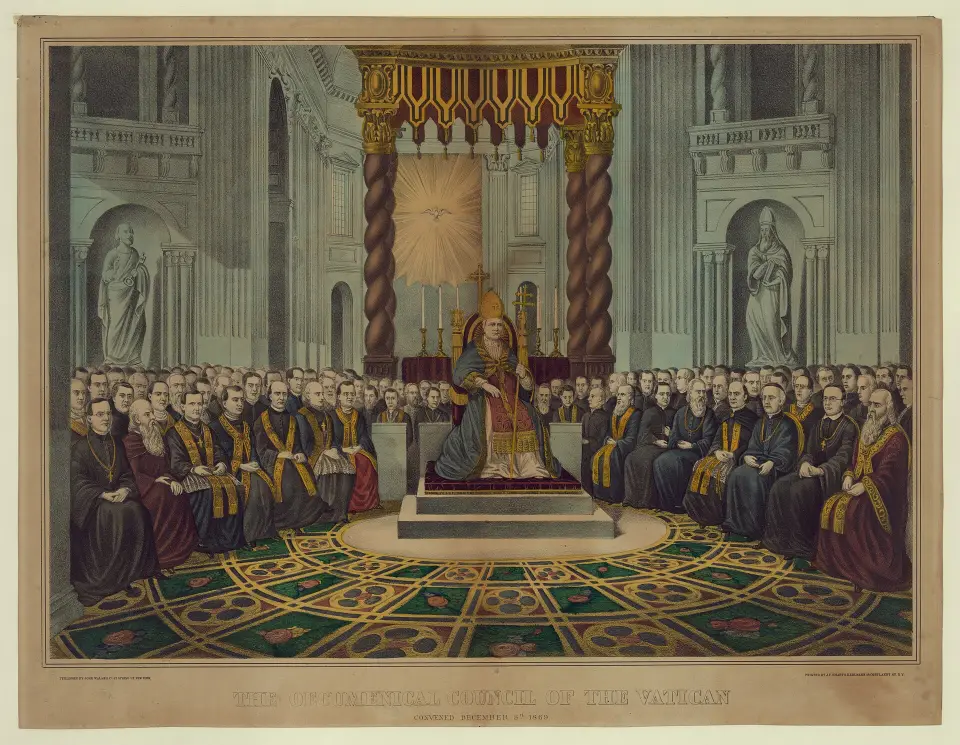
Pius IX convened the First Vatican Council in 1868. It opened on 8 December 1869 under the control of ultramontanists led by Cardinal Manning.
On 18 July 1870 the constitution Pastor Aeternus was adopted by an overwhelming vote: 522–533 to 2, with over a hundred abstentions. It proclaimed that the pope, speaking ex cathedra on faith and morals, is infallible. His definitions are irreformable of themselves, apart from the church's consent. The council was interrupted by the Franco-Prussian War and never formally closed.
The German historian Ignaz von Döllinger refused to accept the dogma and was excommunicated. Some Catholics in Germany, Austria, and the Netherlands formed the "Old Catholic" church under Bishop Reinkens.
On 20 September 1870, two months after the dogma's proclamation, Italian troops occupied Rome. The pope declared himself a "prisoner of the Vatican." The papacy's temporal power, dating back to the "Donation of Pepin" (756), came to an end.
Key points
- The constitution Pastor Aeternus (18 July 1870): papal infallibility ex cathedra
- A vote of roughly 522–533 to 2
- Döllinger's excommunication and the formation of the Old Catholic Church
- The council's interruption by the Franco-Prussian War
- Italian troops' capture of Rome (20 September 1870) and the end of papal temporal power ("prisoner of the Vatican" until 1929)
- Shelley: Vatican I (1869–1870) was the culmination of ultramontanism; on 18 July 1870, 533 bishops voted for the infallibility dogma, two against. The start of the Franco-Prussian War (19 July 1870) sent many Council fathers hurrying home, and the occupation of Rome by Italian nationalists on 20 December 1870 ended hopes of continuing the Council. Symbolically, the Council ‘rebuilt the Bastille’; besieged Rome sheltered behind infallible papacy, but citadels are stuffy.
People
- Pius IX
- Henry Edward Manning
- Ignaz von Döllinger
- John Henry Newman
- Joseph Hubert Reinkens
- Victor Emmanuel II
Place
Rome (Vatican); Germany; Netherlands; Austria
Sources disagree
The number of votes in favor is given as either 522 or 533 (against two) across the sources; the discrepancy is left as reported.
Sources
- Tony Lane – Christian Thinkers (Russian edition), p. 300–303
- Justo L. González – A History of Christian Thought, vol. III: From the Protestant Reformation to the Twentieth Century (Abingdon, rev. ed. 1987), p. 408–410
- J. North – A History of the Church (Russian edition), p. 322–323
- Justo L. González – A History of Christian Thought in One Volume (Abingdon, 2014), p. 400–401
- Justo L. González – The Story of Christianity, vol. II (Russian edition), Part 3, ch. 29, section «Пий IX»
- Louis Berkhof – History of Christian Doctrines (Russian edition), p. 176
- Bruce L. Shelley – Church History in Plain Language (Russian edition), Ch. 36, sec. «Непогрешимость папы»
More on the doctrine
Data compiled: 2026-11-09