17th–18th centuries (1682) · 17th century
Gallicanism, Febronianism and ultramontanism: the limits of papal authority
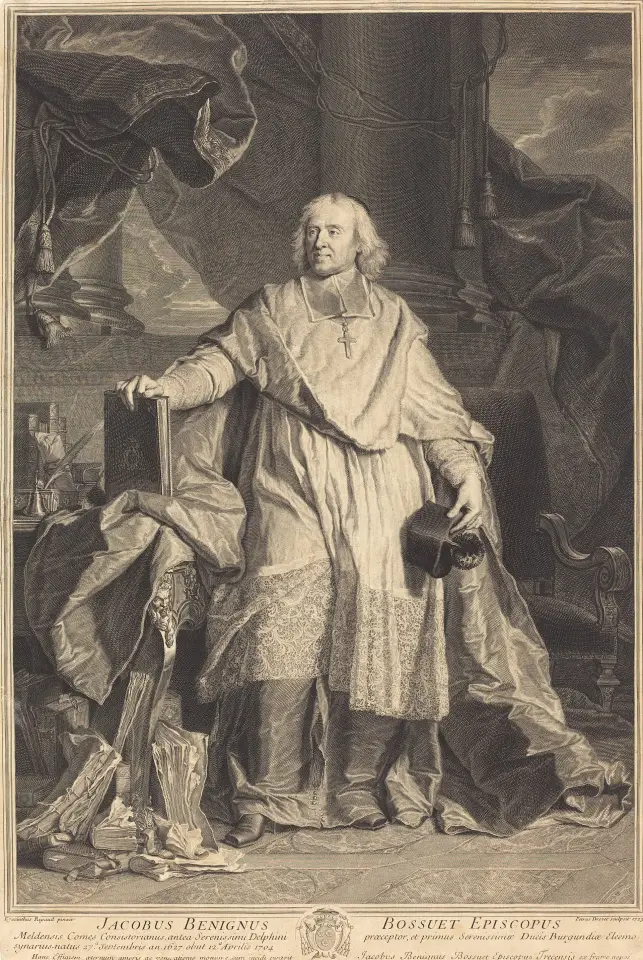
One of the chief theological questions of Catholicism in the 17th–19th centuries was the nature and extent of papal authority. The Gallicans regarded the pope as a constitutional monarch subject to the council; the ultramontanes ("beyond the mountains") as an absolute monarch from whom even the council's authority derives. Richer (1611) made Gallicanism theological: the only head of the church is Christ, who delegated authority to the faithful, and the pope is the servant of the council. The Six Articles of the Sorbonne (1663) and Bossuet's Four Articles (1682) affirmed the king's independence in temporal matters, limited the pope's authority by the ancient canons and denied his infallibility as a binding dogma. Febronius (1763) taught that the pope's authority comes from the whole church and a council may judge him; de Maistre and Lamennais, by contrast, placed the pope above kings and held him to be infallible.
Positions
- The Gallicans (Richer, Bossuet)
- The pope is a constitutional monarch; the council is above the pope; papal decisions need the approval of the church
- Febronius
- The pope's authority comes from the whole church; he is not above the other bishops and may be judged and deposed by a council
- The ultramontanes (de Maistre, Lamennais)
- The pope is an absolute monarch, above the king, infallible; there is no lawful resistance to him
- The pope, the Inquisition
- Refusal to accept the Four Articles; condemnation of Febronianism (1764) and Josephinism (1794)
Key points
- González: the roots lie in the concordat of 1516, which gave the king extensive powers over the Church; the "Gallican liberties" were traditional practices. The bishops’ genuine defense of the national Church’s autonomy must be distinguished from the king’s desire to extend his power: in 1682 Louis XIV used Gallicanism for his own ends. The pope's power over the church grew while the church's real power diminished
- Joseph II applied Febronius' theories in the empire (Josephinism), together with measures against the orders as instruments of the pope
- Lamennais called Gallicanism “a system of believing as little as possible without being a heretic and obeying as little as possible without being a rebel”
- Lamennais was later condemned (1832, 1834)
Outcome
The French Revolution put an end to Gallicanism, Febronianism and Josephinism, and in the 19th century ultramontanism quickly prevailed (González); by the 19th century most Catholics, according to Lane, shared ultramontane views.
People
- Edmond Richer
- Jacques-Bénigne Bossuet
- Louis XIV
- Justinus Febronius (Hontheim)
- Joseph II
- Joseph de Maistre
- Félicité de Lamennais
Terms
- Gallicanism
- Opposition to excessive church centralization, especially in France.
- ultramontanism
- The defense of papal authority, whose center lies "beyond the mountains" (the Alps).
Place
France, Germany, Austria
Sources disagree
González: the concordat in 1516, the Six Articles in 1663, the Four Articles in 1682, Febronius' treatise in 1763; Lane regards the Four Articles of 1682 as the classic expression of Gallicanism.
Sources
- Justo L. González – A History of Christian Thought in One Volume (Abingdon, 2014), p. 398–400
- Justo L. González – A History of Christian Thought, vol. III: From the Protestant Reformation to the Twentieth Century (Abingdon, rev. ed. 1987), p. 397–407
- Tony Lane – Christian Thinkers (Russian edition), p. 296–297
Related entries
- Develops: Conciliarism: the authority of the council over the pope (1378–1417)
- Rejected in: The First Vatican Council: the dogma of papal infallibility (1870)
In church history
- Gallicanism, Febronianism, Josephinism, and the French Revolution's Assault on the Church (1615–1799)
Data compiled: 2026-11-17