1962–1965 · 20th century
The Second Vatican Council: the collegiality of bishops and the Church in the modern world
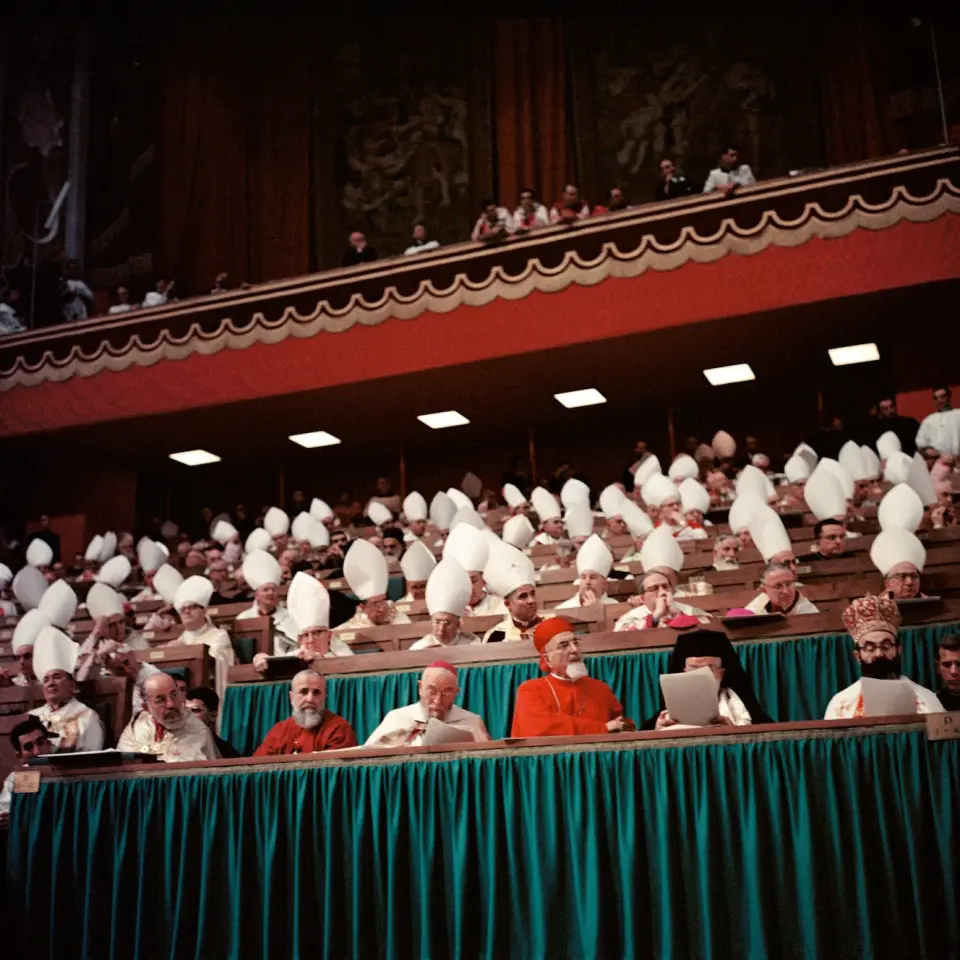
John XXIII, elected in 1958, convened the council for the sake of "aggiornamento": dogma is unchanging, but the form of its expression can and must change; Protestants are "separated brethren." According to Lane, the constitution on the Church seeks to correct the First Vatican Council's emphasis on the absolute sovereignty of the pope: bishops are "successors of the apostles in the authority of teaching and pastoral governance," and the body of bishops has supreme and full power over the universal Church "together with its head, the Roman pontiff, and never without him," while the pope retains full, supreme, universal power. Rahner understood catholicity as the Church's incarnation in the various situations of the world and developed the collegiality of bishops as a sign of catholicity rather than a limit on papal power. The pastoral constitution Gaudium et spes expressed the Church's solidarity with the joys and hopes, griefs and anxieties of people of our time.
Positions
- The First Vatican Council (according to Lane)
- The absolute sovereignty of the pope
- The Second Vatican Council
- The college of bishops together with the pope holds supreme authority; the pope retains full power
- The theological commission and the curia
- Preserve the "deposit of faith" from modern errors and tighten discipline
- Rahner
- Catholicity is incarnation, not uniformity; vernacular languages; the collegiality of bishops
Key points
- Lane: the image of a "pilgrim Church" instead of a "Roman fortress"; the council closed the 400-year period of "Tridentine Catholicism". Mary's status is treated in the last chapter of the constitution on the Church as part of the Church; a separate document on her was rejected by 1,114 votes to 1,074
- González: documents on liturgical reform (Mass in the vernacular), religious freedom (which set aside Pius IX's Syllabus), ecumenism and the Eastern churches; the experts included Rahner, Congar and de Lubac; most bishops came from Third World countries
- Paul VI and John Paul II, according to Grenz and Olson, brought a conservative reaction
Outcome
The council placed the pope within the college of bishops while leaving him full power (Lane), and opened the Church to the modern world and to dialogue with other Christians; the spirit of the council, according to González, did not always prevail afterwards.
People
- John XXIII
- Paul VI
- Karl Rahner
- Yves Congar
- Henri de Lubac
- Hans Küng
Terms
- aggiornamento
- Bringing the Church up to date with the present.
- collegiality
- According to Rahner, the collegiality of all bishops as a sign of catholicity, not a limit on papal authority.
Place
Rome
Sources disagree
González: the council was announced three months after John XXIII's election (1958) and opened on 11 October 1962; Lane: convened in 1961; Grenz and Olson date the start of aggiornamento to 1959.
Sources
- Justo L. González – A History of Christian Thought in One Volume (Abingdon, 2014), p. 424–425
- Justo L. González – A History of Christian Thought, vol. III: From the Protestant Reformation to the Twentieth Century (Abingdon, rev. ed. 1987), p. 474–477
- Tony Lane – Christian Thinkers (Russian edition), p. 303–304
- Stanley Grenz, Roger Olson – 20th-Century Theology: God and the World in a Transitional Age (Russian edition), p. 359–360
Related entries
- Response to: The First Vatican Council: the dogma of papal infallibility (1870)
In church history
Data compiled: 2026-11-17