c. 180 · 2nd century
Irenaeus: the apostolic succession of bishops against the Gnostics
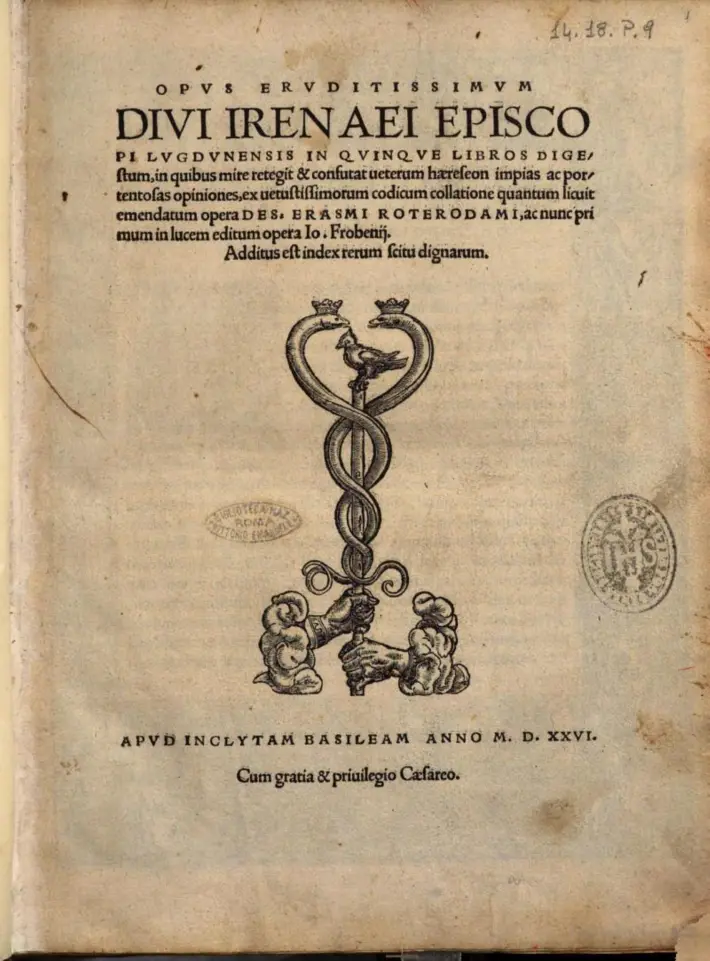
The Gnostics presented their teaching as secret apostolic knowledge. Irenaeus replies (Against Heresies 3.3.1–3) that if the apostles had had secret knowledge, they would have passed it on to the bishops they appointed; therefore the truth is kept openly in the churches where the succession of bishops from the apostles can be checked by lists – above all in the Roman church. González shows that under the pressure of heresies the ideas of succession and of the monarchical episcopate merged into the notion of an unbroken chain of bishops. Berkhof sees a turning point here: the Church came to be understood as an external organization governed by the bishop as the direct heir of the apostles, and the visible communion as the channel of grace.
Positions
- The Gnostics (Marcion, Valentinus, Basilides)
- Secret apostolic knowledge received by a special route – through Paul, Theudas, Glaucias
- Irenaeus
- There was no secret knowledge; the truth was handed on openly to successor bishops and is kept in churches where the succession can be verified
Key points
- Irenaeus: all churches must agree with Rome “because of its preeminent authority” (Against Heresies 3.3.2)
- Hall: this refers to the apostolic tradition preserved in Rome, not to a right to dictate dogma. Irenaeus developed a theory of the “unanimity of bishops” enabling a correct understanding of the Word of God; he has no direct statements about grace passed on through successors. Around 200 city bishops extended their authority over the surrounding area – Hall sees in this a hierarchy of the conciliar type proposed by Irenaeus
- Irenaeus: “Where the Church is, there is the Spirit of God; and where the Spirit of God is, there is the Church and all grace” (Against Heresies 3.24.1)
- Pelikan: the doctrine of the means of grace developed faster than the doctrine of grace itself; “apostolic”, “catholic” and “orthodox” became synonyms
- Tertullian challenged Marcion to produce even one church going back to an apostle
Outcome
Succession became one of the chief anti-heretical arguments; a single system of authority took shape – Scripture, tradition, creed, and episcopal succession (Pelikan). Berkhof sees here the seeds of the Roman Catholic conception of the Church.
People
- Irenaeus of Lyons
- Polycarp of Smyrna
- Tertullian
- Hegesippus
- Victor, bishop of Rome
Terms
- apostolic succession
- The appointment of church leaders by the apostles and the transmission of their authority to successors; an unbroken chain of bishops leading back to the apostles.
Place
Lyons, Rome
Sources disagree
Hall: c. 180, with the list of Roman bishops repeated in a letter to Victor in 190; González: c. 170–202; Pelikan and Berkhof give no date (2nd–3rd centuries).
Sources
Primary sources
- Irenaeus of Lyons – Against Heresies, bk. III, ch. 3–4, 24
Textbooks
- Stuart G. Hall – Doctrine and Practice in the Early Church (Russian edition), p. 27, 42–43, 50–51
- Jaroslav Pelikan – The Christian Tradition: A History of the Development of Doctrine, vol. 1 (Russian edition), p. 137–140, 162–163
- Louis Berkhof – History of Christian Doctrines (Russian edition), p. 44–45, 166
- Justo L. González – A History of Christian Thought in One Volume (Abingdon, 2014), p. 62, 71–72
Related entries
- Develops: First Clement: the apostolic succession of ministry (late 1st century (c. 96))
- Develops: Ignatius of Antioch: the monarchical episcopate and the "catholic church" (early 2nd century (no later than 115))
- Developed in: Tertullian, The Prescription against Heretics: Scripture Belongs to the Church (c. 200)
- Developed in: Cyprian: the unity of the Church in the episcopate and "no salvation outside the Church" (251–258)
In church history
- Irenaeus of Lyons and his work Against Heresies (c. 130 – 202 (chief work written c. 180))
Data compiled: 2026-11-17