c. 200 · 2nd century
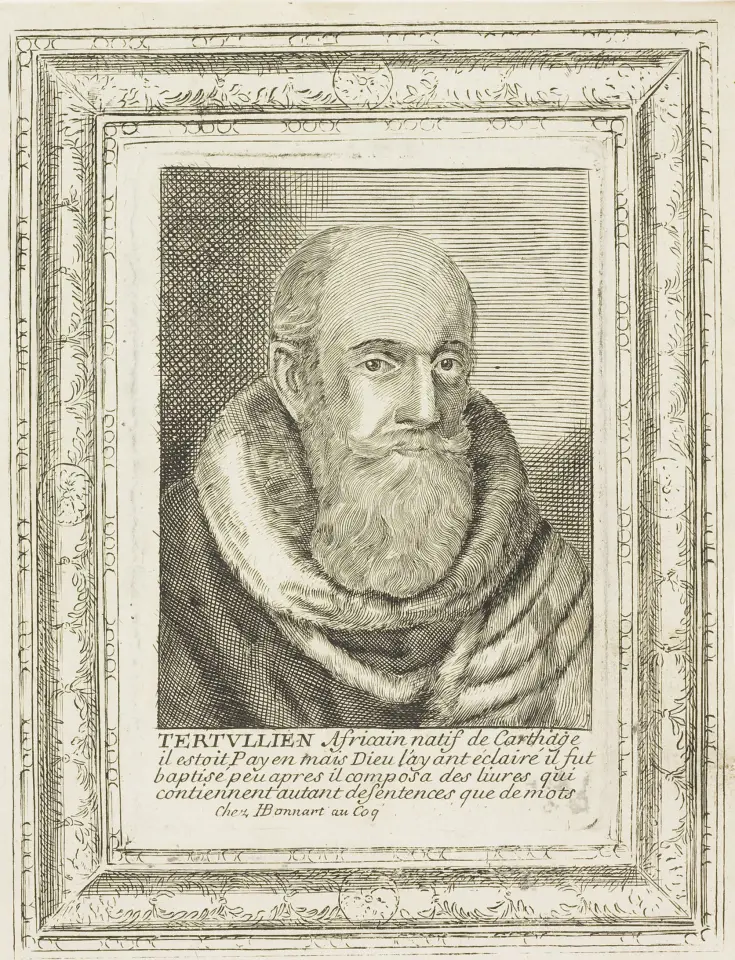
Tertullian, The Prescription against Heretics: Scripture Belongs to the Church
In Roman law the word praescriptio denotes an objection that the opposing party has no right to bring the case. Developing the arguments of Irenaeus, Tertullian does not discuss the teachings of the heretics but denies them the right to argue on the basis of Scripture (chs. 15–19): the apostles handed on the Scriptures and the true teaching, briefly expressed in the rule of faith, to their successors, and these to theirs. The heretics cannot prove succession (ch. 32); they are "newcomers" with new teachings (chs. 29–31) and are therefore not Christians (ch. 37). Hence also the famous question: "What has Athens to do with Jerusalem?" (ch. 7)
Positions
- Tertullian
- Scripture belongs only to the Church, which inherited it from the apostles; heretics have no right to appeal to it: "what are you doing with my property?" (ch. 37)
- Hall
- Tertullian himself is steeped in the ideas of ancient philosophy, especially Stoicism, and hides this from himself
Key points
- Heresies, according to Tertullian, are ancient errors of the philosophers transferred to the level of faith (ch. 7)
- Hall: Tertullian stresses the authority of Rome, where Peter and Paul died (ch. 36)
- González: Tertullian soon became a Montanist and had to use exactly the kind of argument the Prescription had ruled out
- Lane: the same argument did not prevent Tertullian from sharply criticizing the catholic church
Outcome
A position took shape in which apostolic succession and the rule of faith serve as the criterion of truth, and the right to interpret Scripture belongs to the Church.
People
- Tertullian
- Marcion
- Valentinus
- Apelles
Terms
- prescription – praescriptio
- In Roman law, an objection to the proceedings themselves rather than to the substance of the case.
- rule of faith – regula fidei
- The brief content of apostolic teaching, professed at baptism: one God the Creator, Jesus Christ and his coming, the Holy Spirit, resurrection and judgment. In Irenaeus, also the "rule of truth".
Place
Carthage
Sources disagree
The books do not date the treatise precisely. González: the Apology – 197, the turn to Montanism – "probably 207"; Hall places Tertullian's turn to Montanism in 200 and the treatise in the early 3rd century; Lane – after 197.
Sources
Primary sources
- Tertullian – The Prescription against Heretics, ch. 7, 15–21, 29–32, 36–37
Textbooks
- Stuart G. Hall – Doctrine and Practice in the Early Church (Russian edition), p. 47–48
- Justo L. González – A History of Christian Thought in One Volume (Abingdon, 2014), p. 73–75
- Tony Lane – Christian Thinkers (Russian edition), p. 22–23
Related entries
- Develops: Irenaeus against the Gnostics: Open Apostolic Tradition, the Rule of Faith and the Four Gospels (c. 180)
- Develops: Irenaeus: the apostolic succession of bishops against the Gnostics (c. 180)
In church history
Data compiled: 2026-11-17