early 2nd century (no later than 115) · 1st century
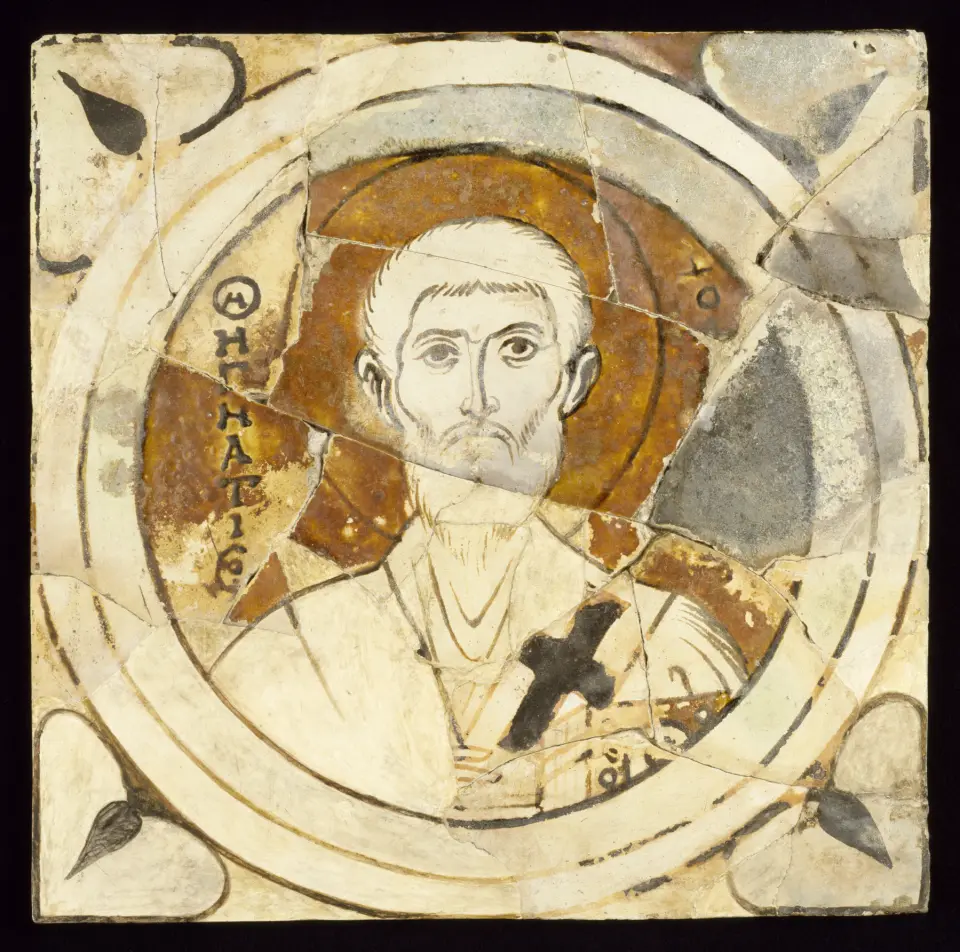
Ignatius of Antioch: the monarchical episcopate and the "catholic church"
In seven letters written on his way to execution in Rome, Ignatius is the first to present clearly the threefold ministry: one bishop with presbyters and deacons. The bishop “presides in the place of God”, the presbyters “in the place of the assembly of the apostles” (To the Magnesians 6); without the bishop it is not lawful “either to baptize or to celebrate a love-feast”, only a Eucharist administered by the bishop or by one he entrusts is proper, and nothing may be done for the church (To the Smyrnaeans 8). The bishop is the center of unity against schisms and heresies; Ignatius is the first to speak of the "catholic church" (To the Smyrnaeans 8). Pelikan notes that the unity of the Church in the bishop is his constant theme, while the Church is called "holy" only once.
Positions
- Ignatius
- One bishop at the head of the community; without him or his blessing there is no Eucharist and no baptism
- The Roman church (as Hall supposes)
- Governed by a council of presbyters, all of whom were called bishops
Key points
- Those who do not obey the bishop do not obey God (To the Ephesians 5); only a Eucharist performed by the bishop or by one he appoints is valid (To the Smyrnaeans 8)
- Lane: Ignatius mentions the bishop in every letter except the one to the Romans (there he calls only himself “the bishop of Syria”, To the Romans 2), so the system had not yet reached the West
- González: Ignatius stressed the authority of bishops against heretics without mentioning apostolic succession
- Pelikan: heresy and schism are closely linked, since both violate the unity of the Church
- McGuckin: Ignatius saw the persecution and his own arrest not as a political accident but as an eschatological “testing” of the church; in Ignatius the bishop “presides in the place of God”, the presbyters “in the place of the assembly of the apostles”, the deacons are “entrusted with the ministry of Jesus Christ” (To the Magnesians 6), and McGuckin sees the threefold ministry as a sign of the Trinity (cf. Phil. 7)
Outcome
The first witness to the monarchical episcopate; according to Hall, the ideas of Ignatius and Clement appealed to the great majority of communities.
People
- Ignatius of Antioch
- Polycarp of Smyrna
Terms
- monarchical episcopate
- Leadership of a local church by a single bishop.
- catholic church
- Ignatius' term for the one universal church; "where the bishop is".
Place
Antioch, Asia Minor, Smyrna
Sources disagree
Hall: no later than 115; González and Lane: "early 2nd century" without exact years.
Sources
Primary sources
- Ignatius of Antioch – Epistle to the Magnesians, ch. 6
- Ignatius of Antioch – Epistle to the Smyrnaeans, ch. 8
- Ignatius of Antioch – Epistle to the Ephesians, ch. 5
- Ignatius of Antioch – Epistle to the Romans, ch. 2
- Ignatius of Antioch – Epistle to the Philadelphians, ch. 7
Textbooks
- Stuart G. Hall – Doctrine and Practice in the Early Church (Russian edition), p. 26–27
- Jaroslav Pelikan – The Christian Tradition: A History of the Development of Doctrine, vol. 1 (Russian edition), p. 167
- Justo L. González – A History of Christian Thought in One Volume (Abingdon, 2014), p. 33–34
- Tony Lane – Christian Thinkers (Russian edition), p. 15
- The Cambridge Companion to the Trinity, ed. Peter C. Phan (2011), p. 65
Related entries
- Develops: First Clement: the apostolic succession of ministry (late 1st century (c. 96))
- Developed in: Irenaeus: the apostolic succession of bishops against the Gnostics (c. 180)
In church history
- The martyrdom of Ignatius of Antioch and his letters (107 or 115)
Data compiled: 2026-11-17